Why AI Engineering Is Outpacing Pure Research: The Future of Practical, Scalable Intelligence
For the better part of a decade, the story of artificial intelligence was written in research papers. Every few months, a breakthrough would hit the arXiv, promising a new architecture or a training technique that would change everything. The field moved at the speed of discovery. But a fundamental shift is happening right now. The age where pure research dominated the conversation is fading. A new era is taking its place—one where the real winners are not necessarily the inventors of the next algorithm, but the engineers who can deploy, scale, and monetize the algorithms we already have. AI Engineering is winning.
The Great Pendulum Swing: From Exploration to Exploitation
To understand why engineering is pulling ahead, we have to look at the maturity curve of AI technology. The foundational breakthroughs that gave us modern deep learning—transformers, diffusion models, reinforcement learning from human feedback—happened in rapid succession between 2017 and 2023. These were gold rush moments for research. Any lab could make a name for itself by shaving a few percentage points off an academic benchmark. The ecosystem was built on novelty.
That world is rapidly changing. Today, the low-hanging fruit in model architecture has largely been picked. We now have incredibly powerful foundation models that are good enough for a vast majority of use cases. The marginal benefit of training another 1-trillion-parameter model that scores 1% better on a leaderboard is shrinking compared to the value of taking an existing 70-billion-parameter model and making it work perfectly in a production environment.
The energy is moving downstream. The hard problems are no longer just "how do I train this?" but "how do I serve this reliably to millions of users at a reasonable cost?" and "how do I ensure this system behaves safely and predictably over time?"
What this means for the future: The competitive moat for most companies will no longer be access to secret research or proprietary architectures. It will be their ability to build robust data pipelines, fine-tune efficiently, optimize inference latency, and integrate AI seamlessly into complex workflows. The research provides the spark, but engineering provides the engine.
Why Engineering Wins in the Real World
There are three core reasons why the engineering focus is winning out over the research-first mindset, especially when we look at real-world impact and business value.
1. Reliability Trumps Novelty
Academic research is often judged on average performance. A model that gets 90% on a benchmark is considered a success, even if it fails catastrophically on 10% of cases. In the real world, that 10% is a dealbreaker. An enterprise customer cannot tolerate a customer service chatbot that hallucinates a fake refund policy 5% of the time. They cannot deploy a medical coding system that is only 95% accurate.
Engineering disciplines fix this. Engineering is about building systems that are deterministic in their guardrails, monitored for drift, and rigorously tested for edge cases. It is about turning a probabilistic machine into a reliable utility. This shift from "SOTA" (State of the Art) to "SOP" (Standard Operating Procedure) is exactly what is needed for mainstream adoption. The winners will be the teams that obsess over the last 5% of reliability, not the first 5% of accuracy improvement.
2. Cost Economics
Research tends to ignore cost in pursuit of performance. A lab might happily spend $10 million on a single training run to prove a point. A business cannot. Engineering focuses relentlessly on the total cost of ownership. Techniques like quantization, speculative decoding, prompt caching, and efficient model routing are engineering innovations that dramatically lower the cost of serving AI.
We are seeing the rise of "inference engineering" as a critical discipline. Companies that can serve high-quality results at 1/10th the cost of their competitors have an enormous strategic advantage. They can offer lower prices, serve more users, and deploy AI in high-volume, low-margin applications that were previously unthinkable. This is how you go from a science experiment to a mass-market utility.
3. Systems Thinking Over Model Magic
The most impressive AI products today are not just single models; they are complex systems. ChatGPT is not just a language model. It is a sophisticated system of safety layers, memory, retrieval, plugins, and user experience design. GitHub Copilot is a system that understands code context, latency requirements, and developer workflow just as much as it understands language.
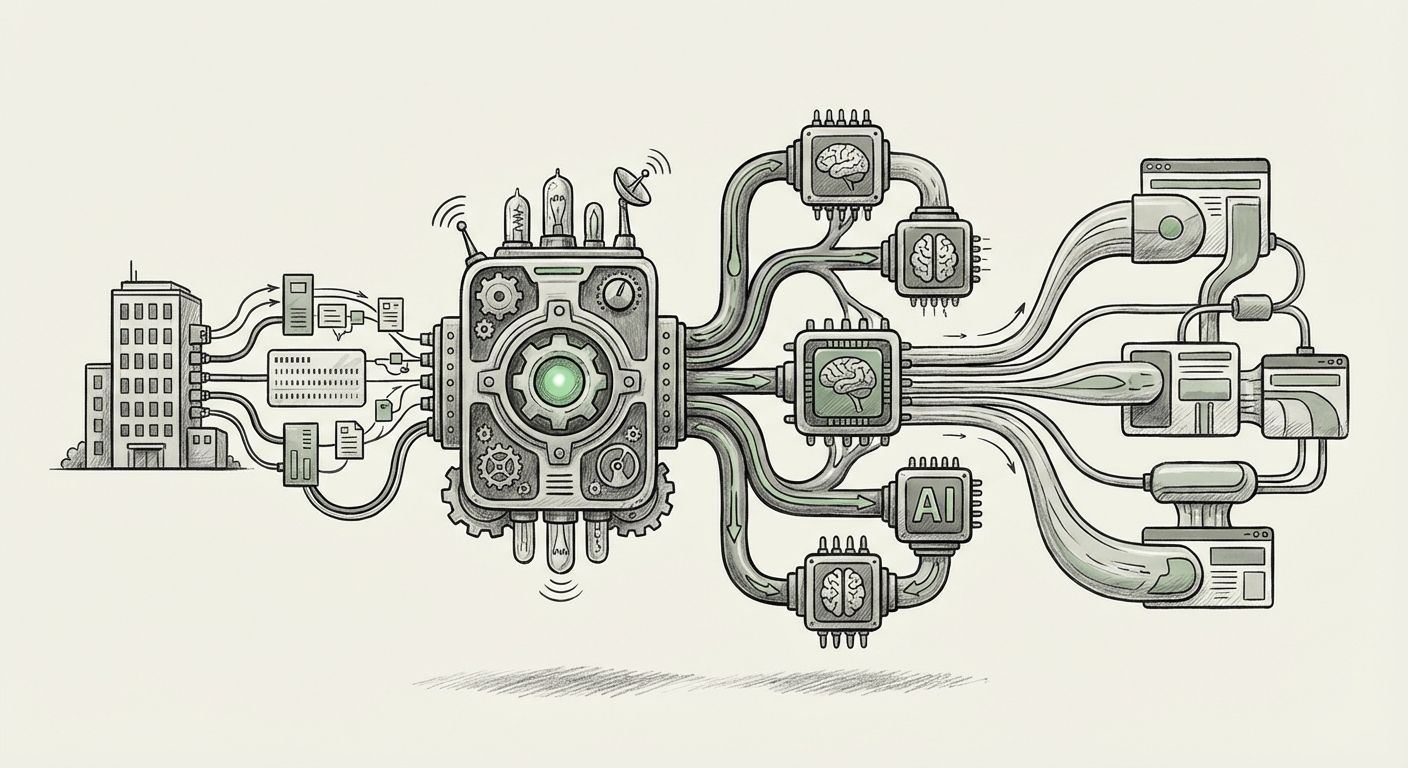
This "systems mindset" is the ultimate engineering win. It recognizes that the best solution often involves orchestrating multiple models—a large one for complex reasoning, a small one for simple tasks, a retrieval model for grounding facts, and a guardrail model for safety. Building this symphony is a pure engineering challenge. It requires deep expertise in software architecture, data engineering, and operations, not just machine learning theory.
The "Overrated" Research Trap for Businesses
The title of the original analysis makes a bold claim: that the age of research is overrated. This is not to say research is useless—far from it. The foundational work of the past decade is the bedrock upon which everything is built. But for the vast majority of businesses and decision-makers, the obsession with "cutting-edge research" has become a dangerous distraction.
Too many companies fall into the trap of thinking they need to invent their own models or hire a team of Nobel-caliber researchers to win. They see the release of a new model as a threat to their strategy. This is a mistake. The businesses that win over the next five years will not necessarily be the ones with the best research lab. They will be the ones that leverage the best available models, regardless of source, and integrate them into a superior product experience.
The research-driven mindset can also lead to "shiny object syndrome." Teams chase the latest paper instead of iterating on what they have built. They restart projects to use a slightly better architecture. They over-invest in training from scratch when fine-tuning an existing model would deliver 90% of the value at 1% of the cost.
Actionable Insight: Stop asking "Which model is the most powerful?" and start asking "What system can we build that solves our customer's problem reliably and affordably?" The answer to the second question is almost always an engineering problem, not a research problem.
What This Means for the Future of AI Work and Talent
This massive shift from research to engineering has profound implications for the job market and for how companies structure their AI teams.
The rise of the AI Engineer: The hottest job titles of the coming decade are already emerging: AI Platform Engineer, Inference Optimization Engineer, MLOps Specialist, Data Quality Engineer. These roles are about building the scaffolding around the models. They require deep knowledge of distributed systems, cloud infrastructure, CI/CD, monitoring, and data pipelines. The demand for pure "Research Scientists," while still important, will plateau in comparison.
Democratization of AI: This is arguably the most exciting societal implication. When the competitive edge shifts from research to engineering, the barrier to entry drops. You no longer need a $100 million supercomputer and a team of PhDs to participate. A talented engineering team with a strong product vision and a good grasp of publicly available models can build world-class AI applications. This unlocks a wave of innovation from startups, mid-market companies, and even individual developers.
Safety and Alignment become engineering disciplines: For a long time, we treated AI safety as a research problem. We needed to invent new algorithms to align models with human values. While research continues, the front line of safety is now an engineering battle. It is about building robust red-teaming pipelines, implementing real-time monitoring for toxic outputs, writing deterministic constraints, and creating auditable deployment processes. The most effective safety measures are the engineering ones that are baked into the product lifecycle.
How to Win in the Age of AI Engineering
So, how do you position your team, your company, and your career to thrive in this new era? Here are five actionable insights drawn directly from the reality that engineering is winning.
- Invest in Data Infrastructure: Your data is your moat. Build the pipelines that allow you to collect, clean, and curate high-quality data. Invest in synthetic data generation. The best model in the world is useless without great data to fine-tune it or retrieve from. Data engineering is the foundation of AI engineering.
- Obsess over Evaluation: Before you write a single line of application code, build your evaluation framework. Automated tests ("evals") that measure factual accuracy, tone, safety, and latency are the single most important engineering investment you can make. Without evals, you are flying blind. With them, you can iterate rapidly and confidently.
- Embrace MLOps from Day One: Treat your AI models as software artifacts. Version them. Test them. Deploy them with canaries. Monitor them for drift. The discipline of MLOps is what separates a fragile demo from a robust product. It is the engineering practice that turns AI into a reliable service.
- Think in Systems, Not Models: The best AI solutions are multi-modal, multi-model, and multi-layered. Use a small, fast model for simple routing. Use a large model for complex reasoning. Use a retrieval agent for factual grounding. Use a guardrail model for safety. The architecture of this system is a pure engineering design problem.
- Focus on the User Experience: At the end of the day, AI is a feature, not a product. The goal is not to deploy a model; it is to solve a user's problem. Focus relentlessly on the interaction design, the latency, the error handling, and the overall reliability of the experience. A simple, fast, and reliable AI feature will beat a powerful, slow, and flaky one every single time.
Conclusion: The Maturation of a Field
The idea that "AI Engineering is winning" should not be seen as a criticism of research. Science is the seed. But we are well past the planting stage. We are in the growth stage, and growth requires the hard work of cultivation, irrigation, and building strong trellises for the vines to climb.
This is the natural maturation of any transformative technology. The telephone was a research breakthrough in the 1870s. The engineering of the telephone network, the switchboards, the undersea cables, and the modern cellular infrastructure is what made it a global utility. The internet started as a research project (ARPANET). The engineering of the web, the protocols, the data centers, and the search algorithms is what made it indispensable.
We are now in that crucial phase for AI. The age of pure exploration is giving way to the age of exploitation, scale, and disciplined execution. The winners of the next decade will not necessarily be the ones who invent the next "Transformer." They will be the ones who build the most reliable, scalable, and delightful systems powered by AI. Embrace the grind of engineering. That is where the future is being built today.