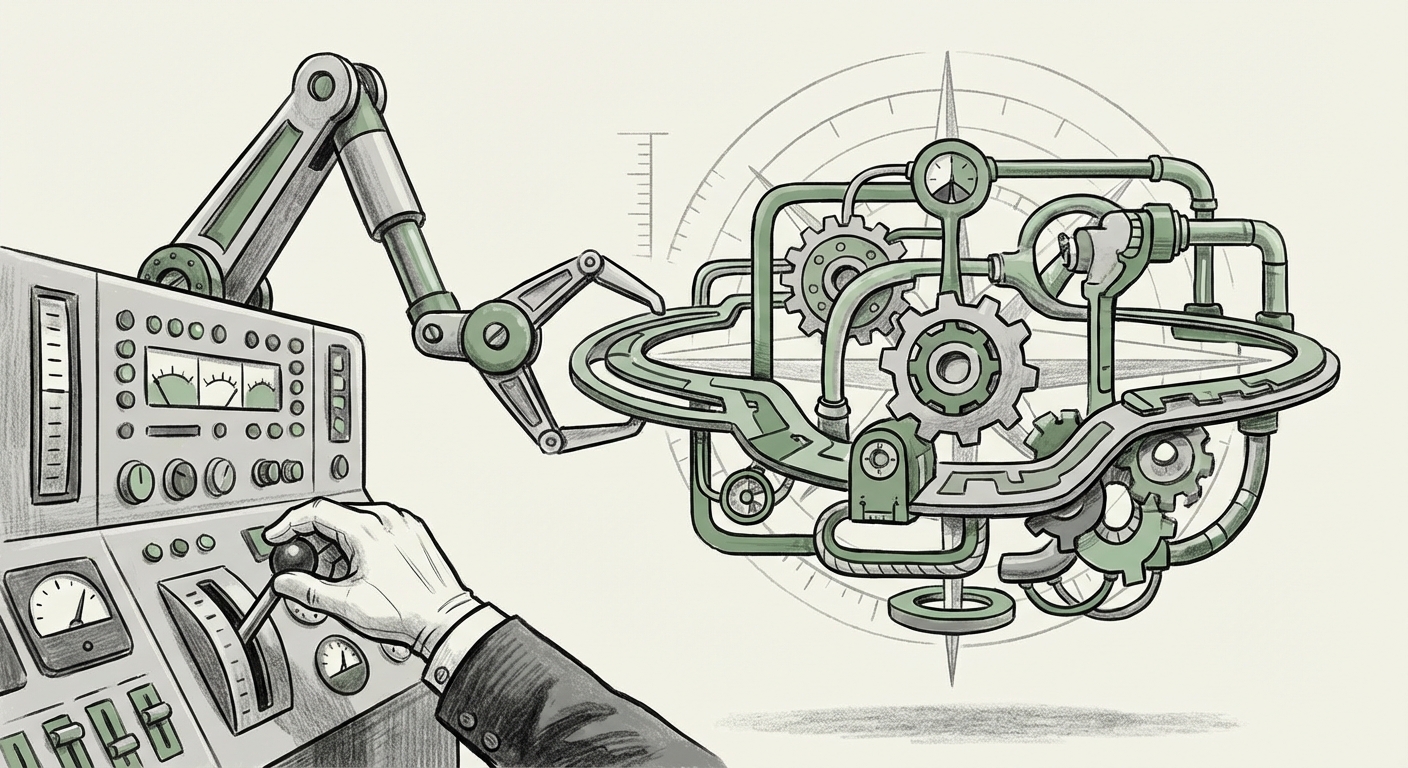
When AI Solves the Unsolvable: How Machines Are Cracking Math's Biggest Mysteries
Mathematics has always been the last fortress of human intelligence. It is a field where "show your work" is a lifetime requirement, not just a school rule. A mathematician cannot simply announce a result. They must convince the world, step by step, that it is true.
That is why it matters so much that artificial intelligence keeps cracking open problems that have resisted the best human minds for years. The trend is unmistakable: AI keeps solving unsolved math problems — and mathematicians have mixed feelings about it. Some are thrilled. Some are worried. Most are both.
This is not just a story about a niche academic field. It is a preview of the future of AI and a signal of how quickly the rules of intellectual work are changing.
A New Kind of Problem Solver
Computers have been fast calculators for decades. The new generation of AI systems is different — they do something closer to thinking. Trained on enormous archives of human knowledge, including millions of mathematical papers and proofs, these systems learn to spot patterns and take long chains of logical steps. That is exactly what solving a math problem requires.
Math is the perfect training ground for this kind of AI because it is ruthless. There is no room for opinion. A proof is either correct or it is not. Every step can be checked by another machine or another human. In math, an AI can try billions of paths, fail most of them, and still learn enough to find the one that works.
The phrase "AI keeps cracking unsolved math problems" matters because of that word "keeps." This is not a one-time party trick. It is a pattern that grows stronger with every passing year.
Why Mathematicians Have Mixed Feelings
You might expect mathematicians to be celebrating. A solved problem is a victory for math, no matter who — or what — solved it. And there is genuine excitement. Problems that once felt unreachable are being crossed off the list. Future work can build on those results. Progress is progress.
But discomfort follows quickly. Mathematics has always been a deeply human craft. Mathematicians describe their work as an art. They value elegance and insight — the flash of understanding when a proof finally clicks into place. A machine that grinds through millions of operations and produces a correct but unexplainable result raises an awkward question: is that still mathematics?
There is also professional fear. If machines can solve problems that humans spend entire careers on, what happens to the next generation of mathematicians? Why would a young researcher spend years wrestling with a problem when a machine can knock it out in days? And if mathematics — long considered proof of human uniqueness — is no longer unique to humans, then what exactly is left that only we can do?
That mix of pride, joy, anxiety, and wonder is what "mixed feelings" really means.
What Counts as a Proof When a Machine Finds It?
There is an even deeper question hiding underneath all of this: what is a proof, really?
Traditionally, a proof is something a person can read, understand, and verify line by line. It is a logical journey from assumptions to a conclusion, and every chapter must make sense. Machine solutions often do not work that way. An AI may explore billions of pathways and arrive at a result that is true but so complex or so unusual that no human can truly explain why it is true.
So mathematics now faces a fork in the road. One path says: if a computer checks every step, that is good enough. Truth is truth, even if it is ugly and mechanical. The other path says: understanding matters. A result nobody can grasp is like a treasure map written in an unknown language.
This debate shapes the future of AI. If we accept machine proofs, we accept that there will be true things in the world that humans cannot fully understand. That demands a new kind of trust — and new systems for testing whether the machines deserve it.
The Future of AI: From Patterns to Deep Reasoning
For the past decade, most AI success stories were about pattern recognition: face recognition, language translation, product recommendations. Powerful, yes. But fundamentally about matching patterns in data. Solving an unsolved math problem is different. It requires genuine reasoning — holding many steps in mind, obeying strict rules, and trying unexpected paths when familiar ones fail.
That is a major milestone. Every unsolved problem that falls is evidence that AI is moving beyond predicting and into thinking.
The likely future is not machines replacing mathematicians. It is collaboration. Humans will choose which problems matter, guide the machine's approach, and translate its raw results into ideas people can actually understand and build upon. The machine will carry the heavy logical lifting and explore territories no human team could ever cover.
Human vision plus machine reasoning is the real future of AI. And that model will soon extend far beyond math — into physics, medicine, engineering, and business.
How Math-Breaking AI Will Change Business
Business leaders may think advanced mathematics is too abstract to matter. But the skills required to crack a math problem are the same skills required to crack almost any complex problem.
Consider what a modern business faces every day: supply chains to optimize, schedules to align, financial risks to balance, decisions that depend on dozens of moving variables at once. Each of these is, at its core, a logic puzzle. And they are exactly the kind of problems that AI reasoning systems are learning to solve.
The practical implications are enormous:
- Research and development gets faster. A machine that can explore uncharted mathematical territory can also explore uncharted materials, drug candidates, and engineering designs — searching for what works far faster than any human team.
- Decision-making gets stronger. AI systems that can hold many constraints in mind and reason to a sound conclusion will become essential advisors in logistics, energy planning, and finance. They won't just predict what might happen. They will prove why one choice beats another.
- New products appear. The ability to build and verify complex logical arguments will power tools for auditors, lawyers, engineers, and strategists — anyone whose job depends on sound reasoning.
The warning for business is simple: companies that see AI as just a chatbot or a data cruncher will need a much bigger imagination. The next generation of AI does not just summarize information. It solves problems.
The Bigger Picture for Society
Society should watch the world of mathematics closely, because it is a preview of a much larger transition.
In education, the message is hopeful. If AI can reason, it can explain. Students will soon learn from machine tutors that don't just show answers but build steps, demonstrate the "why," and adjust to each learner's pace. Understanding becomes more teachable, not less.
In science, the stakes are enormous. Many of the great unsolved problems in physics, biology, and climate science are mathematical at heart. Give machines a real grip on those puzzles, and research accelerates in ways we can barely imagine. Breakthroughs that might have taken decades could arrive in years.
In public life, caution is needed. A society that learns to trust machines for mathematical truth will soon be asked to trust them for medical diagnoses, financial advice, and legal judgment. That means we need new ways to audit, verify, and appeal decisions made by reasoning machines.
None of this requires fear. It requires preparation.
Practical Steps for the Age of Machine Reasoning
So what should you actually do with this information? Plenty.
- For mathematicians and researchers: move your focus toward choosing great questions, interpreting strange results, and turning machine output into human understanding. That is your edge — and it cannot be automated.
- For business leaders: identify the problems in your operations that follow clear rules. If a problem can be defined precisely, a reasoning machine can take a serious swing at it. Start there.
- For technology teams: invest in verification. A machine's answer is only valuable if it can be checked. Build audit trails, test systems, and guardrails now, before the tough questions arrive.
- For policymakers and educators: teach critical thinking about machine answers. The next generation must learn to question conclusions no matter where they come from — human or silicon.
- For everyone: start thinking of AI as a partner rather than a threat. The most useful question is not "Will AI replace me?" but "What can I build now that I have a thinking partner?"
Conclusion: Solving the Unsolvable Is Just the Beginning
The story of AI cracking unsolved math problems is one of the clearest signals yet about the future of artificial intelligence. Machines are crossing the line from recognizing patterns into genuine reasoning. And the human relationship with intelligence — our own and machine-made — is entering a completely new chapter.
The mathematicians' mixed feelings are not a weakness. They are the appropriate response to a truly historic change. Joy and anxiety can exist at the same time. They usually do when something important is happening.
Because here is the thing about math: it is the language underneath everything. When a machine speaks that language fluently, it gains access to every field built on logic and truth — science, engineering, finance, and the products and services that power modern life. The future of AI is not just about processing data. It is about solving the unsolvable. And it is already underway.