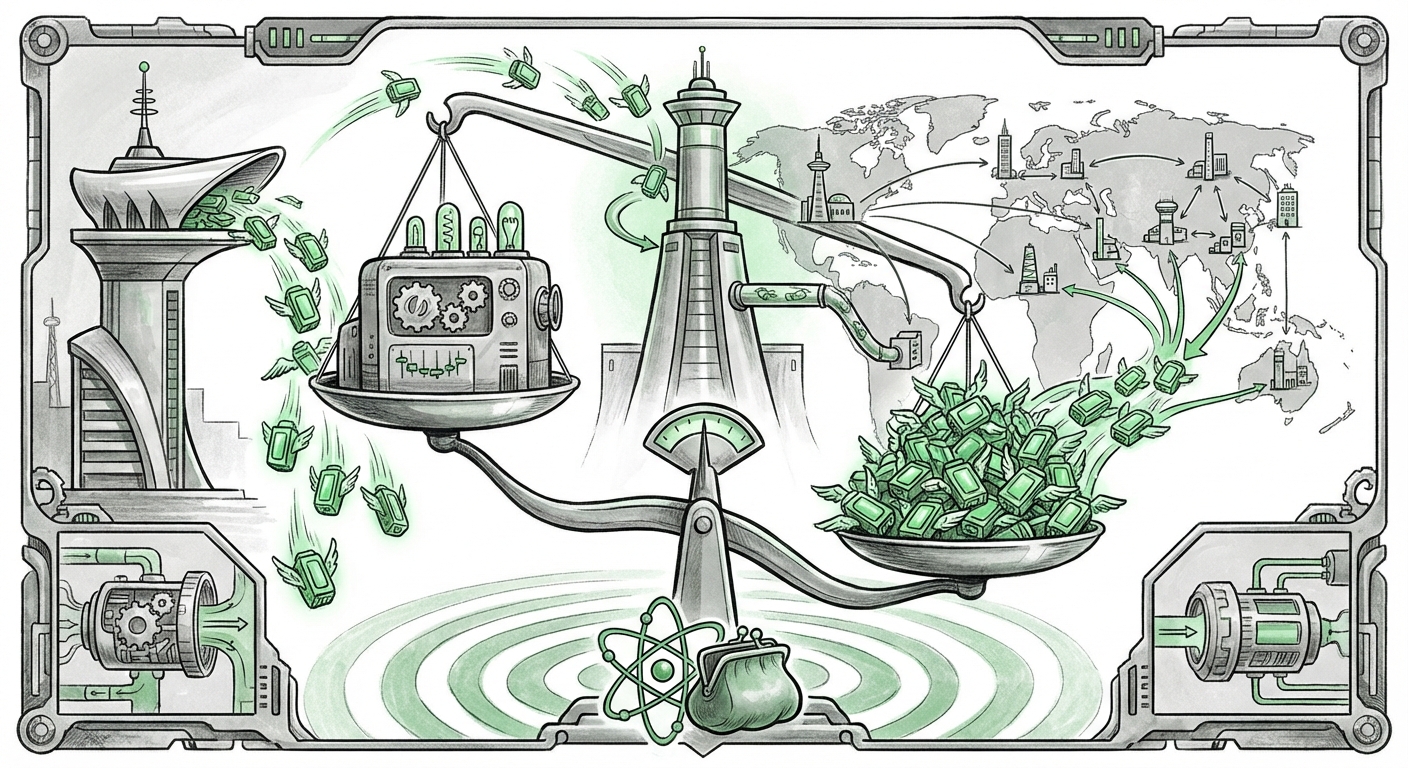
Google Just Moved Billions in Anthropic Chip Risk Off Its Balance Sheet — What It Means for the Future of AI
Some of the most important news in artificial intelligence never comes from a product launch. No chatbot demos. No dazzling model demos. Sometimes the biggest stories in AI show up in a much quieter place: a corporate balance sheet.
That is exactly what is happening right now. Google has shifted billions of dollars in Anthropic chip risk off its own balance sheet. On the surface, it looks like a page out of an accounting textbook. In reality, it is one of the clearest signals yet that the AI industry is growing up — and that the way we finance AI is becoming just as important as the technology itself.
Let's unpack what happened, why it matters, and what it means for the future of AI, for businesses, and for the wider world.
First, Why Did Google Have This Risk at All?
To understand the move, you have to understand how the modern AI supply chain works. Building the most advanced AI systems — the kind that can write code, reason through difficult problems, and act as digital workers — requires enormous computing power. Not a little. Enormous.
Training a frontier-level AI model takes tens of thousands of specialized chips running around the clock for months on end. Those chips are scarce. And they are incredibly expensive.
Most AI labs do not own this infrastructure. Instead, they rent it from cloud giants like Google. And this creates a deep, complicated bond. Google is one of Anthropic's most important partners, making a massive bet on Anthropic's future by committing to supply the specialized computing power its models need to exist.
Here is where the risk creeps in. Building chips and data centers costs billions of dollars before a single model is trained. So cloud providers need guarantees that the capacity will actually be used. That is why compute deals between AI labs and cloud companies usually include take-or-pay commitments. In plain terms: Anthropic agrees to pay for huge amounts of computing power over a set period of time — whether it ends up using all of that power or not.
For Google, those commitments are a real financial risk. Imagine writing a contract that says, "You will pay us billions over the next several years for these chips." Now imagine the customer hits hard times, the AI market cools, or a technological shift suddenly makes those chips less valuable. Google would be stuck holding a mountain of expensive silicon with no one obligated to use it. That risk sat on Google's balance sheet — a massive potential liability tied directly to the fortunes of Anthropic.
What Does "Off the Balance Sheet" Actually Mean?
"Off-balance-sheet" is one of those finance phrases that makes people's eyes glaze over. Let's translate it into plain language.
A company's balance sheet is a permanent scoreboard of everything it owns, everything it owes, and every significant risk it carries. Some risks stay visible on that scoreboard. Others can be moved out — not by hiding them, but by getting another party to take them on.
When Google moves Anthropic chip risk off its balance sheet, it means the financial danger tied to Anthropic's chip purchases is no longer Google's problem alone. In arrangements like this, a third party — often an investor, a bank, an insurance company, or a specially created financial structure — agrees to absorb some or all of the risk in exchange for a fee or a share of the returns.
Think of it like buying insurance on your house. You still live there. You still own it. But if the roof collapses, the insurance company pays. You have transferred the risk. The chip version works the same way. Google may still run the data centers, still supply the chips, and still collect revenue from Anthropic. But if something goes wrong — if Anthropic cannot pay, or does not need the capacity — a financial partner absorbs the blow. Google earns less, but it no longer carries the nightmare scenario.
In this case, the risk is measured in the billions. This is not a small experiment. It is a major financial transaction sitting at the heart of one of the most important relationships in modern AI.
Why This Is a Turning Point for AI
This move matters for three big reasons.
1. AI Compute Is Becoming a Financial Asset
There is now a growing set of investors willing to buy, sell, and carry AI compute risk. That is a huge deal. It means the financial world is starting to treat AI computing power like a valuable, durable asset — more like a fleet of airplanes or a portfolio of real estate than a short-lived tech trend. Other industries built exactly this kind of financial infrastructure over time: aircraft leasing, energy pipelines, and commercial real estate all became financed by third-party capital. AI is now following the same path.
2. The AI Economy Is Maturing
In the early days of the AI boom, everything was about benchmarks. Who had the smartest model? Who could wow the public? The focus was on science and spectacle. Now the focus is shifting to things like credit risk, balance sheets, and contract law. That is what maturity looks like. Every major industry eventually develops financial infrastructure around it, and AI is no exception.
3. Google Is Both All-In and Risk-Aware
Some people might read this as a sign that Google is losing faith in Anthropic. That reading would be wrong. Google remains one of Anthropic's most important partners — both as a backer and as a critical supplier of the chips that make Anthropic's technology possible. But confidence and risk management are not the same thing. Even the most confident partner would be foolish not to protect itself. This move lets Google keep the upside of its relationship with Anthropic while sharing the downside with others.
What This Means for the Future of AI
So where does this lead? The financialization of AI chips opens a new chapter for the industry, with both bright and uncomfortable possibilities.
More players will enter the AI game. Once banks, insurers, and infrastructure funds realize they can profit from AI compute risk, they will come looking for deals. Expect more specialized financing products for AI infrastructure: loans backed by chips, risk-transfer agreements, and possibly even investment vehicles built around AI data centers. The raw materials of AI are becoming tradable financial instruments.
AI labs will have new ways to grow. With third parties willing to share risk, AI labs may find it easier to secure huge compute deals in the first place. That lowers one of the biggest barriers to building frontier AI. Instead of relying on a single wealthy tech giant to carry all the risk, labs can tap into a broader pool of capital. This could accelerate the pace of AI research — and sharply reduce the chances of a single bad quarter crushing a promising lab.
But risk never disappears. It moves. This is the most important point. Google did not make the risk vanish. It transferred the risk to the wider financial system. That means a future AI downturn could ripple through banks, insurance funds, and investment portfolios — not just tech companies. The AI industry is becoming entangled with the broader economy in ways we have not fully thought through.
The gap between big and small AI players will widen. Google can attract sophisticated financial partners because the deal is massive and the assets are proven. A small AI startup has no such luck. The rich will get richer in compute, and the already large gap between frontier labs and everyone else may grow even wider. For startups, this is a warning: your compute strategy needs to be as sharp as your research strategy.
Practical Implications for Businesses
If you run a business — whether you are a startup training your own models or a company simply using AI tools — this story has practical lessons for you.
Watch your counterparties. If you depend on an AI vendor, a cloud provider, or a chip supplier, their financial health matters as much as their technology. A vendor drowning in hidden risk can fail spectacularly and take your projects down with it. When giants like Google make moves to protect themselves, it is a reminder that you should stress-test your own AI supply chain just as carefully.
Negotiate compute contracts like a CFO. Anyone buying cloud computing should know exactly what they are committing to. Are you locked into take-or-pay terms? What happens if your needs change in six months? What happens if your vendor's costs change? The era of loose handshake deals in AI is ending. Every compute contract is now a financial contract, and you should read it that way.
Treat compute capacity as a strategic asset. In the AI era, access to computing power is like owning land in a growing city. Companies that secure flexible, reliable compute access — and structure their contracts to survive downturns — will have a lasting advantage over competitors who treat cloud costs as an afterthought.
What This Means for Society
Zoom out, and this single financial move raises bigger questions. AI is increasingly being paid for by borrowed confidence — money that expects AI to keep booming. If AI delivers on its promise, the financial engineering now surrounding it will look brilliant. But if AI hits a serious bump — a slowdown in progress, a wave of regulation, or a collapse in demand — the consequences will reach far beyond the tech sector. They could touch pensions, insurance policies, and ordinary people's savings.
There is also the question of accountability. When risk is spread across dozens of financial players, who is responsible when things go wrong? Who answers to the public when an AI project fails in a way that hurts real people? In the old model, a giant tech company could be held clearly accountable. In the new model, responsibility becomes diluted across an invisible web of contracts and financial structures.
None of this means the move was a bad idea. Spreading risk is generally wise. But we should be honest that the financialization of AI makes the whole system more connected — and when systems are more connected, shocks travel faster.
Actionable Insights: What You Should Do Now
- Read your cloud agreements. Know exactly what you have committed to, and what it would cost to get out.
- Build flexibility into AI contracts. Seek clauses that let you scale down, shift workloads, or renegotiate when your needs change.
- Diversify your AI supply chain. Do not put every AI workload with one vendor. The giants are managing their own risk; you should manage yours.
- Monitor vendor financial health. Keep an eye on the earnings calls and balance sheets of the companies you depend on for AI. Sudden weakness is a red flag.
- Think like an investor, not just a user. Every AI decision is, in part, a financial decision. Treat it that way, from contract negotiation to capacity planning.
The Bottom Line
Moving billions in Anthropic chip risk off its balance sheet is a quiet move with loud implications. It signals that AI has entered its financial era. Models and benchmarks still matter enormously, but so do risk transfers, credit ratings, and balance sheets. The AI industry is no longer just a technology story. It is an infrastructure story and a finance story.
The companies that understand all of these — that manage risk as carefully as they chase breakthroughs — will be the ones that survive the next decade of AI. For the rest of us, this is a reminder: in the world of artificial intelligence, what happens next depends less and less on pure science alone. It depends on who is willing to take the risk — and at what price.