AMD Acquires Taalas: What "Baking AI Models Into Silicon" Means for the Future of AI
There are headlines that announce a product, and then there are headlines that quietly reveal where an entire industry is heading. AMD's acquisition of Taalas, a startup that bakes AI models directly into silicon, is firmly in the second category. At first glance, it reads like a niche engineering story: a chip giant buying a small hardware team. But look closer, and this deal is one of the clearest signals yet that artificial intelligence is about to become faster, cheaper, and physically embedded in the world around us in ways most people haven't fully grasped.
This is not about making GPUs that run AI a little bit better. It is about a completely different philosophy: instead of building a general-purpose chip that calculates an AI model on the fly, you build a chip that is the model. The knowledge, the math, the "brain" of the AI is literally etched into the hardware at the factory. To understand why that matters, for businesses, for society, for the future of computing itself, we need to break down what this technology actually is and where it's taking us.
What Does "Baking AI Models Into Silicon" Actually Mean?
Today, almost all artificial intelligence runs on general-purpose processors, chips designed to handle all kinds of tasks. When you ask an AI chatbot a question, a GPU somewhere in a data center runs billions of calculations to process your request. The model itself is stored as software, a massive collection of numbers, called "weights," that the chip reads and applies to your input. Think of it like a chef reading a recipe fresh every single time you order the dish.
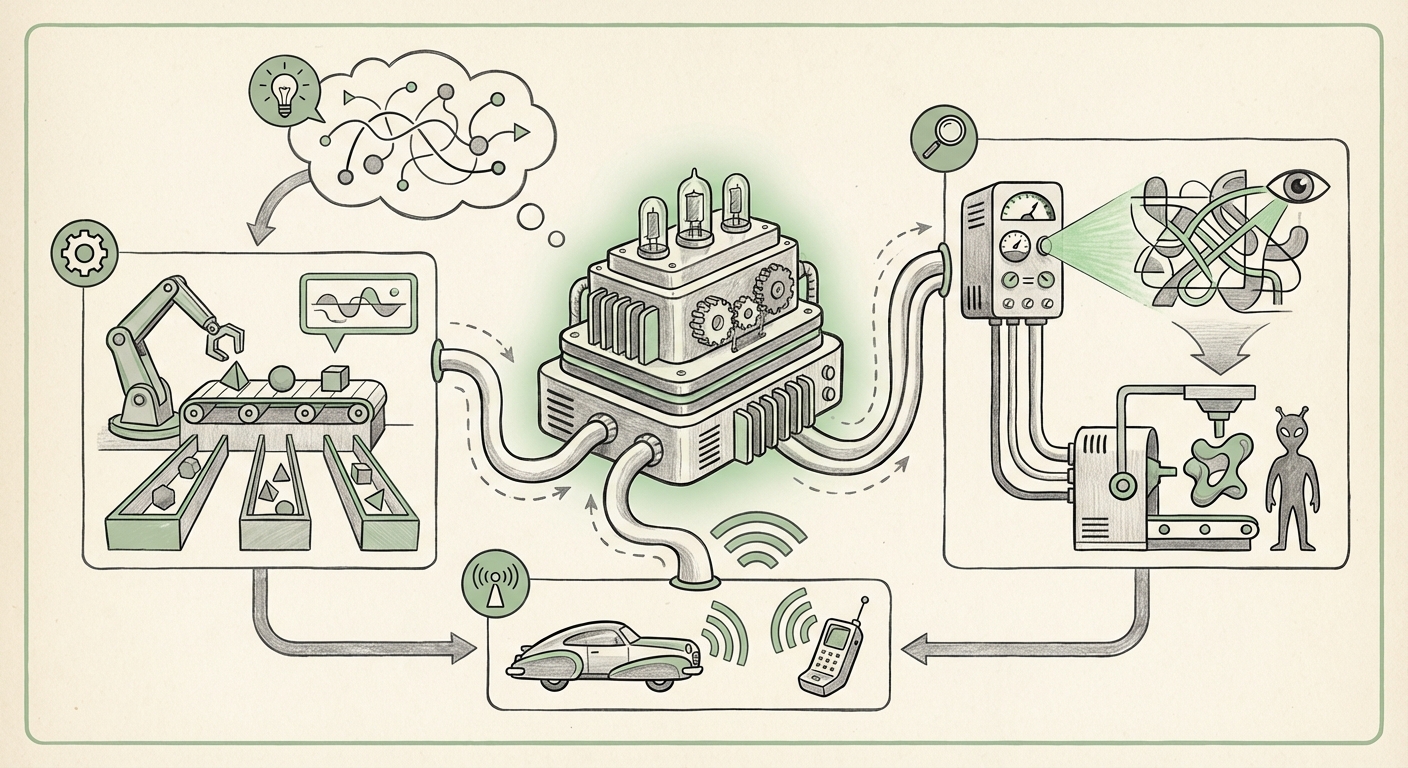
Taalas's approach flips that idea on its head. Instead of loading the model's weights into memory and calculating the answers, the model is built directly into the physical structure of the chip, the chip's wiring, logic gates, and circuits are arranged in a way that the AI's behavior is essentially hardwired into the hardware. There is no "loading" the model. There is no software layer. The silicon is the model.
A useful analogy: imagine the difference between a general-purpose computer running a music app, and a dedicated music box that plays one song perfectly, every time. The computer can do a thousand things, but it uses a lot of power and takes a moment to "think." The music box does one thing only, but it does it instantly, with almost no energy, and it can never get it wrong. That is the trade-off Taalas's chips are built around.
This approach is sometimes called "model-in-silicon" or "inference at the hardware level." It sacrifices flexibility, you can't just download a newer, better model onto that chip, but it gains enormous advantages in speed, cost, and energy efficiency.
Why AMD Is Making This Bet
AMD is one of the world's largest chip makers, with products ranging from personal computer processors to powerful data center hardware. The company has been a major player in the AI boom, but AI computing has been dominated by the kind of general-purpose accelerators that power today's cloud data centers. Acquiring Taalas signals that AMD sees a real future in a different kind of AI chip: one that doesn't just accelerate AI workloads, but turns each deployed model into purpose-built physical hardware.
The economic logic here is powerful. When an AI model is fresh and constantly being improved, you want a flexible chip that can keep up with changes. But when a model becomes stable and is used millions or billions of times, think of the speech recognizer in your phone, the recommendation engine in your favorite app, or the vision system in a self-driving car, the biggest costs come from running it over and over again. At that scale, even a small improvement in cost or speed per request translates into enormous savings. A chip with the model baked in can crush that cost because it has no wasted motion; every transistor exists to do exactly the job that model requires.
There is also a strategic dimension. The AI hardware market is heating up, and chip makers are looking for ways to differentiate. A flexible, general-purpose chip is a commodity; a chip that runs a specific model with unmatched efficiency is a specialized product that customers may be willing to pay a premium for. This acquisition hands AMD a head start in a category that rivals are also racing toward.
What This Means for the Future of AI
If you zoom out, this deal points to a future where AI is no longer just a cloud service in a distant data center, it becomes a physical material. Here are the big trends this acquisition signals:
1. AI Will Become Drastically Cheaper to Run
Right now, many businesses and products are limited by the cost of AI computation. Running a large language model for customers, or analyzing images at volume, requires constant payments for cloud compute. When a model is baked into silicon, each individual "run" costs a tiny fraction of what it does today. This could unlock AI for thousands of applications that were previously too expensive to justify.
2. Real-Time AI Will Finally Become Practical
Latency, the delay between sending a request and getting an answer, is one of the biggest challenges in AI today. A chip with a model baked in can respond in microseconds because it is essentially a direct circuit, not a computation that has to be fetched and executed. For self-driving cars, factory robots, medical monitoring devices, and interactive voice assistants, this kind of instant response changes what's possible.
3. AI Will Move to the Edge
Because these chips use so little power, they can live in places where a full GPU simply can't, inside appliances, sensors, wearables, cameras, and industrial machines. Right now, many "smart" devices send your data to the cloud to be processed. In the future, a small, energy-efficient chip with an AI model baked in could do that processing locally, on the device itself. That means faster responses, better privacy, and no reliance on an internet connection.
4. The Center of Gravity Shifts From Training to Deployment
For years, the AI world has been obsessed with training, the enormously expensive process of teaching a model. This acquisition signals that the industry's attention is shifting to the deployment phase: once a model is trained and proven, how do you run it everywhere, at scale, at nearly zero cost? The winners of the next decade may not be the companies that train the biggest models, but the companies that figure out how to make those models run anywhere and everywhere.
Practical Implications for Businesses
For business leaders, this news is not abstract. If this technology plays out as expected, it will change the economics of every project that involves AI. Here is what to watch for:
- Lower barriers to entry. When AI inference is cheap enough to be measured in fractions of a penny, small and mid-sized companies will be able to embed AI into products that previously only large corporations could afford. Expect AI to show up in everything from vending machines to medical diagnostic tools.
- New product categories. Devices that do one AI task extremely well, a translation earbud, a quality-inspection camera, a voice-controlled thermostat, become more practical and more reliable when the model is fixed in hardware. There won't be software updates to crash, and the device won't slow down over time.
- Beware of frozen models. The same stability that makes baked-in silicon so efficient is also its biggest weakness. If your business bets on a chip with a specific model baked in, and then a dramatically better model comes along, you can't simply upgrade. Your hardware is now tied to an old brain.
- Plan your workload strategy. The smartest approach will be hybrid. Use flexible, general-purpose hardware for experimental work and for frequently updated models. Reserve specialized, baked-in silicon for workloads that are stable and high-volume, the "cash cows" of your AI applications.
- Reconsider cloud dependencies. If a chip can run your model locally with near-zero power draw, you may not need to send data to the cloud at all. That has implications for your data costs, your privacy posture, and your ability to operate in places with poor internet connectivity.
- Ask about vendor lock-in. A specialized chip is a long-term commitment. Before you design a product around a model-baked-in chip, understand the upgrade path, the second-source options, and the total cost of ownership over the device's lifetime.
Broader Implications for Society
Beyond the business world, the idea of AI physically baked into silicon raises questions that touch everyone.
Energy is the most exciting part. Artificial intelligence currently has a stunning appetite for electricity. Data centers hosting AI models consume enormous amounts of power, and the rapid growth of AI has raised serious concerns about its environmental footprint. Chips that compute a model with vastly less energy could make AI dramatically greener, a significant benefit for a planet already struggling with energy demand. This may be the single most important consequence of this technology.
But there is a concentration-of-power question. Designing and manufacturing specialized silicon is an incredibly difficult, expensive endeavor. Only a handful of companies in the world have the factories and expertise to do it. This acquisition strengthens that concentration: the few companies that control cutting-edge chip production are also gaining more control over how AI is deployed. That is worth watching closely.
Security and ownership take on new dimensions. When a business's AI model is locked into physical chips, stealing intellectual property changes form. You can't hack a chip the same way you hack a server, the model is not in software, it's in the physical layout of the silicon. That could be a security advantage for model owners. On the other hand, if a company's competitive advantage is literally embedded in hardware that a chip supplier produces, that creates a new kind of dependency and risk.
Actionable Insights for AI Decision-Makers
For anyone building AI strategy right now, the Taalas acquisition is a reminder to think beyond the model and toward the hardware that will carry it. Here are practical steps to take:
- Audit your AI workloads. Which of your AI applications are stable and high-volume? Those are the candidates for specialized, baked-in-silicon hardware. Which ones change constantly? Those belong on flexible, general-purpose hardware.
- Follow the chip roadmaps. The products that emerge from this acquisition won't appear overnight, but the direction is clear. Start modeling what your costs look like when inference becomes 10 to 100 times cheaper.
- Design for the edge. If your product relies on cloud AI today, start asking what it would take to run that AI locally. The hardware is coming; the products that are ready for it first will lead their markets.
- Watch the energy numbers. AI's electricity cost is both an ethical issue and a financial one. More efficient chips will become a buying criterion, not just a nice-to-have. Put pressure on your vendors to make efficiency a headline metric.
- Don't over-commit too early. The first generation of any new chip technology has growing pains. Use the next year or two to run pilots and learn, while keeping enough flexibility to switch when the technology matures.
Conclusion: The Era of "Everywhere AI" Begins
AMD's decision to acquire Taalas tells us something simple and profound: the future of artificial intelligence is not just about bigger models and smarter software. It is about making AI so cheap, so fast, and so energy-efficient that it can be embedded into the physical world as easily as a battery or a sensor. When a model is baked into silicon, AI stops being a service you call over the internet and becomes a property of the device itself.
For businesses, that means new opportunities and new decisions. For society, it means an AI that uses less energy, but also one that is controlled by fewer hands. For everyone, it means the promise of artificial intelligence finally breaking out of the data center and into daily life: cars that react instantly, devices that understand you without the cloud, machines that run for years on a single coin cell battery.
The acquisition may have been a quiet announcement, but the future it points to is very loud. The race to bake AI into everything has officially begun.