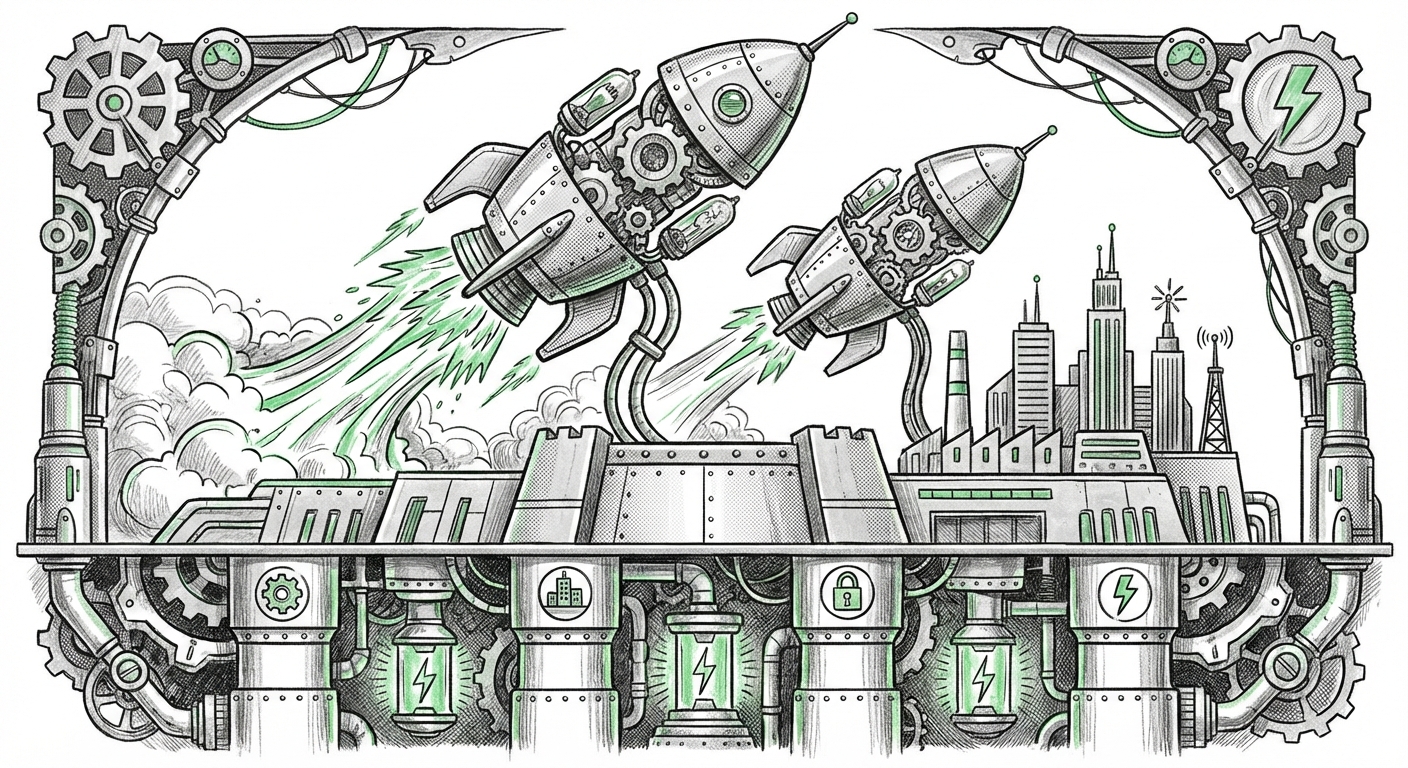
Google Rewires Its Brain and Meta Hires a Coding Swarm: What This Means for the Future of AI
Last week in AI, two headlines captured the direction of the entire industry: Google rewires its brain, and Meta hires a coding swarm. On the surface, these sound like dramatic tech news stories. Look closer, and they describe something much bigger than one deal or one product launch.
They describe how the future of AI will be built. Not one chatbot at a time. Not one feature bolted onto an old system. Instead, AI is becoming the central brain of modern software, and AI agents are becoming the workforce that builds and runs that software.
This article breaks down what each headline really means, why they belong together, and what business and society should do about it.
What Does It Mean for Google to Rewire Its Brain?
A brain is not simply one part of a machine. It is a network of systems that receives signals, remembers context, makes decisions, and sends actions. In software, the "brain" has always been the logic at the center of a product. That is the part that decides how to answer a question, how to rank a result, and how to connect the right data to the right user.
For years, Google's brain was built out of hand-written rules, large databases, ranking signals, and enormous teams of human engineers. A "rewiring" means shifting intelligence from human-written code to machine-learned models. Instead of asking, "What function should we write?" the company asks, "What should the model learn?"
This is not a small change. It is a new computing model. The user may just see better answers or a cleaner search experience. But inside the company, every product starts with AI at the center. The old software architecture becomes the supporting skeleton, and the model becomes the thinking part of the system.
For the future of AI, this is a turning point. It means AI is no longer a feature that sits on top of software. It is the foundation on which software is built. When a company as large as Google rewires its core, every product in that ecosystem is pressured to follow.
What Does It Mean for Meta to Hire a Coding Swarm?
The second headline points in the same direction but focuses on work. Meta hiring a coding swarm signals a future where software is not written only by people. It is also written by many AI agents working together.
A swarm is not a single assistant. A coding swarm is a collection of small, specialized AI agents. One agent might write a test. Another might search for security problems. Another might suggest a code fix. Another might summarize what was changed for a human reviewer. Together, they act like a team of developers that never stops working.
This changes the shape of the software industry. In the old model, a company needing more engineering work would hire more human developers. In the new model, a company can scale its coding effort by launching more agents. The human role shifts from writing every line of code to directing, reviewing, and improving the work of the swarm.
The exact details of the story matter less than the direction. The phrase "coding swarm" tells us that AI is moving from giving answers to doing work. This is one of the most important ideas in modern AI: agents will not just tell you how to fix a bug. They will fix it. They will test it. They will report back.
Why These Two Stories Are Really One Story
Read separately, Google's story is about product architecture and Meta's story is about software development. Read together, they show a single future.
Google rewiring its brain means AI sits at the center of how products think. Meta hiring a coding swarm means AI sits at the center of how products are made. That combination creates a powerful loop:
- AI models power the products people use every day.
- AI coding agents build those products faster than human teams alone ever could.
- Human teams focus on goals, quality, safety, and judgment.
- The speed of software development increases, and the intelligence behind the software increases with it.
This is the future of AI in one sentence: AI becomes both the brain and the hands of the digital world.
What This Means for Businesses
For most companies, the takeaway is simple. AI can no longer be treated as a side project. The businesses that thrive in the next few years will be the ones that make AI a strategic core, not an experimental add-on.
Here is what that looks like in practice:
1. Architecture Will Change
Software used to be organized around data and rules. In the future, it will be organized around models. Companies should start asking where their own "brain" lives. Where are the decision points in their products? Which decisions could be handled by a learning model instead of a fixed rule?
2. Workers Will Manage AI Teams
In the world of coding swarms, the most valuable person is not the one who writes the fastest function. It is the one who can set a clear goal, review AI output, catch errors, and improve the system. This is a new kind of role: an AI manager. Businesses need to train people for it now.
3. Data Becomes Even More Important
A rewired brain is only as smart as the information it learns from. Companies with clean, organized, and well-labeled data will get much more value from AI. Companies with messy data will see their AI systems make messy decisions. Data quality is not a technical task. It is a business priority.
4. Speed Creates Risk
A coding swarm can produce massive amounts of code in a short time. That speed is exciting, but it also means a bug can multiply quickly. Old safety rules still apply. Human review, strong tests, and careful rollbacks are more important than ever.
What Society Should Watch Carefully
These trends are not only for technology companies. They affect workers, students, and everyday users of software.
First, job roles will shift. This does not mean every coding job disappears tomorrow. It means the job description changes. Developers will spend more time designing systems and reviewing AI work. People who cannot work alongside AI tools will struggle. People who can will become more valuable.
Second, accountability becomes harder. If an AI coding swarm writes a buggy program, who is responsible? The company that deployed the swarm. The human who approved the change. The model provider. We need clear rules for this, and the rules are not ready yet.
Third, speed can cause damage. AI that acts quickly can amplify mistakes. A wrong product decision, a security flaw, or a biased model can spread far before someone catches it. That is why governance, transparency, and human oversight must be built into every AI system from the start.
Actionable Insights for Business Leaders
There is no reason to wait for perfect information before preparing for this future. Leaders can take practical steps today.
- Map your organization's current "brain." Identify the decisions, people, and systems that run your core product or service. These are the places where AI will matter most.
- Make AI a core layer, not a side project. Ask every product team how AI changes the product's thinking, not just its features.
- Pilot a small coding swarm. Choose a low-risk project like documentation, unit tests, or internal tooling. Give AI agents a clear goal, a feedback loop, and a human reviewer. Measure the results.
- Build a governance system now. Decide who approves AI models, how agents are tested, and when a human must step in. Do not wait for an accident.
- Invest in people. The future belongs to teams that can evaluate AI output, design good prompts, audit data, and manage risk. Training budgets should reflect this shift.
- Stay flexible with models. The AI market changes quickly. Avoid locking your business into one vendor. Use open standards and portable tools whenever possible.
What This Means for the Future of AI
Looking ahead, the biggest change is not a smarter chatbot. The biggest change is that AI will take meaningful action in the world. It will plan work. It will write code. It will inspect results. It will collaborate with other agents.
Google rewires its brain. Meta hires a coding swarm. Two headlines, but only one story: AI is becoming both the mind and the muscle of modern business.
The companies that understand this will be able to build better products, faster. The workers who understand this will be able to do more meaningful work. The societies that prepare for this will have a better chance of using AI safely and fairly.
The future of AI will not be decided only in research labs. It will be decided in boardrooms, code reviews, classrooms, and training programs. The question is not whether AI will change the world. The question is whether we will change with it.