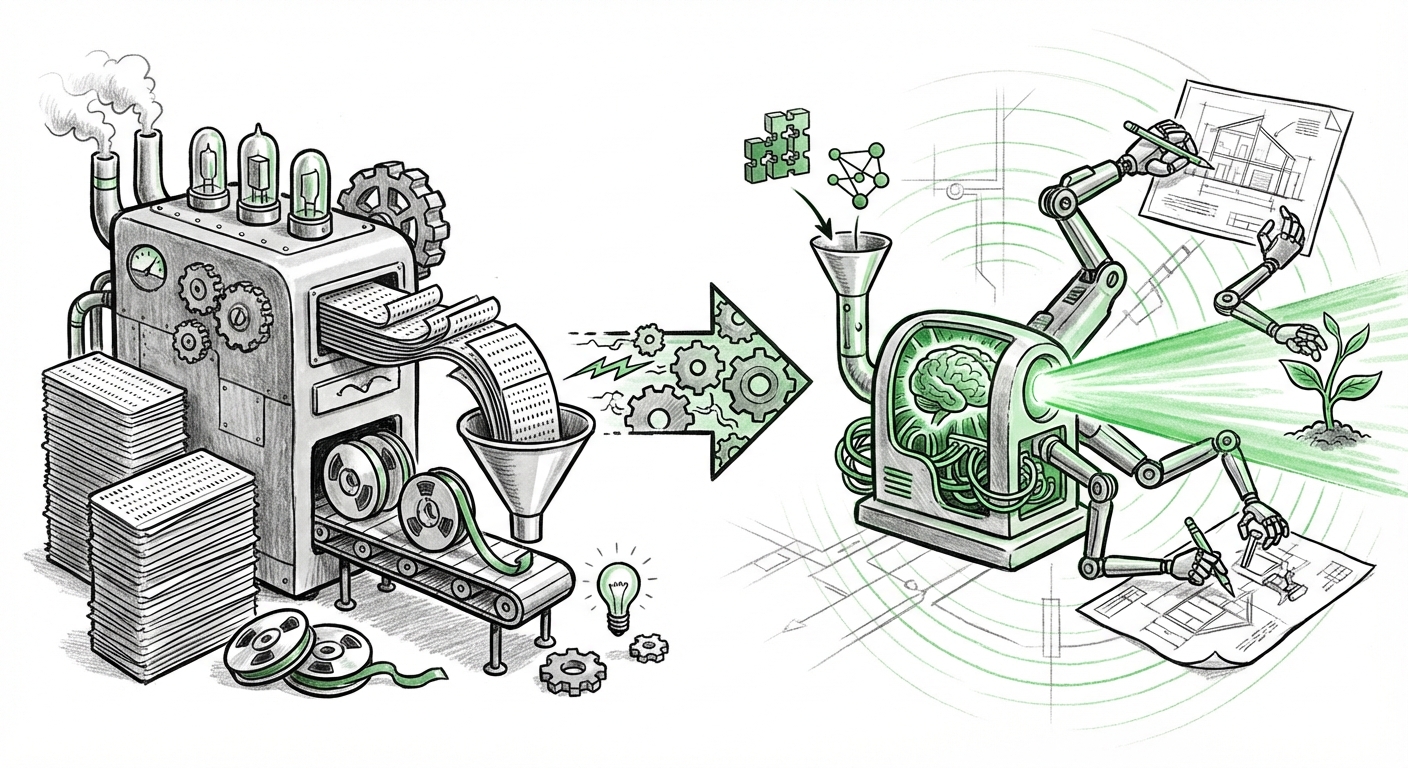
Why Old OCR Text Is Poisoning AI Training — and How FineBooks Plans to Save the Historical Record
Imagine handing a brilliant student a library where every tenth word is misspelled, half the pages are smudged, and the oldest books have letters that look like broken puzzle pieces. That student would still learn, but would make odd mistakes and confidently repeat them. This is the situation facing many large language models (LLMs) today. A lot of their reading material comes from old scanned documents, and the software that turns those scans into text, called OCR, has left behind millions of errors.
Now a project called FineBooks is stepping up to solve this problem at a massive scale. Its mission is simple to describe but hard to do: fix old OCR text so AI can learn from the past without being tricked by the past's messy digital copy.
In this article, we will explore why old OCR text is crippling language model training, why this hidden problem matters for the future of AI, and what it means for businesses and society. We'll also share actionable insights for anyone building or using AI systems that depend on historic or scanned content.
The Hidden Hero and Villain: OCR
OCR stands for Optical Character Recognition. It is the technology that reads printed text in an image and converts it into editable digital text. This is how old newspapers, letters, books, and government records become searchable. Modern phones use a form of OCR to scan receipts and menus. But OCR is far from perfect, especially when the original document is old and worn.
Early OCR systems were build to read clean, modern printed text with standard fonts. They worked okay on crisp pages. But throw them a 200-year-old book with fading ink, curly typography, torn edges, or unusual layout, and they produced gibberish. Common mistakes include swapping "rn" for "m", confusing the letter "l" with the number "1", turning "O" into "0", or merging words split across hyphenated line breaks.
When libraries started huge digitization projects years ago, they used these older OCR tools on millions of pages. The result is a massive digital collection that is searchable but often inaccurate. The original physical books might be in decent shape, but their digital twins are full of subtle defects.
These errors are not always obvious. A human reader can often guess what the word should be from context. But AI models are not so lucky. They take the text at face value and learn patterns, even when the patterns are wrong.
Why Bad Text Is a Big Deal for AI
Language models are trained on enormous amounts of text. They learn grammar, facts, and reasoning by predicting what word comes next in a sentence. If large parts of that text contain OCR errors, the model learns those errors as if they were correct.
This creates three major problems.
First, it causes hallucinations. A model might read a garbled word and connect it to an entirely different concept. For example, an old newspaper line about "the great fire of 1871" could become "the great tire of 1871" after OCR mistakes. The model might later confidently state that the Great Tire of 1871 was a notable event. It will not know the difference because it saw the wrong text many times.
Second, it damages historical reasoning. If a model wants to answer a question about what life was like in the 1800s, it has to rely on old diaries, census records, newspapers, and government reports. If those sources are full of errors, the model cannot build a reliable picture. It may get names wrong, dates mixed up, or locations confused. That makes it dangerous to use AI for historical research without careful human checking.
Third, it hides the truth. Sometimes OCR mistakes are so bad that the text becomes meaningless. A whole sentence might read like a keyboard smash. The model cannot learn from that sentence, and if enough sentences are broken, entire records are lost to the AI. The knowledge is locked in the physical page, but the digital version is unusable.
This is why many experts say training AI on old OCR text is like feeding it a book with hundreds of pages torn out. The model does not know what it is missing. It just thinks the world is a little stranger than it actually is.
Scale: Why This Problem Is So Hard to Fix
One obvious answer is to rescan every document with new, better OCR software. That is not practical. There are tens of millions of books, newspapers, letters, maps, and records in archives around the world. Many are fragile and cannot be handled again. Others were digitized at low resolution decades ago, and the original scans are not good enough for modern OCR.
Even if a perfect scanner existed, the scale is overwhelming. Fixing one document at a time would take centuries. Any real solution has to work at very large scale, cleaning up text that has already been digitized and also doing a better job on new scans.
On top of that, old OCR files often have another problem: missing structure. Paragraphs may run together, page breaks may be in the wrong place, and tables or footnotes might be jumbled. Fixing OCR is not just about replacing one character with another. It means understanding what the page originally looked like and reconstructing it faithfully.
The FineBooks Solution: Fixing It at Scale
This is where FineBooks enters the picture. The project is designed to tackle the massive problem of old OCR text head-on. Instead of fixing a few files, it aims to improve digital text at the scale of entire libraries.
There are a few ways FineBooks could achieve this, and the name itself hints at the goal: creating clean, reliable, "fine" books for AI and for people.But we can think through what any serious effort of this kind would require.
Combining modern language models with traditional correction tools. A modern AI can look at a garbled OCR line and guess what the original words were, because it understands context. It can compare the context to known historical language patterns. This makes the correction much smarter than a simple dictionary swap.
Using massive parallel processing. Millions of pages can be processed simultaneously by many computers, so the work gets done in months, not decades.
Keeping the original scan as a reference. A good pipeline goes back to the image and lets the model "read" the page visually instead of just guessing from the broken text. Modern vision-language models are excellent at this.
Creating openly accessible clean text. If FineBooks is able to release corrected text, then any AI company, researcher, or student can use those improved files without having to start from scratch. This benefits everyone.
What This Means for the Future of AI
Clean historical data would unlock a major upgrade for artificial intelligence. Here is what that future might look like.
Researchers will get a true historical assistant. Instead of searching through thousands of messy scans, a historian can ask a chatbot questions and get answers grounded in correct text. The chatbot can quote exact passages with confidence, track trends over decades, and even identify the first appearance of an idea. This is not possible when the underlying text is riddled with errors.
AI will be better at reasoning across time. Many legal, economic, and social questions depend on understanding the past. With clean OCR, AI could compare old census data with modern records, analyze changes in language, or trace the spread of a disease through old newspapers. The models would finally see the past with clear eyes.
AI education tools will improve. Students may one day use an AI tutor that can read original letters from famous scientists or historical figures. Instead of reading a summary written by someone else, they can explore primary sources with the help of an AI that truly understands them.
Hallucinations caused by broken text should drop significantly. If the source material is clean, the model has fewer reasons to invent nonsense. It will not be perfect, but a large class of errors would disappear.
Practical Implications for Businesses and Society
This is not just an academic issue. Many industries depend on old documents. Let's look at some real-world examples.
Legal firms and courts. Lawyers often need to review cases from the 1800s and early 1900s. Those old court transcripts and casebooks have often been scanned with old OCR. If AI is used to search for relevant rulings, it might skip over important cases because their text is too garbled. Clean OCR would make legal research more complete and accurate.
Genealogy and family history. Millions of people search census records, birth certificates, and immigration lists online. Bad OCR can make it almost impossible to find an ancestor whose name is spelled wrong in the scan. Cleaning these records at scale would help families reconnect with their past.
Healthcare and public safety. Old public health records, disease tracking charts, and hospital ledgers can reveal patterns that help modern science. But if the data is full of errors, those patterns are hidden. Clean historical text could even help researchers study how diseases behaved in earlier generations.
Insurance and finance. Long-standing companies often have archives of policies, claims, and contracts written by hand or typed on early typewriters. When employees retire, their knowledge goes with them. AI needs clean digital text to help new workers understand old agreements.
Society as a whole. The past belongs to everyone. When the world's collective memory is locked inside broken text, we all lose a little piece of our shared history. Projects like FineBooks have the potential to restore that cultural memory and make it useful for future generations.
Actionable Insights: What You Can Do Today
Even if FineBooks succeeds, there are steps that businesses and individuals should take to avoid this problem in their own data.
- Audit your training data. If you are building an AI model, look carefully at your sources. How much of your data comes from scanned documents? Run a quick random check on the text. If you see strange characters or garbled words, your model is at risk.
- Use modern OCR tools with AI correction. Old OCR is not good enough for AI training. Newer services use machine learning to guess the correct words and can handle messy scans much better. Spend the money to do it right the first time.
- Keep the original image whenever possible. If you are digitizing documents, do not throw away the scans after OCR. Having the image lets a better system try again later when technology improves.
- Combine human review with AI. For critical documents, ask trained people to check AI-corrected text. This is especially important in legal, medical, and historical contexts where accuracy matters more than speed.
- Build AI models designed to fix OCR. It is possible to train a language model to "clean up" bad text, just as it can correct spelling or translate languages. This is a valuable task because the cleaned data can then be used for many other purposes.
- Support open data projects. When organizations release clean, corrected text for public use, everyone gets better. Consider contributing time or funding to projects that improve the global digital archive.
- Do not assume raw archives are trustworthy. If someone hands you a corpus of old documents and says it's ready for AI training, verify it first. Garbage in, garbage out is still the number one rule of machine learning.
Looking Ahead
Projects like FineBooks remind us that the quality of AI depends on the quality of what it reads. We are in a strange moment where the newest, smartest technology in the world is being held back by an old, boring problem: messy scanned text. But that is also good news. The problem is fixable.
If FineBooks can truly fix OCR at scale, it will not just improve language models. It will change how we interact with history. AI could become a time machine with readable pages instead of a confused assistant that lightly remixes the past. It will help us uncover stories that were hidden by bad technology, remember names that were misspelled by scanners, and understand the world our ancestors built.
The next time you read an impressive AI answer, remember that behind that answer is a massive amount of text. Some of it is clean and some of it is a mess. Making that mess clean is one of the most important, least glamorous jobs in artificial intelligence. And it is about to get the attention it deserves.