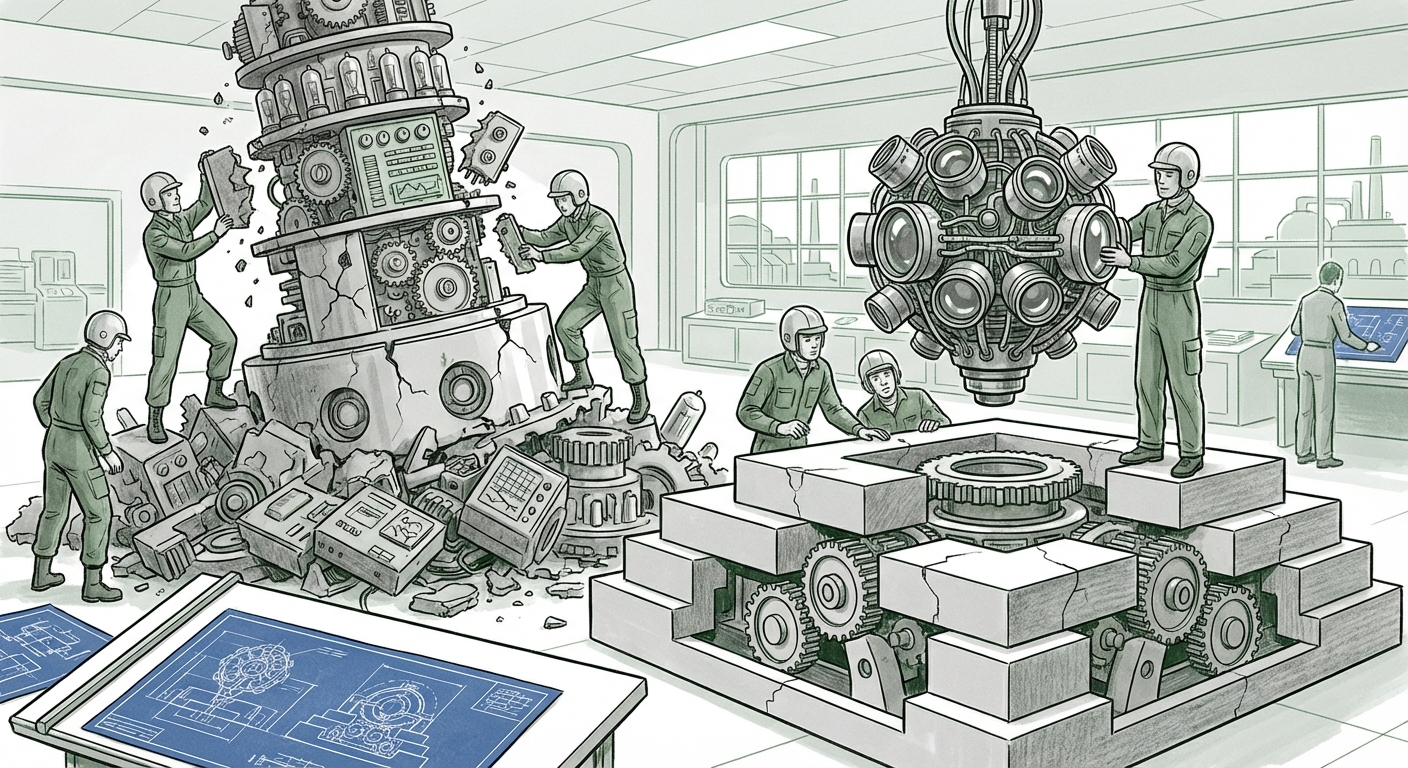
Distilling Diffusion and Multimodal Models: How AI Is Getting Smaller, Faster, and Smarter
In the world of artificial intelligence, the biggest headlines almost always go to the biggest models. Huge neural networks, trained on vast amounts of data, seem to capture all the attention. But right now, some of the most important work in AI is moving in the opposite direction. Researchers and engineers are focused on distillation: the art of taking giant, powerful models and compressing their intelligence into small, fast, and affordable versions that can run almost anywhere.
Three ideas are colliding at the frontier: knowledge distillation, diffusion models, and multimodal AI. Together, they point to a future where the AI in your pocket can see, hear, read, speak, and create — instantly, privately, and at almost no cost. This article breaks down what that means, why it matters, and how it will change the way businesses and ordinary people use AI.
The Big Model Problem
Today's most advanced AI systems are astonishingly capable. They can write code, generate photorealistic images, analyze complex documents, and answer questions about nearly any topic. But that power comes with a serious price. Frontier models are expensive to train and expensive to run. They live in enormous data centers and consume huge amounts of electricity. Every request a user makes has a real cost in time, energy, and money.
The most impressive kinds of AI are often the most expensive. Creating an image, a video, or a voice response takes far more computing power than typing a line of text. For most businesses, this creates a frustrating gap: the most capable technology is the least practical to deploy at scale. There has to be a better way.
There is. It's called distillation.
What Is Knowledge Distillation?
Imagine a master chef teaching an apprentice. The master doesn't just hand over a recipe card. The apprentice watches the master work, learns the techniques, and picks up the judgment behind each step. When the apprentice finally cooks alone, the results are nearly as good — even with far fewer ingredients and tools.
Knowledge distillation works the same way. A large teacher model trains a small student model. But the student doesn't learn from raw data alone. It studies the teacher's behavior: its answers, its confidence, its subtle patterns. These soft signals carry much more information than a simple correct or incorrect label. The student absorbs the teacher's judgment, not just its facts.
The payoff is huge. Students are often many times smaller than their teachers, yet they capture a remarkable share of their abilities. Smaller models run faster. They cost less. They use less energy. They can operate on a laptop, a tablet, or a phone. And because they can run entirely on a device, sensitive data never has to cross the internet.
For privacy-first industries like healthcare, finance, and law, that last point alone is transformative.
How Diffusion Models Work
Diffusion models are the engines behind many of the most impressive image and video generators in existence.
The core idea is surprisingly simple. Imagine taking a clear photograph and slowly adding static noise, step by step, until the image becomes pure visual chaos. A diffusion model learns to reverse that process. Starting from random noise, it carefully removes the fuzziness, step by step, until a clear image emerges.
This technique produces stunning, detailed, and diverse content. The same approach generates music, speech, video, and even 3D shapes. Diffusion is one of the most powerful tools we have for creating new things.
The downside is speed. Reversing the noise takes many small steps, and each step demands heavy computing power. Generate an image, and you wait. Generate a video, and you wait a lot longer.
Again, distillation comes to the rescue. One version, called step distillation, teaches a model to deliver the same result in far fewer steps. Another version shrinks the network itself. Combine the two, and you get diffusion models that can create images almost instantly on ordinary hardware.
The Multimodal Shift
The next frontier of AI is multimodality. Text-only chatbots were the first act. The second act is models that work across text, images, audio, and video all at once.
A multimodal model can look at a photograph and explain what's happening in it. It can listen to a voice message and summarize it. It can read a handwritten note, then sketch a picture based on the words. It processes the world the way humans do — through multiple senses.
These unified models feel like true intelligence, because they connect language with perception. But they are enormous. Each additional sense adds layers of complexity and billions of extra parameters. The biggest multimodal models strain the limits of modern data centers.
This is why distillation matters so much right now. The most exciting research direction in the field is applying distillation to multimodal models — and especially to multimodal diffusion models. The goal is simple: take the world's most capable systems and shrink them until they fit in the palm of your hand.
Why This Convergence Is a Big Deal
Put the three pieces together, and the picture comes into focus.
The future of AI is not just about bigger brains. It's about how much of a giant brain you can squeeze into a small, practical package. The combination of distillation, diffusion, and multimodality creates something new: an AI that is small enough to live on your device, fast enough to respond in real time, and smart enough to perceive, understand, and create.
There is a reason this moment feels significant. The same pattern played out with language models. Years ago, the most powerful language AI was locked inside research labs and expensive clouds. Distillation helped transform it into an everyday product available to nearly anyone. Now that same transformation is spreading to image and multimodal AI. Capabilities once reserved for the richest organizations are about to spread to everyone.
What This Means for Business
For companies, the implications are direct and practical.
- Costs fall dramatically. The price of generating an image, analyzing a document, or processing a voice interaction will keep dropping as smaller models replace big ones in everyday workloads.
- Speed unlocks new products. When generation happens in real time, tools that were impossible become routine: instant video previews, live design assistance, and real-time translation that sees the world through your camera.
- Privacy becomes a feature. On-device models mean customer data never leaves the product. For industries under strict regulation, this is a major advantage.
- The playing field levels. Small businesses will gain access to capabilities that were once available only to well-funded enterprises. A small team can build a multimodal product without a massive cloud budget.
- Infrastructure choices shift. Instead of routing everything through a distant data center, smart companies will build hybrid architectures: a small local model handles everyday tasks, while a giant cloud model steps in only for the hardest problems.
What This Means for Society
The social impact is just as significant. Cheaper, smaller AI means broader access. Students can get instant tutoring with visual explanations. People with disabilities can use tools that see and describe the world aloud. Language barriers will continue to fall as translation becomes immediate and multimodal.
There is also an environmental angle. Running a small model on a phone consumes a fraction of the energy of running a giant model in a data center. If AI demand keeps climbing, efficiency is not just a business metric — it's a climate strategy.
At the same time, this trend amplifies an uncomfortable risk: synthetic media. When convincing fake images, videos, and voices can be made in seconds on a phone, misinformation becomes harder to spot. Provenance standards, watermarking, detection tools, and media literacy will need serious investment. Trust, not technology, will be the scarcest resource.
Actionable Insights for Leaders and Teams
What should you do with this knowledge? Start with four things.
- Experiment with smaller models. Don't assume the biggest model is the best fit. Run side-by-side tests on real tasks and measure the trade-offs in cost, speed, and quality. Smaller models often beat expectations.
- Design for hybrid deployment. Identify the workloads that need frontier-level power and the ones that can run locally. Build systems that route each task to the right tier of intelligence.
- Make privacy a feature. As regulations tighten and customer expectations rise, on-device AI is a way to deliver real value while respecting data boundaries.
- Prepare for the synthetic content era. Establish clear policies for AI-generated content, invest in authentication and provenance, and train your teams to think critically about what they see and hear.
The Road Ahead: Smaller, Smarter, Everywhere
Looking forward, the direction is clear. Distillation will turn the most advanced diffusion and multimodal models from rare, expensive curiosities into everyday infrastructure.
Expect single-step generation to become routine. Expect on-device video creation. Expect personal assistants that watch, listen, and remember — while keeping your life private. Expect AI in cameras, glasses, cars, and robots, making decisions in real time.
The brightest frontier in AI research isn't the one building ever-larger models. It's the quieter effort to compress the wisdom of giants into something small enough to fit in a pocket and fast enough to keep up with human life.
The message for everyone — technologists, executives, and citizens — is the same. Pay attention to distillation. It is the force that will decide whether AI's biggest achievements stay locked in the cloud or spread everywhere, empowering everyone.
The story of AI's future will not only be written by the builders of the biggest brains. It will be written by those who learn to make them small, fast, and universal. Distilling diffusion and multimodal models is not a technical footnote. It is the headline.