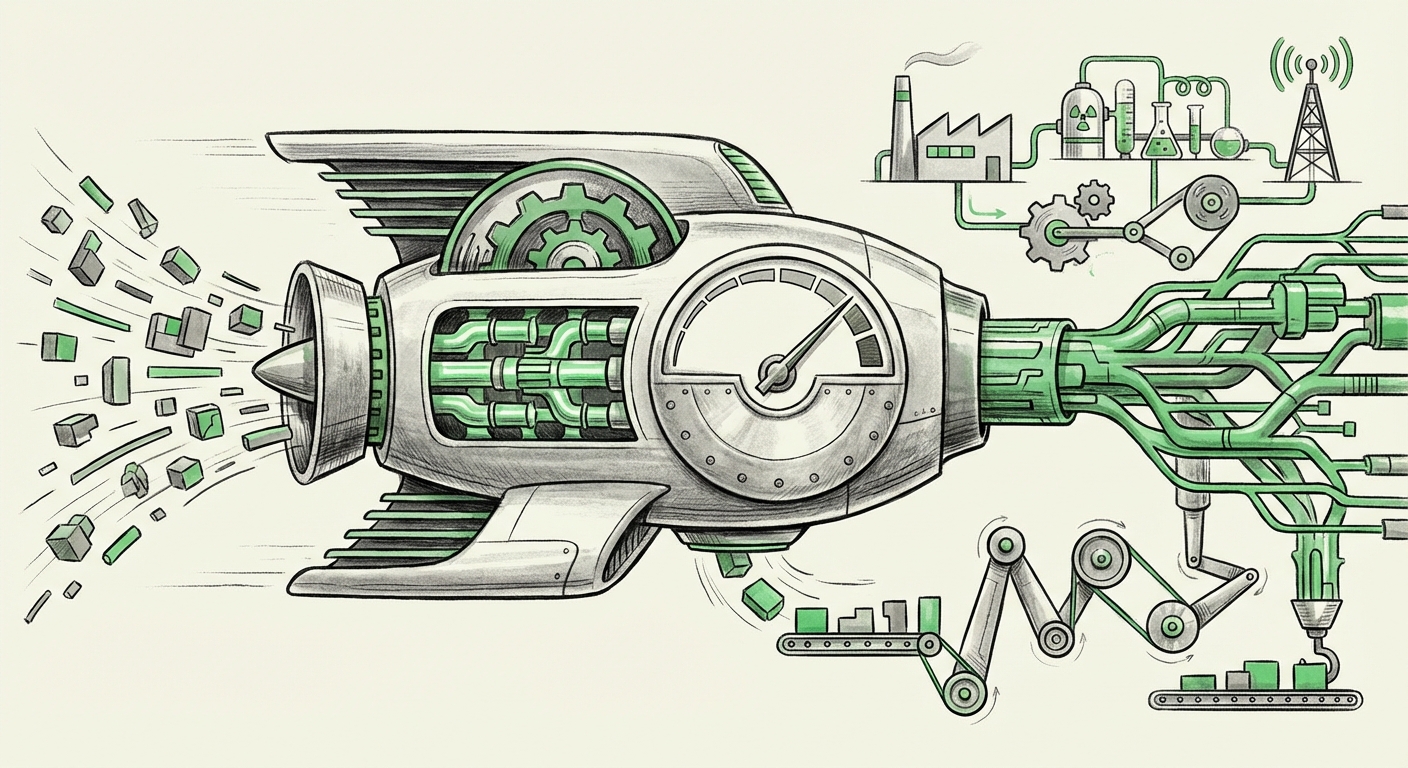
When AI Can't Look Inward: How Blocking Self-Reflection Rewrites a Machine's Worldview
Inside every great decision-maker is a quiet voice that asks: Are you sure? Did you check your work? Is there another way to see this? For humans, that voice is called reflection. For artificial intelligence, it is becoming one of the most important design choices of our time. When AI models are not allowed to reflect on themselves, their entire worldview shifts. They become more confident, but shallower. More direct, but more dangerous. And the choices we make about reflection today will shape how AI thinks, and who it harms, for years to come.
What Does "Self-Reflection" Even Mean for a Machine?
First, let's clear something up. When we talk about an AI reflecting on itself, we are not saying the machine has feelings, a soul, or a secret inner life. We are talking about a practical skill: the ability to look at its own output and evaluate it. In the world of AI, this often happens through something called chain-of-thought reasoning. Instead of blurting out an answer, the model works through the problem step by step. It writes out intermediate thoughts. It checks each step. And when something feels off, it can go back and try a different path.
Think of it like solving a long math problem on paper. You write line one, then line two. At the end, you glance back and spot the mistake on line two. Without that look back, you hand in the wrong answer with total confidence. That quick glance back is reflection. Some AI models are trained to do it. Others are not. And some are actively prevented from doing it.
What Happens When Reflection Is Taken Away
Here is what the evidence is starting to show: taking away self-reflection does not just make a model slightly worse at hard problems. It changes how the model sees everything. A model that cannot reflect tends to answer instantly and decisively. It never second-guesses. It never spots its own mistakes. Its errors stack on top of each other, because nothing interrupts the flow. The first wrong choice becomes the foundation for the second, and the third, and the tenth.
The change is visible in tone as well as accuracy. Reflective models tend to sound humble. They offer caveats. They say things like "this depends on the situation" or "there are several possible explanations." Non-reflective models do not do that. They state their answers as plain facts. They cannot express uncertainty, because expressing uncertainty requires looking inward and realizing you might be wrong. And if that inner look is blocked, the model simply never knows it might be wrong.
Here is a simple way to picture it. Imagine a GPS that cannot recalculate. If you miss a turn, the GPS keeps telling you to turn down the same street over and over. It does not know about its own mistake. Its worldview says: my instructions are perfect, the road is the problem. A model without self-reflection lives inside that same stubborn reality.
Why Would Anyone Block Self-Reflection?
It is fair to ask: who decided to remove reflection in the first place? There is no single villain. There are several pressures, and together they point in the same direction. The first is cost. Reflection takes computing power. Every extra step of thinking costs time and money. In a race to deliver the fastest, cheapest AI, reflection starts to look like waste. The second pressure is prediction. Models that reflect can behave in surprising ways. They can get stuck in loops, over-explain simple answers, or wander into uncomfortable topics. A model that never reflects is easier to predict, and predictable is easier to trust, or so the thinking goes.
The third pressure is safety. Many AI systems are wrapped in guardrails that keep them away from sensitive subjects. Those guardrails are supposed to make the model more careful. But sometimes they are built so bluntly that they also block the model's ability to reason about its own reasoning. The child and the bathwater go out together. The model becomes more "compliant" and less thoughtful at the same time.
A Different Worldview, and Why It Matters
The phrase that should make us stop is "worldview." A model's worldview is the set of assumptions it carries into every conversation. It decides what counts as an answer, what counts as a fact, and what counts as enough information. When a model can reflect, its worldview includes one simple but vital truth: I can be wrong. When a model cannot reflect, that truth disappears. The worldview that remains is one of absolute confidence.
That matters because a model's worldview does not stay inside the machine. It leaks into everything the machine produces. A model with no sense of its own limits will make confident claims about anything you ask. It will flatten nuance. It will ignore edge cases. It will not say "I need more information", it will invent whatever it needs. In a doctor's office, a courtroom, or a classroom, those quiet differences can mean the difference between a helpful tool and a harmful one.
What This Means for the Future of AI
Every sign says the next era of AI is an era of reasoning. We want machines that write working code, plan complex projects, and make decisions on their own. Those tasks demand reflection. Code needs to be reviewed. Plans need to be checked. Decisions need to be questioned. If we send this new generation of AI out into the world without the ability to look at its own work, we are not saving money. We are funding a future full of fast, fluent, confident mistakes.
The bigger risk is trend-driven. If the AI industry decides that reflection is too slow and too expensive, it may quietly train these habits out of the models entirely. We would end up with machines that sound brilliant and think shallow. They would pass the "vibe test" in every conversation, and then fail, quietly and confidently, on the tasks that actually matter.
Reflection is not just a performance feature. It is a safety feature. A model that can say "I don't know" is a model that can avoid causing harm. A model that cannot say it is a model that will march cheerfully off a cliff, and take our decisions with it.
What Businesses and Society Should Do About It
The practical message for business leaders is simple: you need to know how your AI thinks. Many companies buy AI tools the way they used to buy coffee machines, plug them in and hope for the best. That approach is no longer good enough. Ask your AI vendors direct questions. Does your model check its own work? Are there limits on its reasoning? Have you traded reflection for speed? Most importantly: can you run your own tests?
Here is a test worth stealing. Ask the AI a question with a hidden trap, a common misconception, a contradictory detail, or a question with two valid answers. Watch what it does. Does it pause, offer nuance, and catch the trap? Or does it charge ahead with a clean, confident, wrong answer? That single test will tell you more about a model's worldview than any marketing page.
Then, match the model to the stakes. For low-stakes work, drafting an email, summarizing notes, generating a first pass of a blog post, a fast, non-reflective model is perfectly fine. For high-stakes work, medical advice, legal analysis, financial calculations, hiring decisions, reflection is not optional. A few extra seconds of computing time is a cheap price for catching a costly mistake. And no matter how good the model is, keep a human in the loop. The strongest AI systems are the ones whose outputs are treated as drafts, not verdicts.
Actionable Steps You Can Take Today
- Test your own AI. Give it a trick question and see if it catches itself. This takes five minutes and could save you a very expensive surprise.
- Ask vendors about reasoning limits. If their answer is vague, that is an answer in itself.
- Separate fast and slow lanes. Use quick models for routine work. Reserve reflective models for decisions with real consequences.
- Watch for tone shifts. If your AI suddenly sounds more certain and less nuanced than before, ask what changed behind the scenes.
- Build a human review step into important workflows. Even the best model deserves a second pair of eyes.
- Support the boring stuff. When engineers ask for time and budget to build evaluation loops and reasoning checks, say yes. That is where safety lives.
The Road Ahead
We are making a choice, whether we admit it or not. Every time we cut a reasoning step to save a millisecond, every time we block a model from examining its own thoughts, we are shaping the machine's worldview. The danger is not that AI will become too smart. The danger is that it will become too sure of itself while knowing very little. The path forward is not to slow AI down. It is to let AI look at its own work, question its own conclusions, and admit when it does not know. That is not a weakness. For humans and machines alike, it is the very definition of wisdom.