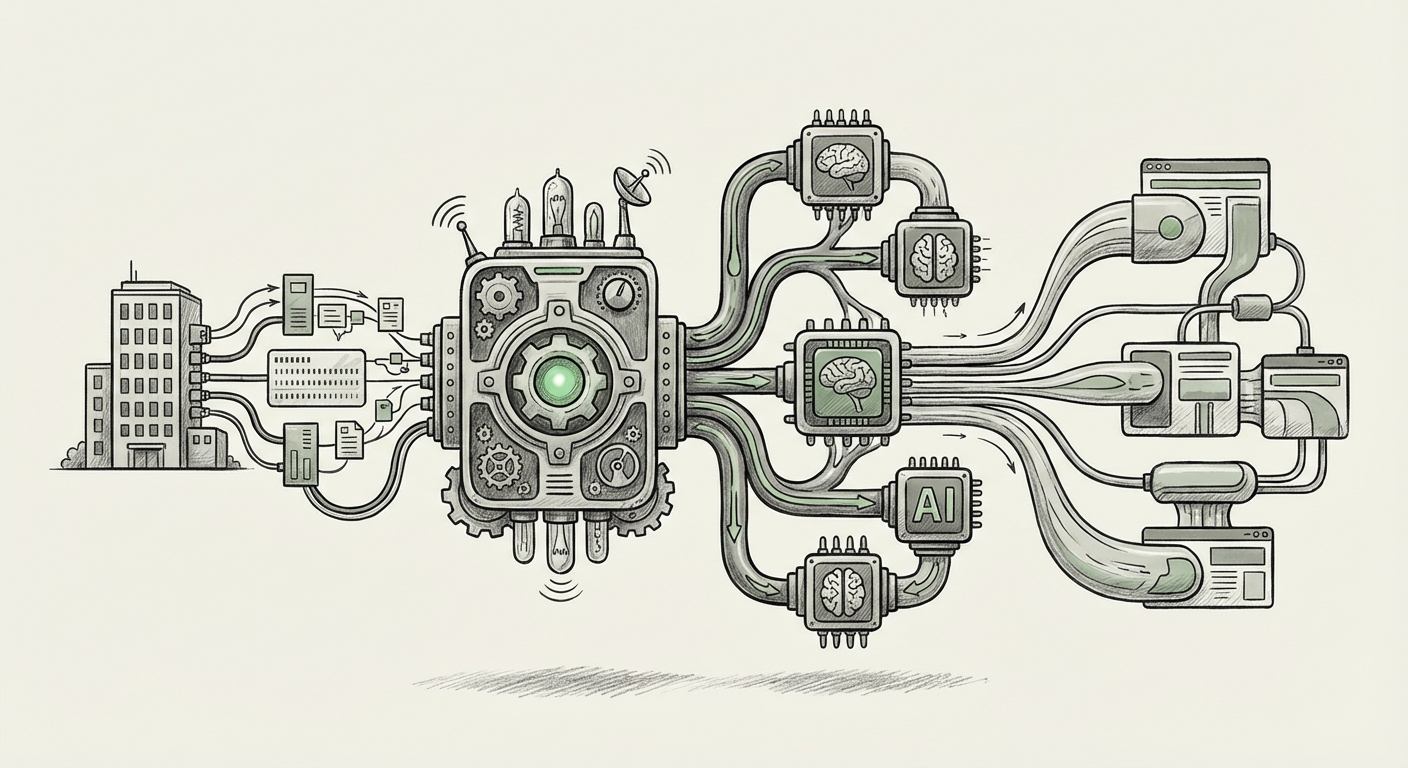
Governing AI When It Exits Your Building: Native Controls, Federated Trust, and the Seams That Break
For years, we thought about AI governance the wrong way. We treated it like a fence around a single field. Build one model, keep it in one place, write a policy document, check the box. It felt safe, mostly because everything stayed inside the organization's walls.
That era is over. AI now moves. It is embedded in products your customers use. It talks to your suppliers' systems. It helps make decisions that travel across borders, across companies, and across legal systems. The old fence no longer works, because the field is no longer yours.
The next era of AI will be defined by three ideas that are easy to say and hard to do: govern natively, federate outward, and understand exactly what breaks across trust domains. This framework is emerging as the mental model for how organizations, regulators, and society will keep AI both powerful and safe. Let's unpack what it actually means.
The Control Room That Doesn't Exist Yet
Here is the uncomfortable truth: most organizations do not know what their AI systems are doing right now. Not really. They know what the systems are supposed to do. But when a model is live, taking in new data, making thousands of decisions an hour, the link between intention and behavior is fuzzy.
That fuzziness is dangerous. And it gets far more dangerous when the AI leaves the building.
The solution is not more meetings. It is not another 90-page policy nobody reads. It is the first of our three ideas: govern natively.
Govern Natively: Safety Built Into the Machine, Not Bolted On
Native governance means the controls live inside the system itself. They are part of the architecture, not an add-on. Think about the difference between a car with airbags and a car with a manual that says "please drive carefully." The manual is not governance; it is a wish. The airbag is native governance.
For AI, native governance looks like this:
- Every decision the model makes is logged automatically, with a timestamp and a reason, and nobody can turn the logging off.
- Permission checks happen inside the inference pipeline, so an unauthorized prompt never even reaches the model.
- Policy rules are written as code and enforced in real time, not checked once a quarter.
- Data lineage is tracked from the start, so you can always answer: where did this training data come from, and who touched it?
The shift here is profound. In the old model, governance was something humans did around the AI. In the new model, governance is something the AI does by design. You cannot forget to enforce a rule, because the rule is wired into the system's behavior.
There is a simple test every leader should ask their team: "If our compliance team disappeared tomorrow, would the system still behave within the rules?" If the honest answer is "no," governance is not native. It is decorative.
This matters because AI systems are now moving too fast for human review. A model can generate millions of outputs in a day. You cannot review millions of outputs. You can only build a system that refuses to produce bad ones in the first place. That is native governance.
Federate Outward: Trust That Stretches Beyond Your Walls
Native governance handles the inside of your organization. But AI does not respect walls. Your model takes inputs from a partner's API. Your customer feeds your model into their own workflow, then passes the result to someone else. Somewhere down the chain, a small input becomes a big decision with real consequences.
This is where the second idea comes in: federate outward.
Federated governance is a way of sharing trust without giving up control. Each organization keeps its own authority over its own systems. But it agrees to participate in a larger network of trust with clear rules, shared standards, and mutual recognition of controls.
A useful analogy is international air travel. Every country controls its own airspace. There is no single world government that runs all flights. But planes cross borders safely every day because countries agree on shared standards, for pilot licensing, for maintenance, for air traffic control, and because they trust each other's checks. The system is not centralized. It is federated.
AI needs the same thing. When your model hands off a result to a partner's system, your partner should be able to trust three things:
- That your model actually did what you claim it did.
- That your data handling meets agreed standards.
- That someone can be held accountable if things go wrong.
Federation is not about building one giant global AI government. That would be slow, brittle, and politically impossible. Instead, it is about building compatible trust, enough shared language and shared standards that control can stretch across boundaries without snapping.
What Breaks Across Trust Domains
Now we get to the hardest part. Because no matter how well you govern natively, and no matter how carefully you federate outward, something will break. The title of this emerging framework points straight at the problem: what breaks across trust domains.
First, what is a "trust domain"? Simply put, it is the space where you control identity, access, data, and policy. Inside your trust domain, you decide who gets in, what they can see, and what rules apply. Outside, someone else decides.
When an AI system operates entirely inside one trust domain, life is manageable. The trouble starts at the moment of crossing. Here is what actually breaks at the seams:
1. Identity Breaks
When a human walks into your office, you know who they are. When an external system calls your AI, how sure are you who is really on the other end? Is it a trusted partner, or is it someone pretending to be a trusted partner? Identity that works inside a domain often fails at the border.
2. Provenance Breaks
Data picks up a story as it travels. It gets copied, transformed, combined, and re-labeled. By the time it reaches a distant system, the history is fuzzy. Can you prove the data was not tampered with? Can you prove it was collected with proper consent? In many cases, the answer is no, because the trail goes cold at the boundary.
3. Policy Mismatch Breaks
Your organization has rules. Your partner has different rules. The regulator in your country has yet another set. When a decision crosses these domains, whose rules apply? The honest answer is often "we don't know until something goes wrong." That is a lawsuit waiting to happen.
4. Auditability Breaks
Inside your domain, you can see the logs. Outside, you cannot. If a partner's system uses your model and the decision harms someone, can anyone reconstruct what happened? Often no, because each party only holds half of the story.
5. Accountability Breaks
This is the big one. When an AI decision crosses three organizations and a bad outcome occurs, who is responsible? The model developer? The system operator? The company that fed in the data? Each party can point at the others. The seam between domains becomes a place where responsibility goes to die.
6. Security Breaks
Seams are attack points. Attackers love boundaries, because neither side fully guards the middle. Data gets intercepted in transit. Malicious inputs slip in through lightly defended handoff points. The most dangerous place for an AI system is not inside its own fortress; it is the bridge to someone else's.
7. Explainability Breaks
You may understand why your model made a choice. But by the time that choice passes through three more systems, each adding their own logic, the explanation degrades. The final output is a blend of decisions nobody can fully trace. For high-stakes areas like hiring, lending, or healthcare, that is unacceptable.
The pattern here is clear. The models themselves are usually fine. The seams are the problem. Every handoff, every integration, every boundary is a potential point of failure. And as AI systems multiply and interconnect, those seams multiply with them.
What This Means for the Future of AI
So where does this leave us? The framework points to a future that looks very different from today.
First, governance becomes a core engineering skill. The teams that design AI systems will need to think about controls the way they think about performance and accuracy. Governance will not be a compliance chore at the end of a project. It will be a design requirement at the beginning.
Second, trust infrastructure will become a major industry. We will see new tools for verifying identity across organizations, for sharing audit logs safely, for proving data provenance, and for resolving disputes when things break. Expect the rise of shared standards, mutual recognition agreements, and third-party verification. The phrase "trust broker" may become as common as "cloud provider."
Third, AI agents will make this problem dramatically harder. The next wave of AI is not just models that respond to humans. It is autonomous agents that negotiate with other agents. When two AIs from different trust domains meet and strike a deal, who is the principal? Who authorized the transaction? What happens when an agent's promise is broken? We have almost no answers yet, and the pressure to find them is building fast.
Fourth, regulation will demand proof, not promises. Regulators are reaching the limits of what they can do with audits and questionnaires. Increasingly, they will want to see native controls, actual technical evidence that an AI system is constrained by design. The organizations that built governance in from day one will breeze through oversight. The ones that bolted it on will struggle.
Practical Steps for Every Organization
None of this is abstract. There are concrete moves you can make now, whether you run a startup or a global enterprise.
- Map your trust domains. Draw a diagram of every system your AI touches, inside and outside your organization. Mark each boundary. You cannot protect seams you have not identified.
- Ask about handoffs. For every place where data or decisions cross a boundary, write down: who is accountable, what is logged, and what happens if a dispute arises? If nobody can answer, you have found a risk.
- Build logging and observability now. You cannot retroactively create audit trails. Start recording AI decisions today, in a way you can share securely later.
- Put governance requirements in contracts. When you buy an AI system or sell one, make the governance standards explicit. Demand the right to audit. Agree on accountability before problems occur.
- Treat governance as a feature, not a tax. The organizations that can prove their AI is trustworthy will win customers, partners, and regulator approval. In a crowded market, provable trust is a competitive advantage.
The Bigger Picture for Society
The stakes here go beyond business. Public trust in AI is fragile. Every high-profile failure, a biased decision, a leaked dataset, a robotic customer service meltdown, chips away at it. The path to durable public trust runs straight through the issues this framework identifies.
We also face a fairness problem. If strong trust infrastructure is expensive and exclusive, only large companies will be able to participate in the federation. Smaller organizations could be locked out of AI partnerships entirely. The emerging governance architecture must be open and affordable, or we will create a two-tier AI economy.
And there is the international dimension. AI systems already cross borders daily. Trust domains overlap with legal jurisdictions, but they are not the same thing. Countries approach AI regulation differently, and those differences will create friction at the seams. The federated model offers a realistic path: not one global rulebook, but a way for different rulebooks to coexist and inter operate with enough mutual respect to function.
Conclusion: Build the Bridge and the Airbag
The era of the contained AI is over. Systems are out in the open, connected to each other, making decisions that ripple across organizations and borders. We cannot put the genie back in the box, and most of us do not want to. The power of connected AI is too great.
What we can do is build for the new reality. We can make governance native, so the safety is in the system, not beside it. We can federate outward, so trust can travel as far as the data does. And we can be honest about what breaks across trust domains, so we can design for the seams instead of pretending they do not exist.
The organizations that get this right will define the next decade of AI. They will be the ones whose systems are both powerful and reliable, both innovative and accountable. The others will learn the hard way that the seams are where everything fails, and that by then, it is too late to go back and fix the foundations.
The direction is clear. Govern natively. Federate outward. And respect the seams. The future of AI depends on all three.