AI's Productivity Paradox: Why Scientists Might Do More Work, and Do It Worse
For years, the story of artificial intelligence in science has been one of escape. AI, the promise goes, will read the papers, clean the data, write the code, and even draft the findings. Scientists, freed from drudgery, will finally have time to think deeply and make breakthroughs at superhuman speed. It is an appealing vision: less busywork, more brilliance, better results in less time.
A new study argues that this vision may have it exactly backwards. Instead of helping scientists do less work better, AI could push them into doing more work that is less good. The claim sounds strange at first, how can a faster machine make us busier and worse at our jobs?, but the logic behind it runs deep, and it applies far beyond the laboratory, to every workplace racing to adopt AI tools.
The Upside-Down Promise of AI in Research
The logic of the study is simple, but easy to miss in all the hype. Most people assume AI removes work. The study suggests it may just move work around.
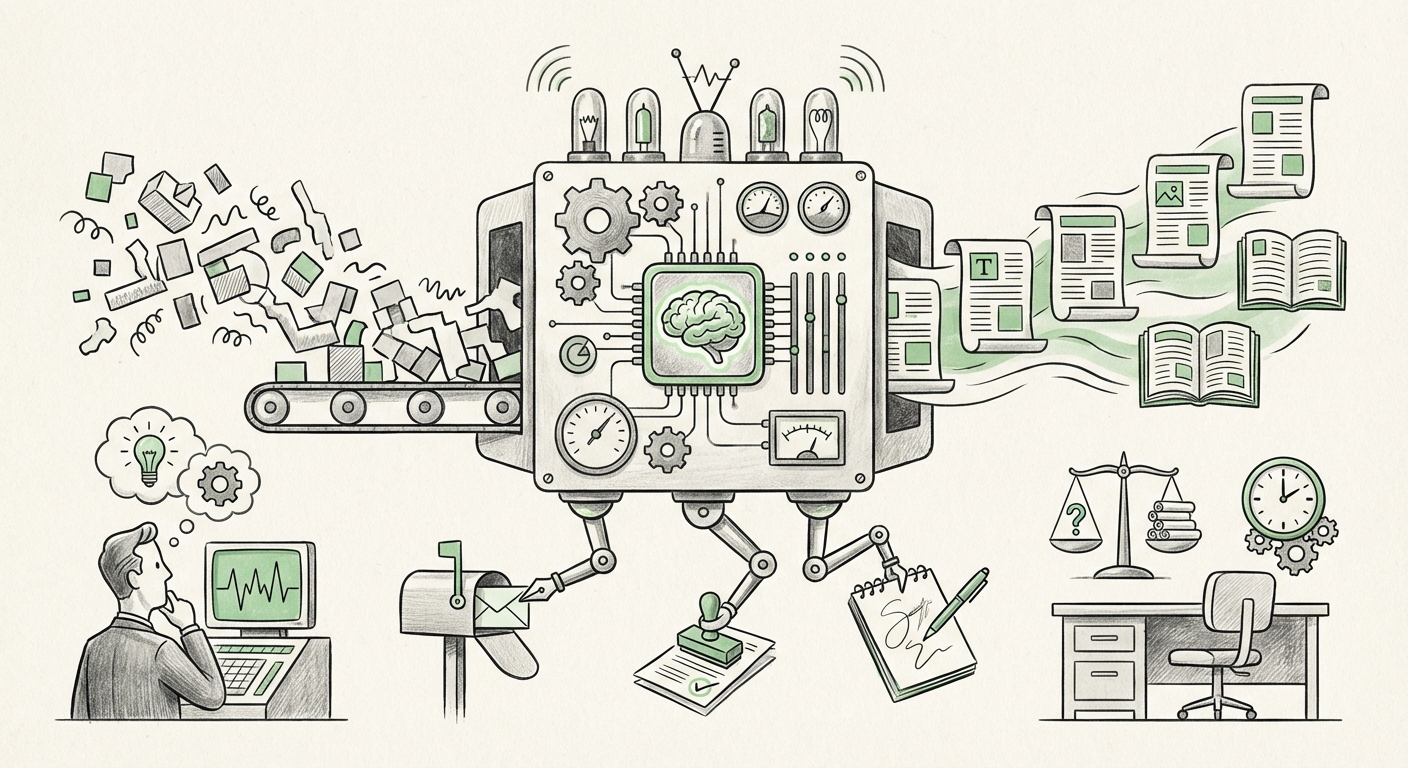
When a machine can produce something in seconds, people produce more of it. Writing, coding, data analysis, experiments, proposals, drafts, all become nearly free. And almost everything that gets produced still needs to be read, checked, questioned, and understood by a human. That checking time does not vanish. It grows.
The real bottleneck in science was never typing. It was deciding whether an idea or a result is actually right. AI makes it easier to produce candidates, and much harder to keep up with verifying them. The result, the argument goes, is a scientist who spends more hours than ever in front of a screen, doing more "work," while the depth and reliability of that work quietly slip.
In economics, there is a famous idea that efficiency can backfire: when something becomes cheap, we use more of it, until the savings are eaten up. A similar effect may be happening with AI in research. Cheaper output does not mean less work. Often, it means far more.
Why More AI Can Mean More Work
How exactly does adding a machine that is supposed to save time end up taking more time? The argument points to several forces that will sound familiar to anyone using AI in an office today.
- The volume trap. AI can generate a hundred hypotheses, a dozen draft papers, or endless lines of code in minutes. That sounds great, until you realize that someone has to evaluate each one. The time saved on generating is spent on sorting, filtering, and rejecting.
- The verification tax. You cannot fully trust AI output, and rightly so. So you check it. But checking AI work often means rebuilding the whole mental model in your own head and comparing it line by line. Sometimes verifying the machine's answer is harder than just doing the task yourself.
- The coordination web. More output means more versions, more files, more email chains, and more meetings to decide which AI idea to pursue. The work becomes a juggling act, and the juggling itself is exhausting.
- The expectation spiral. Once bosses and funders see what AI can do, they expect more results at the same deadline. The time AI saves is immediately swallowed by new demands. Nobody gets to go home early; everyone gets to produce more.
None of this means the technology is broken. It means the workflow around it is. Tools that generate are easy to add. Tools that help humans judge are much harder to build, and much rarer.
Why Quality Sinks When AI Rises
The second part of the study's claim is the more worrying one: not only might scientists do more work, that work might be worse. Why would that happen? Several well-known human tendencies point to an answer.
Automation bias. Humans have a tendency to trust machine output even when it is clearly wrong, especially when it looks polished and confident. An AI system can state nonsense with perfect grammar. The more the AI does the thinking, the less the human reacts to error signals. We stop questioning, and errors sail through.
Slow deskilling. Skills are built by doing. The same mental muscle that lets a scientist spot a flawed experiment or a bad assumption gets stronger with use. If the machine designs the experiment, runs the analysis, and writes the conclusions, the scientist loses the workout that keeps those instincts sharp. The decline is slow, but the study's argument suggests it is real.
Confidence without truth. AI can produce results that look complete and authoritative. That confidence is exactly the problem. In science, results are supposed to be hard-won and carefully inspected. When output becomes cheap and confident while the scrutiny budget stays the same, more flaws slip through. Reproducibility suffers, because quick results are rarely robust results.
Rewards for volume. Science has always counted what is countable: papers, citations, grants. AI inflates what can be produced, and the system responds by rewarding production. The result is more science that is correct in format but thinner in substance.
What This Means for the Future of AI
If this warning is right, the future of AI is not about machines replacing human intelligence. It is about machines reorganising human attention. The most valuable AI tools of the next decade may not be the ones that generate the most. They may be the ones that help humans judge with less effort: tools that flag their own uncertainty, that show their work, and that tell you when they are guessing. A machine that knows what it does not know is far more useful to a scientist than one that is confidently wrong.
We can also expect new norms and rules to grow around AI in research. Honest labels on what was machine-made, standards for verifying computer-generated results, and new ways to give credit will all matter. Science runs on trust, and trust must be rebuilt for a world where machines produce text and data as easily as humans do.
The way AI is used will change even more than the technology itself. The next wave of AI tools will likely think less about generating content and more about helping people make decisions: summarising what matters, surfacing disagreements, and flagging doubts. That shift, from "AI who does the work" to "AI who helps you judge the work", could be the most important change of all.
The Same Trap Awaits Every Business
It would be easy to read this as a science-only story. It is not. Every company racing to adopt AI is walking the same path.
Developers get AI writing code for them, then spend their days reviewing code and wondering where the hidden bugs lurk. Marketers get AI drafting posts, and the whole team rewrites them. Analysts get AI making charts, and the entire office argues with the charts. In many workplaces, the first effect of AI is that people feel busier, not freer.
That is not because AI is useless. It is because most teams treat AI as an add-on. They bolt the technology onto work that was designed for a different era, and they measure success by how much output appears. The companies that actually benefit are those that treat AI as a workflow design problem: fewer outputs, better checking, clearer ownership, and rewards for outcomes rather than volume.
Actionable Insights: How to Use AI Without Drowning
The study is a warning, not a verdict. Used deliberately, AI can still make work better. The difference is in the discipline around it. Here is what scientists, managers, and knowledge workers can do today.
- Keep one human accountable. Every AI-assisted result should have a named person responsible for it. Ownership concentrates attention and creates real review.
- Set an output budget. Decide in advance how many drafts, experiments, or ideas you will seriously pursue. Limit the flood before it starts.
- Measure quality, not quantity. Judge work by outcomes and insight, not by pages produced. Reward the person who finds one right answer, not the person who generates a hundred guesses.
- Protect the core skill. Do some tasks without AI on purpose, so judgment and intuition stay sharp. A pilot still practises landings; a scientist still needs to think from scratch.
- Make the AI show its reasoning. Prefer tools that explain themselves and admit uncertainty. If a tool cannot say why, be twice as careful about what it says.
- Design for the human, not the machine. AI suggests; the human decides. Build workflows that give people the time and quiet to judge, not just the speed to produce.
The Bottom Line: Tools Don't Replace Judgment
The study's message cuts against the loudest voices in the AI conversation. More AI, it argues, will not automatically mean better science, better business, or better work. It may simply mean more work of a lower quality, unless we change how we use it.
That is the real battle of the AI age. It will not be decided by who has the biggest models or the most tools. It will be decided by who builds the systems that let humans judge well, think clearly, and say no when the machine is wrong. The future of AI is not doing more. It is doing what matters, and knowing the difference.