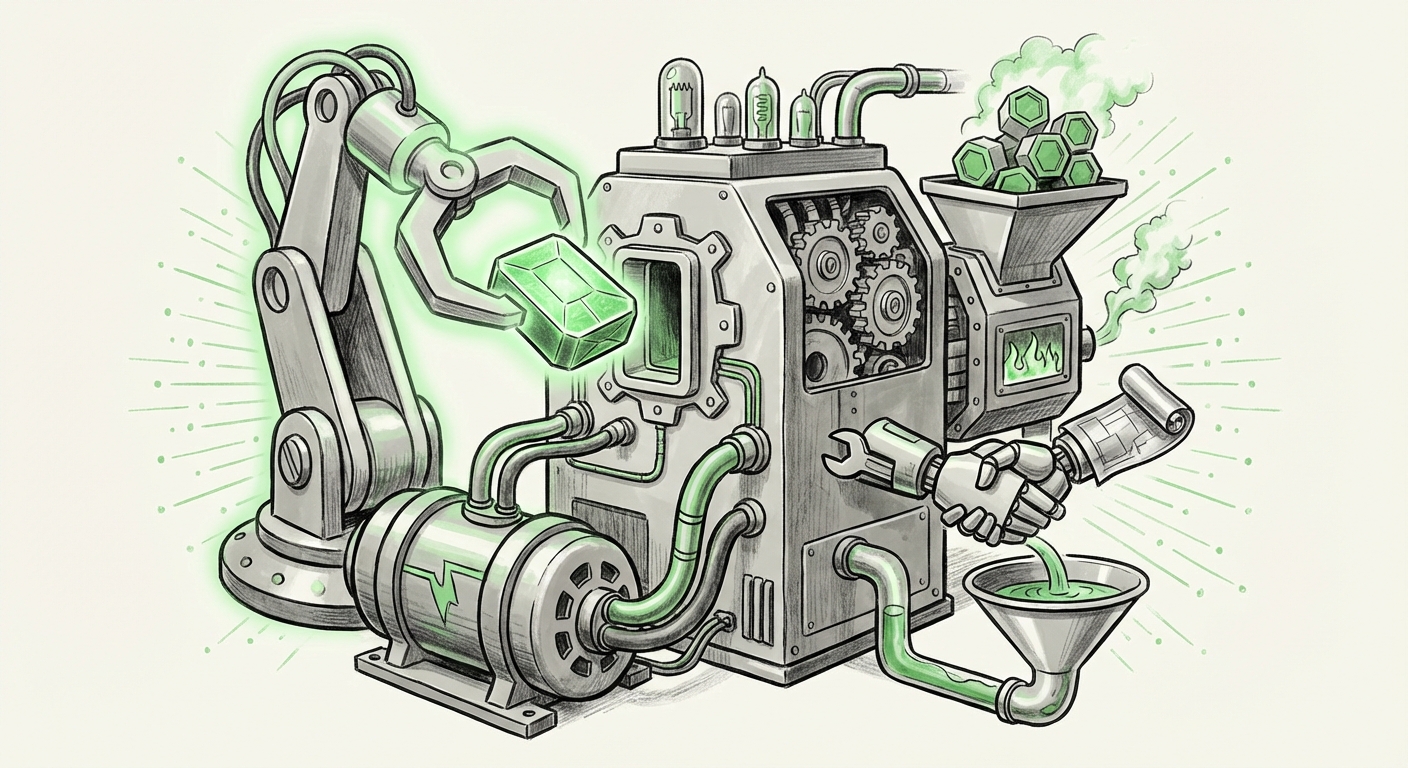
The Physics of Teaching AI: How Distillation Scaling Laws Are Redefining Model Training
Artificial intelligence has reached a strange and exciting turning point. For years, the path to better AI was simple: build a bigger model, feed it more data, throw more computing power at it, and watch its abilities grow. That approach gave us huge leaps in language understanding, image generation, and code writing.
But the path is getting expensive. Modern frontier models cost enormous amounts of money and energy to train. Not every company can afford to build one. Not every product needs one. So the AI world is looking for a smarter way: teaching.
Imagine taking a brilliant senior expert and asking them to train a bright new employee. The employee never reads every book the expert read. Instead, the expert explains the key lessons, shows examples, corrects mistakes, and passes on the most useful knowledge. That is the idea behind knowledge distillation in AI, and a new line of thinking called distillation scaling laws is turning this teaching process into a science.
These scaling laws aim to explain the physics of teaching AI models: how knowledge flows from a large "teacher" model to a smaller "student" model, what gets lost along the way, and how much compute and data are needed to make the transfer successful. Understanding these rules is one of the most important keys to the future of AI.
What Are Distillation Scaling Laws?
To understand distillation scaling laws, it helps to start with the original scaling laws of AI.
For years, researchers noticed something remarkable: when they increased model size, training data, and compute in a balanced way, model performance improved in a smooth, predictable pattern. This predictability is called a scaling law. It tells you roughly how much better a model will get if you make it twice as big or feed it twice as much data.
Scaling laws gave large AI companies confidence. They could plan massive training runs and predict real results. But they also created a problem: the only way to make a better model was to spend more money on a bigger model.
Distillation scaling laws try to solve that problem. They describe the relationship between the teacher, the student, and the training data used to transfer knowledge. Key variables include:
- Teacher quality: How capable is the large model that provides the knowledge?
- Student capacity: How much can the smaller model learn and store?
- Transfer data: How many examples does the student need to see?
- Label richness: Are the answers simple "right or wrong" labels, or rich "soft" outputs that carry more information?
- Compute budget: How much processing power goes into the distillation process?
By studying these variables, researchers hope to find the same kind of predictable curves that made traditional scaling laws so useful. Instead of asking "how big should my model be?", teams will ask "how good should my teacher be, and how big should my student be, to achieve the performance I need at the lowest cost?"
Why Distillation Matters Now
Distillation is not a new idea. AI researchers have used it for years to compress large models into smaller ones that run faster on phones and laptops. What is new is the ambition.
In the past, distillation was seen as a clean-up step after the heavy lifting of training. You trained a giant model, then squeezed it down. Today, distillation is becoming a primary strategy. Some of the most impressive newer models are not trained from scratch at all. They are born from apprenticeship.
The shift matters because of economics. Training a frontier model requires thousands of specialized computer chips, massive data centers, and weeks of time. Distilling a smaller student model can be far cheaper, especially when the teacher already exists.
This creates a powerful new pattern: the best model in the world acts as a university, and thousands of smaller models are its graduates. Those graduates can then be customized, embedded in products, run on private servers, or even placed inside phones and cars.
The Teacher-Student Relationship
Distillation is not simply copying. A student model does not receive a file of the teacher's weights and use them directly. Instead, the student learns by observing the teacher's behavior.
In a typical setup, the teacher model is given inputs and produces outputs. Those outputs become training examples for the student. But the smartest distillation goes beyond hard answers.
When a human teacher solves a math problem, they can show their work. When an AI teacher is asked a question, it produces a probability spread over many possible words or tokens. That spread, called a soft output, is enormously informative. It tells the student not only which answer is right, but which wrong answers are close to being right. This is like a teacher saying, "This answer is correct, but this other one is also interesting, and this one is not even close."
The teacher-student relationship works best when the gap between them is not too big. If the teacher is tiny and the student is huge, the student has nothing new to learn. If the teacher is enormous and the student is very small, the student may struggle to absorb the teacher's complex reasoning. Distillation scaling laws try to find the sweet spot.
There are also variations on the basic pattern. In self-distillation, a model teaches itself, learning from its own confident predictions. In progressive distillation, a model shrinks step by step, like a large textbook being summarized into lecture notes, then into a quick-reference card, without losing the most important ideas.
A Physics of Knowledge Transfer
Why do researchers describe distillation as a physics problem? Because knowledge, like energy, is never transferred with perfect efficiency.
In physics, every time you convert one form of energy into another, some energy is wasted as heat. In distillation, every time you transfer knowledge from a teacher to a student, some information is lost. The student cannot learn everything the teacher knows. It can only learn what the teacher can express, and only within the student's own limits.
Think of it like music. A world-class orchestra can play a symphony with dozens of instruments and layers of sound. A single piano cannot reproduce all of that complexity. But a skilled pianist can play a version of the symphony that captures the melody, harmony, and emotion. The piano is not the orchestra, but it is still valuable, portable, and beautiful.
Distillation scaling laws help us predict what that "piano version" will sound like before we even start playing. They tell us how much musical detail is preserved when we compress a symphony for a smaller instrument. In AI terms, they tell us how much capability is preserved when we compress a large model into a small one.
This is more than an analogy. There is a deep connection to information theory. Distillation is a form of lossy compression, where some fidelity is sacrificed for efficiency. Scaling laws try to quantify the trade-off between fidelity, cost, and model size.
What This Means for the Future of AI
If distillation scaling laws become well understood, the future of AI will look very different from the past.
1. Intelligence Becomes Transmittable
Right now, frontier models are locked inside data centers. Users interact with them through APIs but do not own their capabilities. Distillation changes this. If a company can distill a state-of-the-art model into a small student model, intelligence can be moved around, copied, and embedded almost anywhere.
2. Small Models Get Smarter
We are moving toward a world where small models are surprisingly capable. They will not match the largest models in every task, but they will be good enough for most real-world jobs. They will run fast, cost little, and respect privacy because they can operate offline.
3. Training Shifts to Teaching
Future AI development may focus less on collecting huge raw datasets and more on creating excellent teaching datasets from the outputs of strong teachers. Curating the right examples will become more valuable than brute-force data collection.
4. Emergence of Model Ecosystems
A single powerful teacher model could spawn an entire generation of specialized students: one for medical questions, one for legal documents, one for customer service, one for coding, and many more. These students could be updated later by returning to the teacher for new lessons.
Practical Implications for Businesses
For business leaders, the rise of distillation scaling laws is not academic. It has direct consequences for product strategy, cost, and competition.
Lower Cost of Custom AI
Building a custom AI model used to mean starting from scratch or fine-tuning a general model. Distillation offers another path: take a powerful teacher and distill it into a model tailored to your domain. This can significantly reduce the cost of building useful AI tools.
Faster Deployment
Smaller student models are easier to deploy. They require less server capacity and can even run on customer devices. That means faster rollouts, lower latency, and better user experiences.
More Control Over Data
Many companies hesitate to send sensitive data to an external AI service. A distilled model can run inside the company's own infrastructure. It carries the knowledge of the teacher, but the data used to teach it never has to leave the building.
New Dependencies
There is also a risk. If you rely on a single teacher model owned by another company, you depend on that company's access, pricing, and policies. Distillation may lower barriers to using AI, but it can also concentrate the ultimate source of knowledge. Companies need a strategy for choosing teachers and maintaining access to them over time.
Societal and Environmental Impact
Distillation scaling laws have broader implications for society and the planet.
On the environmental side, distillation is good news. Using a large teacher model to train many small students is far more energy-efficient than training each model from scratch. The expensive, energy-hungry part of AI shifts to a smaller number of frontier models. That is a meaningful improvement, though the teacher still requires significant energy to run and generate training examples.
On the social side, the picture is more complex. Distillation can democratize AI by allowing smaller teams to access advanced capabilities without immense compute budgets. But it can also centralize power: whoever builds and controls the best teacher models can influence what an entire generation of student models learns.
There is also the risk of error amplification. If a teacher has hidden mistakes or biases, those flaws flow into every student model. Distilled students do not correct the teacher's limitations. They inherit them. This makes model auditing and teacher accountability even more important.
Finally, distillation raises a deep philosophical question: when a model teaches another model, does the student have the same understanding as the teacher, or only a shadow of it? The answer depends on the physics of distillation, exactly what the scaling laws are trying to reveal.
Actionable Insights
Whether you are an AI executive, an engineer, or a policymaker, there are practical steps you can take today:
- Define your transfer goal. Do not just ask, "Is the student as good as the teacher?" Ask which specific capabilities matter most for your product, then measure those.
- Choose teachers wisely. The teacher determines the ceiling. If you need excellent reasoning, pick a teacher that excels in reasoning, not just one that is large.
- Invest in teaching data. The quality of the examples used during distillation is often more important than the number of examples. Include hard cases, edge cases, and diverse scenarios.
- Test for inherited bias. Run the student model through the same fairness and safety evaluations you would use for any other model. What the teacher passes down is not always good.
- Plan for updates. Teachers improve over time. Build a system that lets your student model return to the teacher for refresher courses when new capabilities arrive.
- Watch the returns. Distillation has diminishing returns. At some point, a bigger student or more data will not produce meaningfully better results. Use the scaling law to find the point of diminishing returns and stop before wasting compute.
The Bottom Line
AI is entering the age of teaching. The old question was, "How do we build a bigger model?" The new question is, "How do we transfer knowledge efficiently from one model to another?" Distillation scaling laws are the first serious attempt to answer that question with the same mathematical rigor that made large-scale training predictable.
These laws will shape everything from the cost of AI to its environmental impact, from who gets access to advanced capabilities to how much trust we place in small, fast, local models. They may even change the meaning of intelligence in AI: from something you develop from scratch to something you receive, refine, and pass on.
The future may not belong to the biggest model at all. It will belong to the most effective teacher-student ecosystem, a world where intelligence is not only created, but also taught. And the physics of that teaching process will be one of the most important subjects in artificial intelligence for years to come.