Anthropic's $30 Trillion AI Opportunity: What It Means Before the IPO
In the weeks before a company goes public, it tells the world a story. That story includes its history, its products, its customers, and, crucially, its future. For Anthropic, one of the most closely watched companies in the artificial intelligence boom, the future is now summed up in a single number: more than $30 trillion. That is the size of the market opportunity the company says it sees as it approaches its initial public offering (IPO).
It is a breathtaking figure. To put it in perspective, $30 trillion is roughly equal to one quarter of all the economic activity on Earth in a single year. It is larger than the annual output of any individual national economy. And it arrives at a moment when the AI industry is shifting from research breakthroughs to real-world deployment. Understanding what that number really means, and what it signals about how AI will be used in the years ahead, matters for investors, business leaders, workers, and anyone trying to make sense of where the economy is heading.
The Number That Resets Expectations
What does a $30 trillion market opportunity actually mean? It does not mean the company expects to earn $30 trillion in revenue. Investors use a concept called total addressable market (TAM), the total amount of money that could be spent in a market if every possible customer bought the product. The number is a ceiling, not a forecast. It describes the size of the prize, not the size of the slice any one company can capture.
Even with that caveat, the number is extraordinary. Most industries measure their entire global value in the billions or low trillions. A market opportunity above $30 trillion is a claim that AI touches nearly everything: every office, every hospital, every classroom, every factory, every government counter. It is a statement that AI should be compared not to the software industry but to the global economy itself.
That framing matters. It changes the questions people ask. Instead of "Can AI write a better email?" the question becomes "What happens when the cost of thinking and analysis falls to nearly zero in millions of workplaces at once?" That second question is the one the $30 trillion number is really pointing at.
Why Say It Now, Before the IPO?
The timing of the announcement is no accident. An IPO is the moment when a private company sells shares to the public for the first time. It is also the moment when a company must ask investors to imagine its future and place a value on it. A claim like "more than $30 trillion" is, in part, an invitation to think in decades rather than quarters. It tells investors that the company is building for a transformation that will unfold over a generation, not a single earnings cycle.
The claim also raises the bar for the entire industry. When one of the most prominent AI companies publicly frames its opportunity in these terms, it changes how other companies, investors, and governments describe their own ambitions. The conversation shifts from "How useful are AI tools?" to "How should the enormous value of AI be built, shared, and governed?" That is a big leap in one announcement.
Where Does $30 Trillion Come From?
To understand how such a large opportunity could exist, it helps to look at what most human work actually is. Around the world, a large share of work involves processing information: reading, writing, analyzing data, answering questions, making decisions, and coordinating with other people. For most of history, the cost of that cognitive work has stayed relatively steady. AI changes the equation. When the cost of thinking-time drops dramatically, every activity that depends on thinking-time changes with it.
Consider the scale of the industries involved:
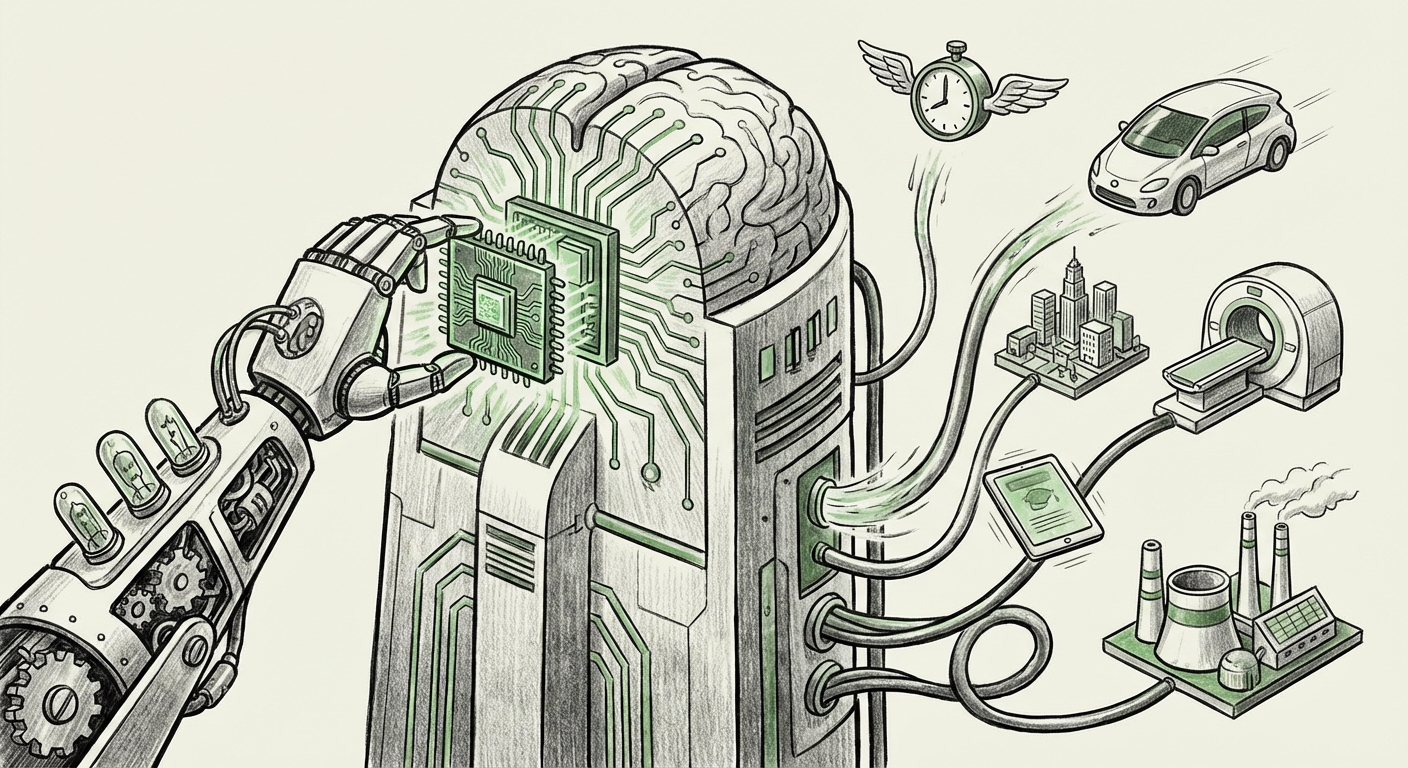
- Healthcare: AI can help doctors interpret medical scans faster, assist nurses with documentation, and support researchers searching for new treatments.
- Finance: AI can detect fraud in real time, speed up analysis, and make complex financial decisions easier to understand.
- Education: AI can act as a personal tutor, available at any hour, adapting to each student's pace.
- Government: AI can reduce waiting times for public services and make the delivery of benefits faster and more accurate.
- Manufacturing and logistics: AI can spot defects, plan supply chains, and reduce wasted materials.
These are not small niches. They are the core operations of the global economy. The $30 trillion figure is a way of saying that AI is not a product category at all. Like electricity or the internet, it is a general-purpose technology, one that overlaps with almost every sector at the same time.
How AI Will Actually Be Used
If the opportunity is truly that large, the next question is how it will be realized. The pattern is likely to arrive in waves.
The first wave is assistance. This is already happening: systems that draft emails, summarize long documents, write code, and answer questions in seconds. In this phase, humans stay in control and AI acts as a supercharged helper.
The second wave is delegation. Instead of helping people complete tasks, AI systems begin to complete tasks on their own, responding to customer inquiries, processing invoices, and triaging requests. Humans step in mainly to review and manage.
The third wave is orchestration. AI systems begin to work together. They coordinate with other software, move data between systems, and complete multi-step processes that once required entire departments.
The fourth wave is redesign. Organizations stop asking "How can we add AI to what we already do?" and instead ask "If work no longer costs what it used to cost, how should we rebuild the work itself?" This is where the largest economic gains appear, but it is also the hardest phase, because it requires changing structures, habits, and culture, not just purchasing software.
A useful rule for the future: AI will matter most where it removes friction in everyday, high-volume activities, not where it is most flashy. The unglamorous uses are the big ones.
What This Means for Businesses
The $30 trillion claim is not just a story for Wall Street. It carries practical lessons for any organization preparing for the AI era.
- Rank your processes. Make a list of the most frequent, most expensive, and most repetitive tasks in your organization. Those are the first candidates for AI. The value will be captured there before it appears anywhere else.
- Treat data as infrastructure. AI systems are only as good as the data and context they work with. Clean records, clear documentation, and well-organized data are the raw materials of the AI economy.
- Start with workflows, not widgets. The most common mistake is buying a tool and expecting transformation. Real change comes from redesigning the workflow around the capability.
- Measure compounding gains. A 5 percent reduction in time or cost may look small. Compounded across thousands of tasks every year, it becomes an enormous competitive advantage. Build measurement into every deployment from day one.
- Make governance a strength. As AI use spreads, transparency, privacy, and safety will become competitive advantages rather than burdens. Organizations that can show how their AI works, and why it can be trusted, will earn customers faster than those that cannot.
- Prepare your people. The winning organizations are unlikely to be those that replace people fastest. They will be those that pair people with AI, giving employees tools that make them dramatically more capable. Reskilling is not a cost center; it is the adoption plan.
What This Means for Society
If AI unlocks even a fraction of a $30 trillion opportunity, the effects will be felt far beyond markets.
On the positive side, the promise is large: more productive economies, faster medical discoveries, better education, safer infrastructure, and lower costs for goods and services. Productivity growth of the kind AI offers is the foundation of long-term improvements in living standards. Families benefit when good services become cheaper and more accessible.
But the risks are equally real. A technology with this much economic potential tends to concentrate benefits in the hands of those who own the infrastructure, the data, and the computing power, and who reach the market first. Workers in cognitive roles will need support as tasks shift. Communities that are left out of the AI economy may fall further behind. And governments will face difficult choices about how to regulate systems whose capabilities are advancing far faster than laws typically move.
The $30 trillion figure is not just an investment story. Whether acknowledged or not, it is also a social contract, an agreement between the companies that build and profit from AI and the public whose data, trust, and labor make the technology possible.
The Hard Part: Turning Trillions Into Reality
Large numbers deserve a dose of caution. Market opportunities are potential, not destiny. History is crowded with industries whose "trillion-dollar" promises took far longer to materialize than anyone expected. The internet was declared dead after the dot-com bust, yet its largest effects on daily life arrived twenty years later.
For AI, the path to a $30 trillion future runs through real economic bottlenecks: the cost of computing power, the price of energy, the availability of skilled engineers, the reliability of the systems, and the willingness of people and institutions to trust them. Each of these can slow adoption, sometimes for years at a time. Safety concerns may delay deployment in high-stakes areas like medicine, law, and public services. That is not a failure; it is the normal pace of responsible adoption.
The organizations that thrive will treat AI not as a hype cycle to be ridden but as a long investment cycle with compounding returns. Progress will be measured in steady reductions in cost and time, not in headlines.
Conclusion
So what should we make of the $30 trillion claim? It is a bold number, stated at a bold moment. But look past the headline and it tells us something durable and important: the AI industry has moved past the phase of proving that the technology works. It is now in the phase of figuring out where the technology creates economic value, and who will capture it.
The future of AI will not be decided by computing scale alone. It will be decided in hospitals, factories, classrooms, offices, and government buildings, wherever repetitive cognitive work can be made faster, cheaper, and better. The exact size of the opportunity matters less than the direction it signals. The AI economy is coming. The only open question is whether the rest of us are organized to participate in it.