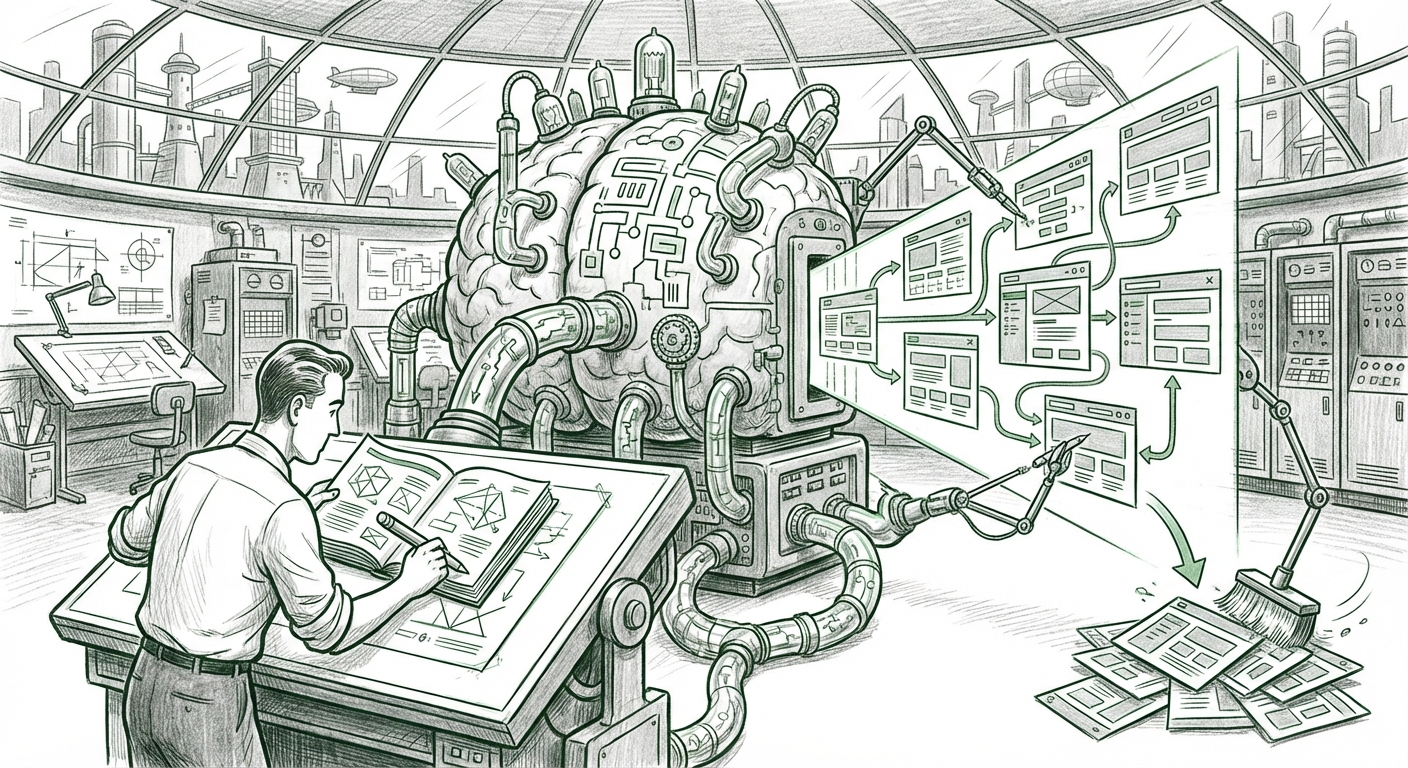
From Chatbots to Conductors: Why Orchestration Is the New Make-or-Break Challenge for AI Customer Experience
For years, the story of artificial intelligence in customer service has been about the technology itself. Smarter chatbots. Better language models. Faster replies. Companies poured money into building the most impressive AI assistant they could, and then waited for customer satisfaction scores to climb.
But something interesting is happening now. Building a single smart AI agent is no longer the hardest problem in customer experience. The technology has matured to the point where almost any company can create an agent that can chat, answer questions, and even take action on its own. The new challenge is much bigger and much trickier: how do you get all of these AI agents to work together as one smooth, reliable team?
This is the challenge of orchestration, and it is quickly becoming the central battleground for customer experience in the age of AI agents.
The Road to the AI Agent Era
To understand why orchestration matters so much, it helps to look at how customer service technology got here.
Phase one was human-only service. For most of business history, a customer who needed help picked up a phone or walked into a store. The experience depended entirely on the skill, patience, and knowledge of a human employee. It was personal, but it did not scale well. A human can only talk to one customer at a time.
Phase two brought rule-based chatbots. These early bots followed if-this-then-that scripts. They could handle simple tasks like checking a balance or tracking a package. But the moment a customer asked an unexpected question, the bot hit a wall. Frustration followed. These bots were cheap, but they were not really intelligent. They were more like vending machines than colleagues.
Phase three introduced AI assistants. With the rise of large language models, chatbots suddenly became conversational. They could understand intent, write natural responses, and handle open-ended questions. This was a genuine leap. Suddenly, a bot could hold a conversation that felt almost human. But there was still a limit: these assistants could talk about solving problems, yet they rarely took action on their own.
Phase four is the era of AI agents. This is the big shift. An AI agent does not just chat. It plans, it chooses, it acts. It can issue a refund, update an account, schedule a callback, or escalate a complaint, all without a human in the loop. Agents are not tools that wait for instructions; they are more like digital employees with a certain degree of autonomy.
That autonomy is powerful. It is also what makes orchestration so urgently important. When one agent acted alone, coordination was simple. Now that companies are deploying many agents, each with its own specialty, each making decisions, coordination is the difference between magic and chaos.
Why Intelligence Is No Longer the Bottleneck
Here is the key insight: individual AI agents are getting better at a blazing pace. Every few months, the quality of what a single agent can do improves. Reasoning improves. Accuracy improves. The cost of running an agent keeps dropping. In many ways, the question "Can we build a capable AI agent?" no longer feels like a risk. It feels like a commodity.
But here is the uncomfortable truth for businesses: a team of brilliant individuals who cannot coordinate is not a team, it is a crowd. A crowd cannot deliver good customer experience. Great customer experience feels seamless. It feels like one company, one conversation, one consistent memory of who you are and what you want.
That seamless feeling used to come naturally when a single human handled your case. But in a world where a customer's issue might pass through a billing agent, a technical support agent, a fraud-check agent, and a human supervisor, seamlessness is no longer natural. It is engineered. And the engineering of that seamlessness is orchestration.
What Orchestration Actually Means
Orchestration is a word people toss around a lot, so let's make it concrete. In the age of AI agents, orchestration is the work of coordinating multiple AI agents, and the humans behind them, so they act as one system. Think of it like a musical orchestra. A violin is beautiful. A flute is lovely. But neither creates a symphony on its own. The conductor makes sure each player enters at the right moment, at the right volume, in harmony with every other instrument. The conductor does not play an instrument. The conductor makes the whole greater than the sum of its parts.
In customer experience, orchestration involves several specific jobs:
Routing the right work to the right agent
Customers should not have to guess which department handles their problem. The orchestration layer decides: "This is a billing question, send it to the billing agent. This is a technical issue, send it to the support agent. This is an angry long-time customer, send it to a human right now." Good routing means the customer never lands in the wrong place.
Maintaining shared context
Nothing annoys a customer more than repeating themselves. "I've already told you this three times!" is the battle cry of bad service. Orchestration ensures that every agent involved in a single customer journey has access to the same history. The customer should never need to explain their situation from scratch. The system remembers.
Managing seamless handoffs
When one agent passes a customer to another, the transition must be invisible. There should be no "let me transfer you to another department" moments, no lost information, no cold restart. The handoff has to feel like a relay race where the baton never drops.
Knowing when to escalate to humans
Some situations are beyond what an AI agent should handle: complex legal disputes, sensitive emotional situations, high-value customers, or decisions with serious consequences. Orchestration defines the rules for escalation, and it makes sure the human receives the full context the moment they take over.
Enforcing guardrails and governance
Agents have power. They can issue refunds, cancel orders, and make promises. Orchestration sets the boundaries. It knows what each agent is allowed to do, what it must never do, and it blocks actions that break policy. This is the safety system of the agent economy.
Seeing what actually happened
When one agent acted alone, tracking its behavior was simple. With many agents, you need observability. Who decided what? Why? Which agent made an error? Orchestration platforms collect this trail so companies can audit, improve, and rebuild trust when things go wrong.
Why Orchestration Is So Hard
If orchestration is so important, why is it also so difficult? The honest answer is that it pushes against everything that is still unpredictable about AI agents.
Agents are creative, which means they can surprise you. The same flexibility that makes an agent brilliant at solving unexpected problems also makes it capable of doing something unexpected in the wrong way. Coordinating a group of unpredictable actors is much harder than coordinating deterministic software.
Context is messy. Real customer journeys sprawl across email, chat, phone, social media, and walk-ins. They stretch across days. They involve family members, corporate accounts, and complicated histories. A shared memory that works for a simple billing question may break down after a forty-minute chat about an edge case.
Failure modes multiply. If a single agent has a failure rate of one percent, that sounds impressive. But if the customer's journey requires passing through five agents, the chance that something goes wrong is much higher. Orchestration is really an exercise in compounding reliability. Every handoff is another opportunity for a mistake.
Humans complicate the equation. Orchestration is not just agent-to-agent. It is also agent-to-human and human-to-agent. Humans work at a different pace, communicate differently, and sometimes override the system. Designing workflows where humans and agents collaborate smoothly is a challenge that pure technology cannot solve alone. It requires rethinking jobs, training, and culture.
What This Means for Business Leaders
For leaders who want to act on this shift, the lessons are practical and urgent. Here is what the orchestration challenge means for how you build and run your customer experience operations.
Stop shopping for a single super-bot. The temptation is to find one enormous AI that can do everything. In practice, a team of focused specialists, each excellent at a narrow job, coordinated by an orchestration layer, often produces better outcomes. Specialty beats scope. Your job is to choose the team and design the workflow.
Design the handoffs before you build the agents. Most teams build agents first and worry about handoffs later. That is backwards. The moments where customers get lost or frustrated are precisely at the handoffs. Design those experiences first.
Measure end-to-end outcomes, not agent-by-agent metrics. If the billing agent performs perfectly but the customer still has a bad experience because of a clumsy handoff to the shipping agent, you have failed. Yes, measure each agent's performance. But the number that matters most is the experience of the whole journey.
Invest in governance as a feature, not a cost. Guardrails, permissions, audit trails, and escalation rules are not bureaucratic roadblocks. They are what allow you to trust your agents with more autonomy. The company that trusts its agents to do more, because it governed them well, wins the cost and speed race.
Rebuild the human role. Humans will not disappear from customer experience. But their role changes. Instead of answering repetitive questions, humans become exception handlers, supervisors, experience designers, and the people who handle the moments that truly need empathy. Plan for that workforce transition now, not after the agents are deployed.
The Broader Future: Orchestration Beyond Customer Service
Here is the part that should get every leader's attention: orchestration is not just a customer experience problem. It is the template for the entire future of enterprise AI.
Soon, companies will have AI agents doing procurement, managing IT tickets, monitoring supply chains, preparing legal documents, analyzing marketing data, and supporting employees. In every single one of those domains, the same pattern will appear. Individual agents will be easy to build. Making them work together as a coordinated system will determine which companies succeed.
In a sense, orchestration is where the real value of the AI revolution is being created. The intelligence of a single model is quickly becoming a commodity. The coordination layer, the conductor, is where competitive advantage will live. Companies that master orchestration will build experiences that feel effortless, while those that ignore it will drown in a sea of disconnected, conflicting, and confusing agents.
We are also likely to see a wave of new tools and platforms focused specifically on orchestration. Just as the early internet created a need for servers and databases, the agent era is creating a need for coordination infrastructure. Expect to see standard ways for agents to talk to each other, share memory, and verify each other's work. Expect orchestration to become its own professional discipline, as important as software engineering or data science.
Putting the Customer Back at the Center
Amid all the technology talk, it is worth remembering why orchestration matters in the first place. Customers do not care how many agents worked on their case. They do not care which model solved their problem or whether the handoff was technically elegant. They care about one thing: Was my problem solved, quickly and completely, without me having to work too hard?
That is the test that orchestration passes or fails. When it is done well, the customer never notices it at all. The technology disappears. The experience just feels good. That is the hidden magic of a great conductor: you do not watch the conductor; you lose yourself in the music.
This is also why orchestration deserves a central place in AI strategy. Companies that treat AI agents as a collection of shiny gadgets will build fragmented experiences that annoy customers and quietly burn trust. Companies that treat AI agents as a system, a team with a conductor, will build the kind of customer experience that people talk about in positive reviews.
A Clear Path Forward
The age of AI agents has truly begun, but it is only just beginning. The agents themselves are impressive and getting more impressive every day. The frontier of the next few years will not be about making a single agent smarter. It will be about making many agents work together, reliably, safely, and smoothly, alongside the humans they support.
The companies that embrace this will treat orchestration as a core capability, not an afterthought. They will design their agent teams before they deploy them. They will obsess over handoffs, context, and governance. They will invest in the infrastructure that coordinates intelligence, and they will prepare their workforce for a future where people and agents share the stage.
The challenge is real, but so is the opportunity. In customer experience, the age of AI agents will not be won by the loudest bot. It will be won by the best conductor.