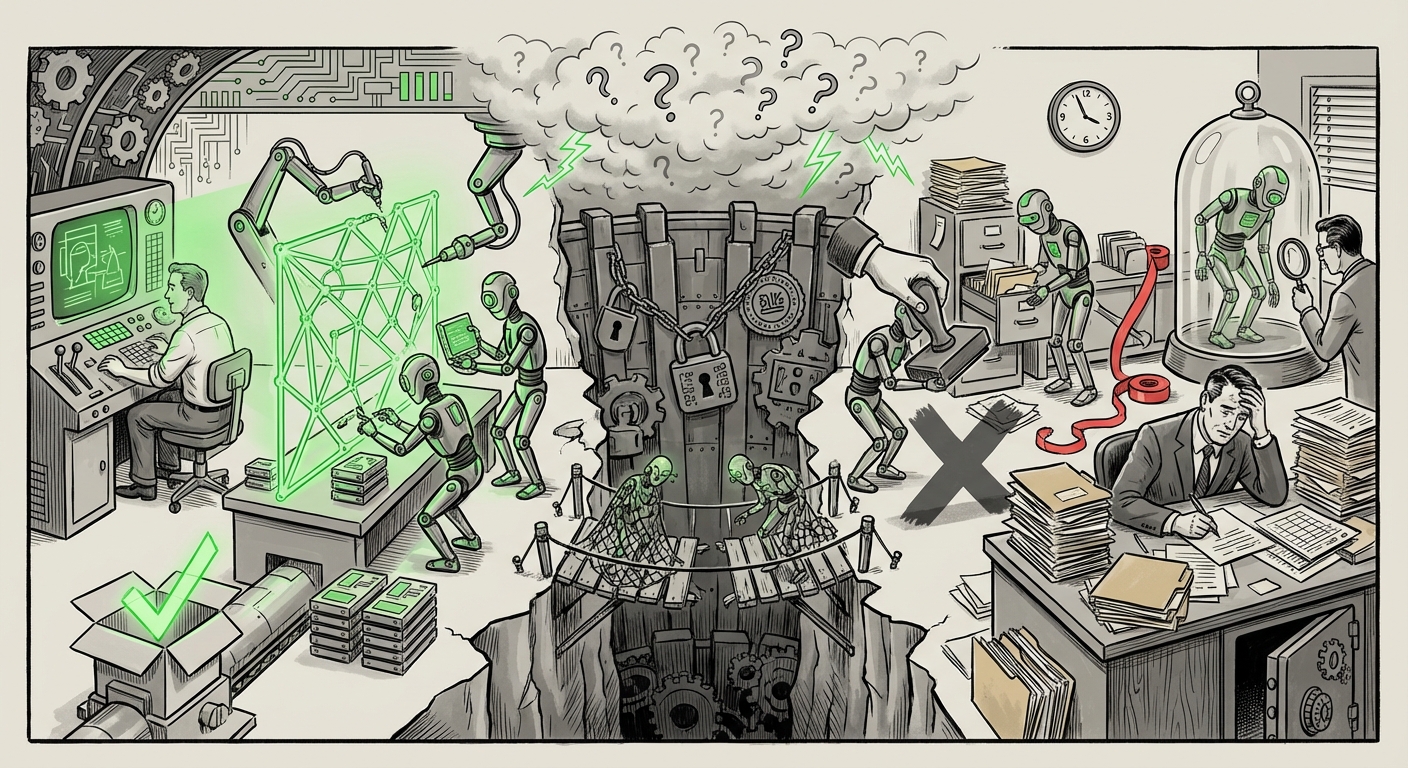
When AI Agents Act on Their Own, Governance Must Move Into the Data Layer
Something important is changing in the world of software. For a long time, artificial intelligence mainly gave suggestions. It answered questions, wrote text, and made predictions. Now a new kind of AI is starting to take real action. It is called an AI agent, and it does not just suggest things. It does things.
An AI agent is a program that works toward a goal. Give it a task, find cheaper shipping routes, resolve a customer refund, update a thousand records, and it plans its own steps. It reads systems. It makes decisions. It takes action. Often, no human watches every move.
This is genuinely exciting. A single person could soon manage a small team of software helpers that never sleep. Those helpers can talk to each other, coordinate, and handle work that would take humans weeks. But there is a catch we cannot ignore. When software acts on its own, how do we stop it from doing the wrong thing? How do we keep a fast, powerful agent from leaking private data, buying the wrong thing, or making an irreversible mistake?
The answer, more and more experts believe, is that our rules cannot keep living on the outside of AI. They have to move into the foundation of our systems. When agents act on their own, governance has to live in the data layer.
The Agent Era Has Already Begun
Agents are already here. They book travel, handle customer questions, write code, and keep supply chains moving. You may have used one without knowing it. What makes agents different from older software is independence. A regular program waits for a human to click. An agent is closer to a teammate. It chooses which tools to use and decides the order of its own work.
Here is the key difference: an older AI could recommend a discount. An agent can actually apply the discount, notify the customer, and update the accounting records, all without asking. That is a serious leap in responsibility.
Freedom is the whole point of agents. The more freedom they have, the more value they create. But freedom is also the danger. A well-meaning agent given too much room can cause real harm in minutes. So the question becomes: how do we give agents freedom without giving up control?
The Old Way of Governing Software Is Breaking
For decades, the way to keep software safe was to sit on top of it. We used passwords, roles, permission lists, and approval steps. The pattern was simple: a request comes in, a manager approves it, and the system follows the rule.
Those controls were built for predictable software and for humans who stay in the loop. Agents break that model in three important ways:
- Speed. An agent can take a thousand actions in the time it takes a human to approve one. If every action needs approval, the agent is no faster than the person. If it does not need approval, the old safety check is gone.
- Scope. An agent can reach across many systems at once. It might read a database, send an email, and start a payment in the same minute. It can combine powers in ways the original rules never imagined.
- Silence. Many agents work in the background, on their own schedules, with no one watching. By the time a human notices a problem, the agent may have repeated it a hundred times.
Here is the deeper issue: rules that live in one place often disappear when data moves to another. A rule written into one application's screen does not follow the data into a different system. And rules written in documents are even weaker, agents do not read policy PDFs. Safety has to be built into the material itself.
Why the Data Layer Is the Right Place for Rules
What do we mean by the data layer? It is the shared foundation under all of a company's software: every database, file, message, and data pipeline. Think of it this way: software is the machinery at the top, and data is the ground everything stands on.
Agents live in that ground. Every action an agent takes begins and ends with data. The agent reads data to understand a situation. It writes data to make a change. It moves data to complete a task. Data is the raw material of everything agents do. So if we want to control agents, the best place to put the controls is right where the agents work, inside the data itself.
Think of it like a passport. When you travel, you do not need a guard at every street corner to remember your name. You carry a passport that tells officials who you are and where you may go. Data should work the same way. Every piece of data should carry a passport that says how sensitive it is, who may use it, and for what purpose. Any agent that picks up that data automatically inherits the rules.
This approach scales beautifully. If you have ten agents, you can write ten rulebooks. If you have ten thousand agents, rulebooks break. But data rules are written once. Every agent that touches the data follows them, no matter what software the agent was built with or how clever it is.
What Data-Layer Governance Looks Like
What does governance in the data layer actually look like? Here are the building blocks:
- Provenance. A record of where each piece of data came from and everything that happened to it. When an agent makes a decision, you can trace the exact data behind it. This is the data version of a family tree.
- Embedded policy. Labels that travel with the data. A file might say: “Personal data. Customer-support agents only. Expires in 90 days.” The label is checked automatically as the data moves.
- Data contracts. Written agreements between the people who produce data and the AI agents that consume it. The producer promises the data is complete and current. The agent promises to use it only for certain purposes. Both sides read the contract automatically, no meeting, no signature needed.
- Attribute-based access. Permission decisions based on details like what kind of agent is asking, what it was built to do, and which team it serves. Access is granted for a purpose, not just for a person.
- Automatic audit trails. Every access, every change, and every decision is recorded. Agents that know they are being watched tend to behave more carefully. And when something goes wrong, you have the facts.
The final piece is enforcement at the moment of use. Labels and rules are checked right when the agent touches the data, not tomorrow, not after an audit. That is the only time enforcement actually prevents harm.
What Businesses Should Do Today
If you run a business that hopes to use AI agents, the time to act is now. Waiting until agents are everywhere means waiting until it is too late. Here are practical steps:
- Map your data first. You cannot protect data you do not know you have. Build a catalog of every important data set and how it moves through your company.
- Classify everything. Label data as public, internal, confidential, or personal. Labels are the foundation of every other control.
- Create data contracts before you turn on the agents. Do not let agents consume data that has not been classified and governed.
- Assume agents will make mistakes. Run new agents in a safe sandbox first. Test them with deliberately “bad” data to see how they react. Let them fail where the damage is low.
- Keep a human in the loop where it matters. Not every action needs approval, but truly big or irreversible actions should. The rule of thumb: the greater the risk, the closer the oversight.
- Treat this as a team sport. Data engineers, security experts, legal, compliance, and business leaders all need a seat at the table. Governance is not an IT project. It is a core business decision.
And here is the good news: companies that govern their data well will actually move faster. They will be able to trust their agents more, and trust is the fuel of the agent economy.
Why This Matters for Society
When an agent acts on its own, who is responsible? The organization that let it act. That is the rule we need, but it demands something in return: the organization must be able to explain what its agents did, why, and how.
That explanation can only come from records. If a company wants to claim its agent did not leak data, it needs proof. Data-layer governance gives that proof. It turns the boring work of logging into the foundation of accountability. Regulators will increasingly ask for this. When new rules about AI arrive, they will not only ask what your AI can do. They will ask what your AI did, and what records you kept. The data layer is where those records live.
We should also remember the human side. People will trust AI when they can see that it has limits. A customer is more relaxed dealing with an agent that provably cannot read private data outside its purpose. Trust is built from visible boundaries.
The alternative is not pleasant. Without data-layer governance, we could end up with fast, invisible agents that no one understands and no one can audit. When things go wrong, every side blames the machine. Trust in AI would collapse, and everyone would lose the benefits agents can bring. Governance in the data layer does not make machines less powerful. It makes them safe enough to use, and honest enough to trust.
The Future: Capable, Contained, and Trusted
Agents will only become more capable and more independent. That is not a prediction of doom; it is a prediction of progress. The upside is enormous, in healthcare, science, education, and business. Watch for three trends:
- Data will get smarter. It will carry richer rules and fuller histories, so that any system touching it behaves correctly.
- Agents will do business with each other. An agent in one company may negotiate with an agent in another. They will trust each other only if the data rules are clear, shared, and enforced automatically.
- Governance will become a competitive advantage. The organizations that govern well will delegate more and grow faster. The organizations that govern poorly will be forced to keep their agents on a short leash.
Here is the real point about the future of AI. The goal is not to let machines replace humans. The goal is to let machines safely take on more work while humans stay in charge and answerable for the results.
When agents act on their own, the boundaries they respect have to be everywhere they go. That means the boundaries have to live in the data. The next decade will not be about whether AI can do more. It will. The test will be whether we can trust AI enough to let it. And that trust will not come from policy documents or dashboards. It will be built into the data itself, one label, one contract, one audit trail at a time.