AI's Industrial Turn: How Artificial Intelligence Is Moving From Screens to the Factory Floor
For the past several years, the artificial intelligence world has been obsessed with words. Chatbots write emails, answer questions, and generate code. Image generators turn text prompts into stunning visuals. It has been an incredible chapter in the AI story, but it is not the whole story.
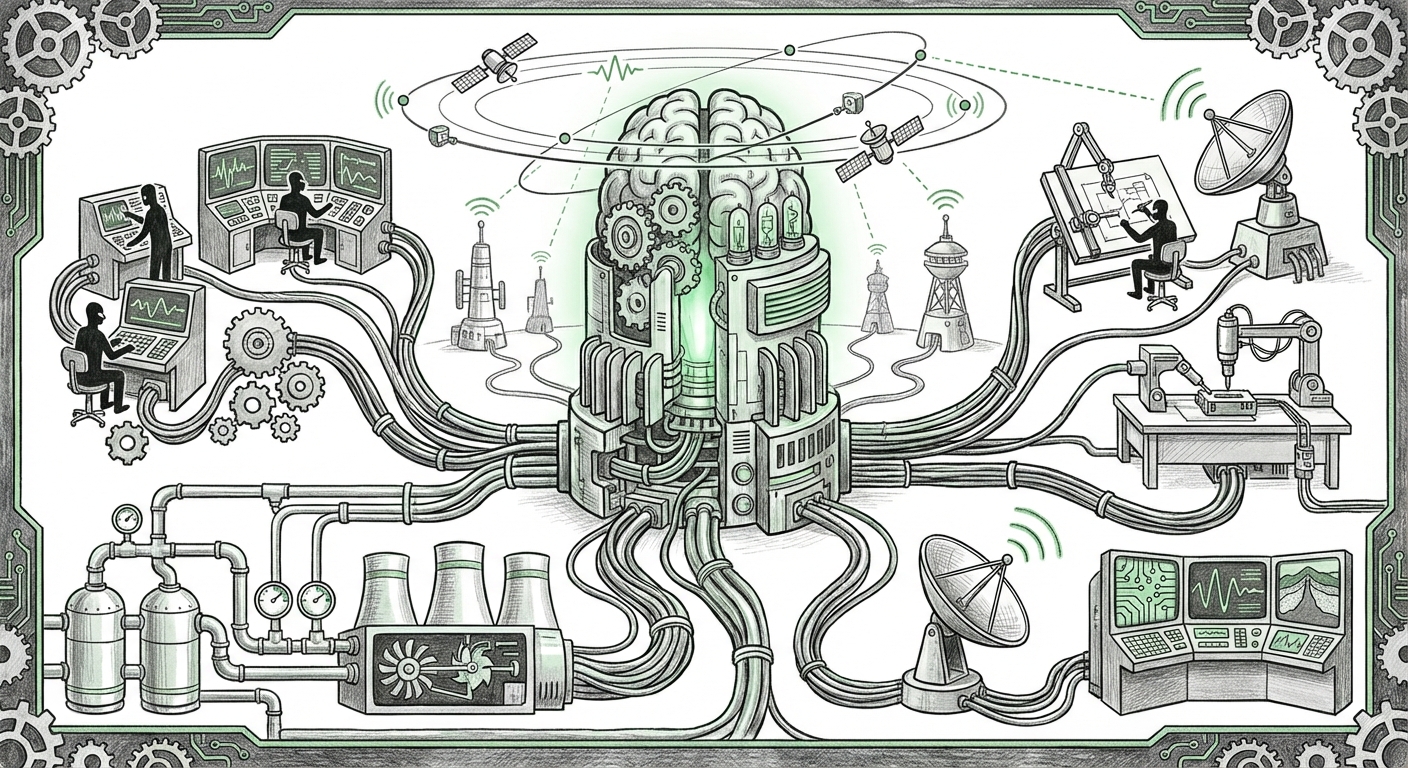
The latest weekly radar on AI developments points to a major inflection point: artificial intelligence is taking its industrial turn. That phrase, "AI's Industrial Turn", captures something profound happening right now in the technology world. After years of focusing on digital tasks like language and images, AI is stepping off the screen and into the physical world. It is heading to the factory floor, the supply chain, the power grid, the warehouse, and the field.
What does this shift mean for the future of AI? For businesses? For society? Let's unpack the trends and what they signal about where artificial intelligence is headed, and how you can prepare for it.
What Exactly Is AI's "Industrial Turn"?
The idea behind the industrial turn is simple: AI is growing up and getting a real job. The technology has spent its teenage years dazzling us with conversational tricks and creative parlor games. Now it is ready for the working world, and the working world is ready for it.
In practical terms, the industrial turn refers to AI's movement from purely digital use cases into physical, operational, and industrial use cases. Instead of writing a poem, AI is now inspecting a weld on a car chassis. Instead of drafting an email, it is predicting when a turbine will fail. Instead of generating marketing copy, it is optimizing an entire factory's energy consumption in real time.
This is not an entirely new idea. Industry has been using AI in some form for years, think predictive maintenance algorithms and quality-control vision systems. But the scale and sophistication of this latest turn are different. Several converging trends have pushed industrial AI from experimental projects into mainstream deployment, and the pace is accelerating.
The Forces Driving the Shift to Industrial AI
Why now? Why are so many companies and researchers making the industrial turn at this exact moment? A handful of powerful forces are converging.
1. The Limits of Screen-Based AI
We have reached a point of diminishing returns for purely digital AI applications. The low-hanging fruit of conversational AI has been picked. Businesses have discovered that a chatbot that writes good emails does not, by itself, transform a company's bottom line. To unlock serious economic value, AI needs to touch the real world, to move physical objects, control physical processes, and make physical decisions.
2. Better Hardware and Edge Computing
AI models can now run faster and closer to where the action happens. The rise of edge computing means a vision model can run on a camera attached to a robotic arm, making split-second decisions without waiting for a cloud server. Cheaper sensors, faster industrial networks, and more rugged computing hardware have made it practical to deploy AI in noisy, hot, dusty, and demanding industrial environments.
3. A Persistent Labor Challenge
Factories and warehouses around the world are struggling to find enough workers. Skilled welders, electricians, machine operators, and maintenance technicians are becoming harder to find. The industrial turn is, in part, a response to this reality. Companies are turning to AI-powered automation not because they want to replace workers, but because they cannot find enough of them in the first place.
4. The Push for Resilience and Reshoring
Recent global disruptions taught manufacturers a hard lesson about fragile supply chains. Many companies are bringing production closer to home, a trend called reshoring, and they are using AI to do it cost-effectively. AI helps factories run with less downtime, less waste, and more flexibility, making local production more economically viable than it has been in decades.
5. Maturation of Core AI Technologies
Computer vision has gotten remarkably good. Robots have gotten smarter and cheaper. Simulation environments allow AI models to be trained in virtual worlds before they ever touch a physical machine. These enabling technologies have matured to the point where the industrial turn is not just possible, it is practical.
What the Industrial Turn Looks Like in Practice
To understand where AI is heading, it helps to picture the actual applications taking shape across the industrial landscape. These are not speculative concepts; they are the concrete ways AI is being deployed on the ground.
Intelligent Manufacturing and Quality Control
Machine-vision systems now inspect products at speeds and levels of accuracy no human could match. A camera moving along a production line can detect a microscopic scratch, a misaligned component, or a weld defect in milliseconds. These systems learn from every inspection, getting better over time and flagging problems before they become costly recalls.
Predictive Maintenance
One of the most valuable applications of industrial AI is predictive maintenance. Rather than fixing equipment on a fixed schedule, or after it breaks down, AI monitors vibration, temperature, sound, and performance patterns to predict when a machine is likely to fail. Maintenance teams can then act before downtime occurs, saving millions in lost production. This is the difference between a fire alarm and a smoke detector: the goal is to catch problems early, not react to disasters.
Robots That Learn and Adapt
Industrial robots have traditionally been rigid machines that repeat the exact same motion thousands of times. The new generation of AI-powered robots is different. These robots can adapt to variations in their environment, picking up randomly oriented parts, navigating around unexpected obstacles, and working safely alongside human colleagues. Instead of being programmed by engineers, they learn through demonstrations and simulation.
Supply Chain Optimization
AI is turning supply chains into intelligent networks. Machine learning models process enormous amounts of data, weather, shipping delays, demand signals, inventory levels, geopolitical events, and recommend adjustments in real time. A disruption in one part of the world can be automatically rerouted, re-planned, and re-optimized before it ever becomes a crisis for the end customer.
Energy and Resource Efficiency
Industrial facilities are some of the biggest consumers of energy on the planet. AI is now being used to optimize energy use in real time, adjusting heating, cooling, lighting, and machinery schedules to shave costs and reduce carbon footprints. For companies under pressure to meet sustainability goals, this is one of the fastest ways to deliver measurable results.
What This Means for the Future of AI
So what does the industrial turn tell us about where AI is going over the next decade? Several important implications emerge.
First, the center of gravity in AI is shifting from cognition to action. The industry's biggest buzzwords are moving away from "large language models" and toward "embodied AI" and "physical AI." A model that can reason about the world is impressive, but a model that can act on the world is transformative. The future of AI will be defined less by how well it talks and more by how well it does.
Second, data will matter more than ever. Language models were trained on the vast expanse of the internet. Industrial AI, by contrast, depends on highly specific operational data, the hum of a particular compressor, the texture of a particular material, the workflows of a particular plant. Organizations that own the best industrial data will have a durable advantage over those that do not.
Third, AI will become deeply embedded in infrastructure. The industrial turn means AI will be woven into the systems that keep society running, electricity grids, water treatment, transportation, food production, manufacturing. It will be less visible than a chatbot, but far more impactful. The quiet intelligence running a power substation matters more than a hundred conversational assistants.
Fourth, safety and reliability take center stage. When a chatbot hallucinates a fact, the cost is embarrassment. When an AI-controlled robot makes an error, the cost can be injuries, damaged equipment, or environmental harm. The industrial turn forces the AI field to grow up in a hurry when it comes to safety, verification, and trust, and that rigor will eventually make all AI better.
What This Means for Businesses
For business leaders, the industrial turn is not abstract, it delivers real advantages for organizations that move early. Here are the most important practical implications.
The Value of an Industrial Data Strategy
Every company should be asking itself: What operational data do we already have, and how could AI help us use it better? The companies that will win in the industrial AI era are not necessarily the ones with the most advanced technology, they are the ones with the cleanest, most organized, most accessible data. Start by inventorying what data you already collect from machines, sensors, cameras, and operators.
Start Small, But Start Now
You do not need to overhaul your entire factory to benefit from the industrial turn. The most successful companies are choosing one high-value, well-scoped problem, a single production line, a single maintenance operation, a single quality-control step, and deploying AI there first. Prove the value, measure the results, and then scale.
Reskilling Is a Competitive Advantage
The industrial turn will change the nature of frontline work. Workers will be less involved in repetitive physical tasks and more involved in supervising, maintaining, and collaborating with intelligent systems. The companies that invest in reskilling their people, teaching them to work alongside AI rather than fear it, will build loyalty and capability at the same time.
Think About Human-AI Collaboration, Not Replacement
Despite the alarmist headlines, the most effective deployments of industrial AI put humans and machines on the same team. AI handles the tedious, dangerous, and data-intensive work. Humans handle judgment, creativity, unusual situations, and oversight. The companies that design for collaboration, rather than automation for its own sake, tend to see the best outcomes on both productivity and morale.
Prepare for a Culture Shift
Bringing AI into industrial operations is not just a technology project; it is a change-management project. Engineers who trained in traditional programming will need to learn new skills like data science and model maintenance. Operators will need to trust recommendations from a system they cannot see inside. Leadership will need to set clear expectations about what AI can and cannot do. The cultural adoption of AI is often the hardest part of the industrial turn.
What This Means for Society
The industrial turn of AI carries big implications for everyday life, even if most people will never see the machines that make it work.
For workers, this is a story of transformation rather than simple job destruction. Yes, some routine physical jobs will be automated away, but the skills shortage in manufacturing means industrial AI is often filling roles nobody can fill today. The bigger opportunity is the creation of new kinds of jobs: robotics technicians, AI operations specialists, industrial data engineers, and automation supervisors.
For consumers, the industrial turn should mean more reliable products, fewer shortages, lower costs, and more sustainable production. When factories run smarter, they waste less, break down less often, and respond faster to changes in demand, and those benefits eventually show up in price and availability.
For the planet, intelligent industry is an environmental win. AI-optimized energy use, reduced material waste, and more efficient logistics all shrink the environmental footprint of production. The industrial turn is not just an economic opportunity; it is one of the most practical tools we have for building a more sustainable economy.
Actionable Insights: How to Get Ready for the Industrial Turn
Whether you run a business, work in a plant, or simply invest in technology, you can take concrete steps today to prepare for the industrial era of AI.
- Audit your data. Identify the operational data you already capture and the gaps that would be worth filling with new sensors or instrumentation.
- Pick one high-value problem. Choose a single, measurable pain point, unplanned downtime, quality defects, energy waste, and build a focused pilot around it.
- Invest in people first. Train your existing workforce in AI literacy, data skills, and human-AI collaboration before you buy more technology.
- Demand real-world proof. Be skeptical of vendors selling flashy demos. Insist on deployments with measurable performance, reliability, and clear return on investment.
- Plan for safety and governance. Develop clear protocols for how AI decisions are made, reviewed, and overridden by humans, especially in environments where failures carry real physical consequences.
The Road Ahead
We are standing at an inflection point in the history of artificial intelligence. The first chapters of the AI story were written in server rooms, powering search engines, recommendation systems, and chatbots. The next chapters will be written on factory floors, in distribution centers, and across energy grids. AI is taking its industrial turn, and the turn is only just beginning.
The transition will not always be smooth. There will be technical challenges, workforce adjustments, and hard lessons learned. But the direction is unmistakable: AI is leaving the screen and entering the world. The organizations, communities, and individuals that understand this shift and prepare for it early will be the ones that thrive in the era of intelligent industry.
This is the moment when artificial intelligence stops being just a technology we talk to and becomes a partner we work with.