Distilled AI Models Explained: Why Smaller Is the Future of AI
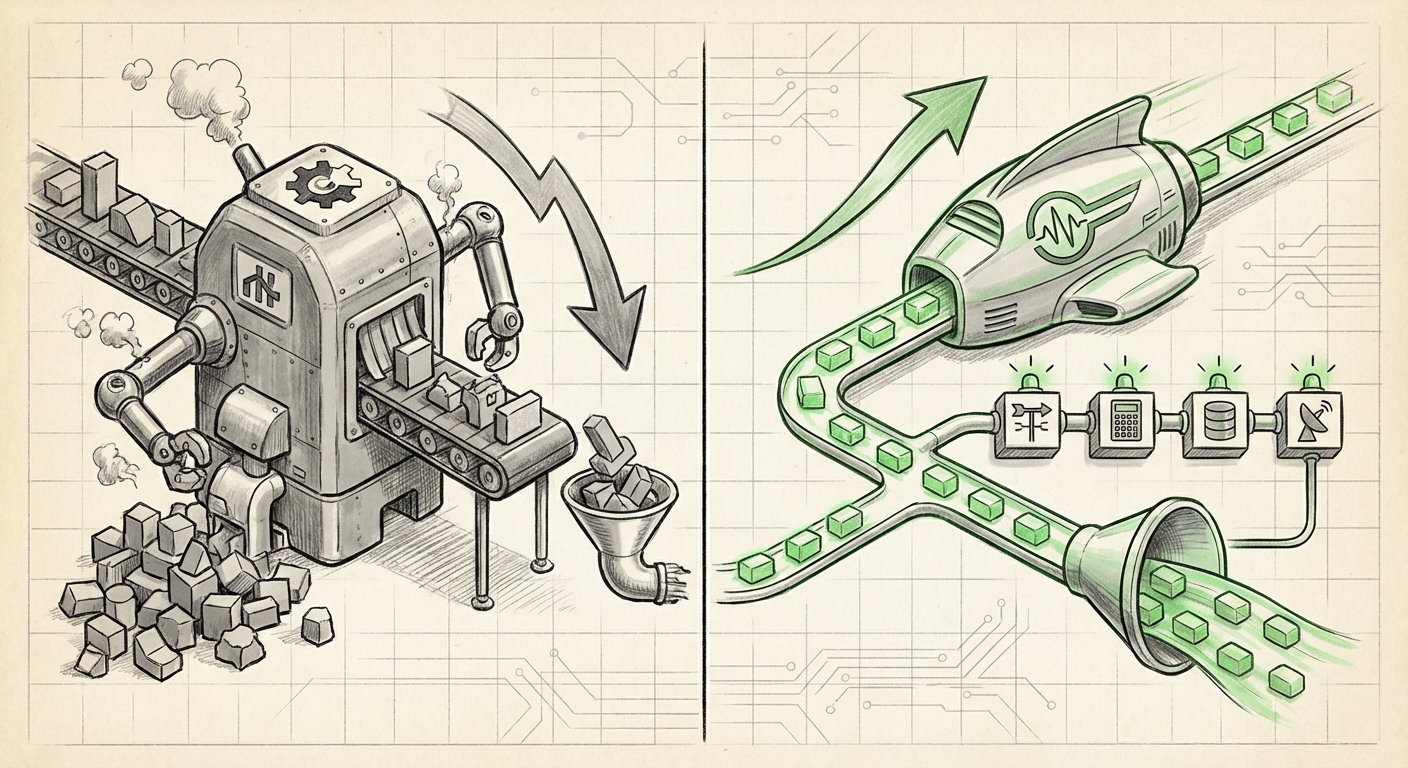
For years, the story of artificial intelligence has been a story about size. Bigger models. More data. More computing power. Every few months, another record-breaking "frontier" model would arrive, and the world would be amazed at what it could do. But something important has changed. In 2026, the most exciting trend in AI is no longer about building the biggest brain in the world. It is about taking a giant brain and squeezing it into something small enough to run on a phone, a laptop, or a factory machine. These compact intelligent systems are called distilled models, and they are reshaping the future of AI in ways every business leader should understand.
This article explains what distilled models are, why they have become so important, and what they mean for the future of AI and how it will be used. For anyone who follows AI, the takeaway is simple: don't only watch the big models. Watch the small ones. They are about to do most of the real work.
What Is a Distilled Model, Anyway?
Imagine the greatest teacher in the world. This teacher has spent decades learning, practicing, and mastering every detail of a subject. But the teacher is slow and expensive to hire. Now imagine that this teacher trains a young apprentice. The apprentice never reads every book or practices for decades. Instead, the apprentice learns from the teacher's experience and ways of thinking. In a surprisingly short time, the apprentice becomes almost as good as the teacher, while being much faster, cheaper, and easier to take anywhere.
That is the idea behind a distilled model. In AI, a huge "teacher" model is trained on enormous amounts of data. Then, instead of using that huge model directly, researchers use it to teach a smaller "student" model. The student doesn't just copy the teacher's answers. It learns the teacher's judgment, the confidence, the reasoning steps, the patterns of thought. This process is called knowledge distillation.
The result is a model that is dramatically smaller but surprisingly smart. It may not beat the teacher at everything, but it comes close, often within a few percentage points on everyday tasks, while costing a tiny fraction to run.
Why Distilled Models Are Suddenly Everywhere
Why are distilled models now one of the most important developments in AI? Because they solve the three biggest problems with large models: cost, speed, and privacy.
1. Cost
Running a frontier model requires massive servers and enormous electric bills. A distilled model can run on normal hardware. For businesses, this means an AI system that costs a fraction of the price can now handle the same workload.
2. Speed
Distilled models respond in milliseconds, and they can run entirely on a device with no internet connection. There is no waiting for a distant data center to think and reply.
3. Energy and the Environment
AI's hunger for electricity is a growing global concern. Distilled models use a fraction of the energy of large models. Greener AI is not a dream for the future; it is one of the main benefits of distillation happening today.
4. Privacy and Trust
Because small models can run directly on a phone, a car, or a store's computer, sensitive data never has to leave the device. That is a huge advantage at a time when privacy is both a legal requirement and a competitive edge.
The Distilled Models You Need to Know About: Five Key Trends
Model distillation has moved from a research trick to a standard practice. Here are the trends shaping what many are calling the era of the small model.
Trend 1: Distillation Is Now a Standard Stage of AI Development
Leading AI organizations no longer train one giant model and stop. They train a massive flagship model, then distill it into a whole family of smaller models designed for different jobs. Small has become the default product, while the giant model is the factory that creates it.
Trend 2: Small Models Are Closing the Quality Gap
Distilled models are now handling tasks that seemed to require the biggest models just last year, writing code, summarizing documents, answering customer questions, and analyzing images. The gap between teacher and student is shrinking so quickly that many users cannot tell the difference.
Trend 3: Little Models Are Learning to Think
Earlier distilled models mostly copied answers. Newer ones learn reasoning: planning, breaking problems into steps, and double-checking their own work. This matters because step-by-step thinking was the last stronghold of the biggest models. Now it is appearing in models small enough to run on a laptop.
Trend 4: Specialists Are Appearing Everywhere
Instead of one general-purpose assistant, builders are creating specialists. Distilled models are being shaped for medicine, law, coding, and different languages and cultures. Each specialist is small, focused, and cheap enough to be embedded directly inside an app. This is how AI enters design tools, spreadsheets, medical devices, and even kitchen appliances.
Trend 5: A Great Division of Labor, Teachers and Workers
We are moving toward a clear split in the AI world. A small number of frontier labs will run giant "teacher" models that push the boundaries of what AI can learn. Meanwhile, thousands of businesses will run small "student" models that do the actual work in real products. Distillation is the bridge that connects the two.
What This Means for the Future of AI
The rise of distilled models means the future of AI is not only about the smartest model in a laboratory. It is about the most useful model in your pocket.
First, it ends the "bigger is always better" era. Large models will still exist, and they will keep getting smarter. But they will become the research engines of the AI world, not the daily workhorses. The average app, website, and device will run on distilled models.
Second, it means AI everywhere. When a model is small, cheap, and fast, it can be placed inside almost anything. Your phone, your car, your smart speaker, hospital equipment, cash registers, warehouse robots, and factory sensors all become capable of intelligence. The future of AI is not a single super-intelligence in the cloud. It is thousands of small intelligences living in the objects around you.
Third, it democratizes AI. A start-up no longer needs millions of dollars in computing power to build a powerful AI product. Using distilled models, a small team can create useful and reliable tools that were impossible for anyone but the biggest companies just a couple of years ago. This is one of the most exciting possibilities: the next generation of AI inventors may not work at giant companies at all.
Practical Implications for Businesses
For business leaders, the rise of distilled models is not just a technology story. It is a cost story, a speed story, and a strategy story.
- Stop paying for more intelligence than you need. Many everyday business tasks, answering common questions, sorting emails, drafting responses, and summarizing meetings, simply do not require a frontier model. Distilled models handle these tasks almost as well for a fraction of the cost.
- Design hybrid systems. The winning approach is usually a mix: a small local model handles the hundreds of simple tasks, and only the hardest, most complex requests are sent to a large model. This kind of routing can cut AI costs dramatically while keeping quality high.
- Turn privacy into an advantage. Since distilled models can run on-device, customer data stays local. Businesses can use AI without the risk of sending sensitive information to the cloud.
- Move faster. Small models are easy to update and fine-tune. Instead of waiting for a giant model to improve, teams can improve their own small models using their own data whenever they want.
Actionable Steps to Take Today
If you want to prepare for the era of distilled models, start with these practical moves:
- Audit your current AI usage. List every task you automate, then sort those tasks by difficulty and volume.
- Test, don't assume. Benchmark distilled models against your current approach using your own data and your own real customer scenarios.
- Build a "model shelf." Keep a few small models ready and a smart routing system so you can swap in better models as they appear.
- Invest in evaluation. A strong test set will tell you exactly when a smaller, cheaper model is good enough for the job.
- Teach your team. Skills in fine-tuning and distillation will be among the most valuable AI skills over the next few years.
The Risks of the Small-Model Era
A balanced view requires honesty about the risks as well.
A distilled model inherits the limits of its teacher. If you rely only on small models, you may cap how good your AI can become, and you may be copying the teacher's flaws in the process. If everyone distills from the same handful of large models, the entire AI ecosystem risks becoming too similar. We could end up with an industry of sameness: the same blind spots, the same biases, and the same mistakes repeated across thousands of products. And because a student learns from the teacher's output, any error in the teacher tends to show up again in the students.
The answer is not to avoid distillation. It is to keep humans in the loop for important decisions, to demand strong testing, and to preserve an ecosystem where different approaches and different model sizes all have a place.
Conclusion: Small Models, Big Future
The big AI models captured our attention. The small AI models will do the work. Distillation is the distribution engine of the AI age: it takes everything the frontier has learned and delivers it into the real world, cheaply, quickly, privately, and at scale. The organizations that understand this shift early will not just save money. They will build products and experiences that were unimaginable just a few years ago. The future of AI is not only about the largest brains ever constructed. It is about the smallest pieces of intelligence, placed exactly where people need them.