Sam Altman Warns of "Unsustainable Silliness" in the AI Compute Boom, What It Means for the Future of AI
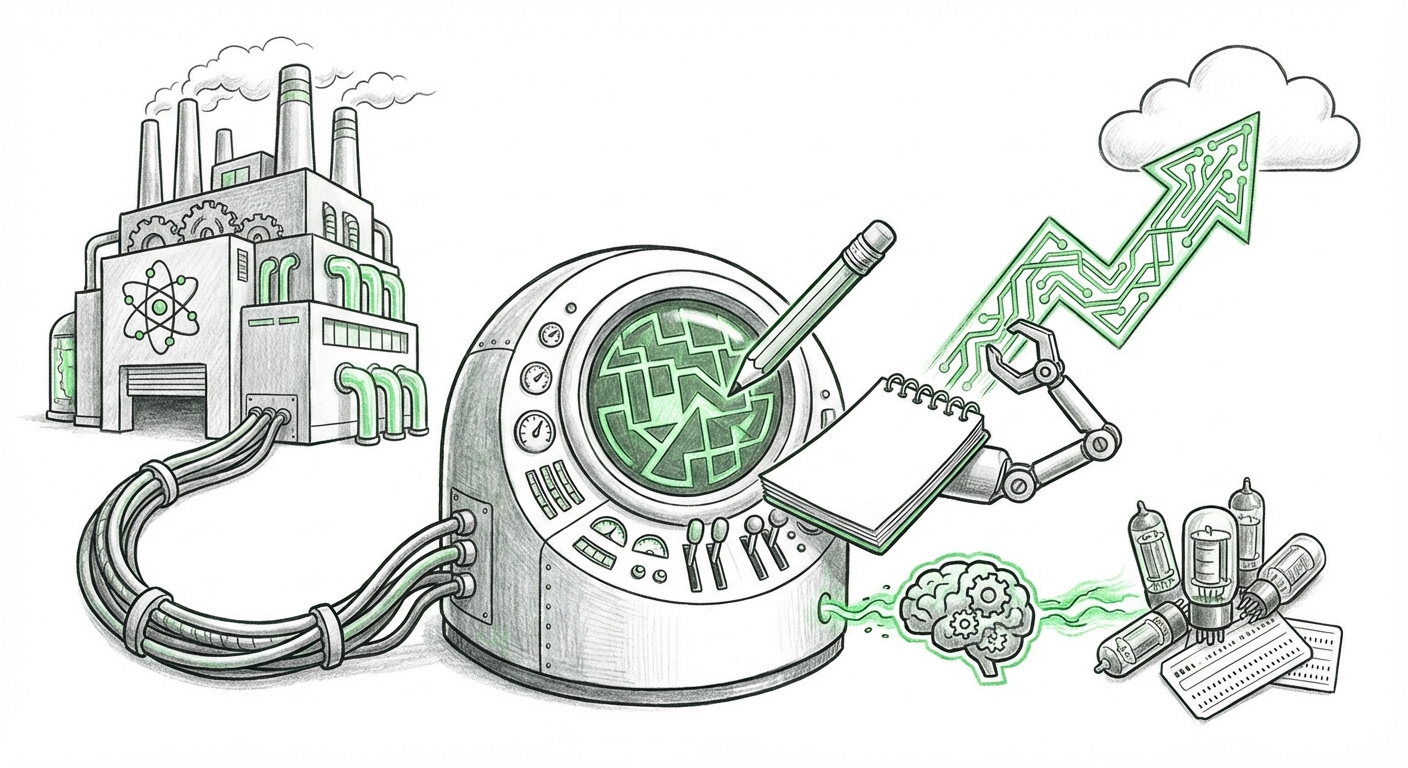
Imagine a world where cities are racing to build enormous airports, each one bigger and more expensive than the last, before anyone knows how many people will actually fly, which routes they will take, or whether planes might soon run on something completely different. That is the closest real-world analogy to what is happening right now in artificial intelligence. Around the globe, companies are pouring staggering amounts of money into "compute", the raw processing power that makes AI work, building giant data centers, securing electricity, and ordering chips by the truckload.
So when OpenAI CEO Sam Altman, one of the most influential people in AI and a driving force behind the boom, warns of "unsustainable silliness" in the compute buildout, the entire industry should pause and listen. This is not a skeptic on the sidelines. This is a leader of the race itself saying that parts of the race have become detached from reality. His warning touches on one of the most important questions facing technology today: Is the massive bet on AI infrastructure a brilliant investment in our future, or a bubble waiting to burst?
The honest answer is complicated. And understanding that complexity matters for every business leader, developer, investor, and everyday person who will be touched by AI in the coming years. Let's break down what this warning means, why it matters, and how it could reshape the future of AI.
What Exactly Is the "Compute Buildout"?
To understand the warning, we first need to understand the thing being warned about. In simple terms, compute is the brainpower behind AI. It is made up of specialized computer chips, usually graphics processing units (GPUs) and similar hardware, that are wired together inside vast data centers. These facilities train large AI models by showing them enormous amounts of data, and they also run the models when millions of people use them every day.
Over the past few years, these data centers have grown from large warehouses into something closer to small cities. They consume massive amounts of electricity, require elaborate cooling systems, and take years to build. Companies are competing to construct them at an almost frantic pace, because the underlying logic of the AI industry has been simple: the more compute you have, the more powerful your AI can be. Whoever owns the most compute, the thinking goes, wins the future.
Governments see it as a matter of national pride and security. Investors see it as the next gold rush. Tech giants see it as survival. The result is a global construction frenzy where the only question seems to be "how fast can we build?", not "should we?" That is precisely the attitude Altman is calling out.
Why Would One of AI's Biggest Builders Call It "Silliness"?
Altman is not against building compute. In many ways, his own company depends on it. So his choice of words is significant. When someone deeply invested in an industry uses a phrase like "unsustainable silliness," they are usually pointing at a few specific problems:
- Building far ahead of actual demand. Just like those imaginary airports, much of the current data-center construction is based on predictions about how many people will use AI in the future. If those predictions are even slightly too optimistic, the world could end up with far more compute than it can fill. Empty server racks do not make money; they burn cash and electricity while sitting idle.
- Duplicated effort everywhere. Many different companies are building similar facilities for the same customers. Rather than filling genuine gaps, they are trying to keep up with rivals. This kind of copycat behavior often leads to overbuilding across an entire industry at the same time, a classic recipe for a crash later.
- Efficiency keeps improving. AI researchers are constantly finding cleverer ways to train and run models using less compute for the same result. Software, algorithms, and chip designs all keep getting smarter. If today's enormous facilities become less necessary in a few years, some of them could become extremely expensive monuments to yesterday's assumptions.
- Speculation and hype feeding each other. When every new announcement about AI infrastructure makes headlines and drives up stock prices, the incentive to make even bigger announcements grows. At some point, the cycle is driven more by fear of missing out than by real customer needs. That kind of energy rarely ends well.
- Reality constraints. Power grids, land, water for cooling, and skilled workers are finite resources. Pushing too hard too quickly strains communities and the environment. There is a difference between ambitious and reckless, and Altman's warning suggests some builders have crossed that line.
None of this means AI itself is a bubble. It means the construction frenzy around it might be. And when leaders at the very top start admitting this publicly, it is a strong signal that a correction, or at least a serious slowdown, may be on the way.
The Other Side: Silly Today, Essential Tomorrow
Before we write off the whole buildout as madness, we should consider the counterargument. Much of the technology we rely on today looked ridiculous in its early days. The first railroads were mocked as expensive toys before they connected continents. Early internet companies spent fortunes laying fiber-optic cables that seemed wildly ahead of demand, and while many businesses collapsed, the network they built became the backbone of modern life.
There is a pattern worth remembering: new technologies are usually overbuilt before they are underbuilt. It is entirely possible that much of today's compute infrastructure counts as "silly" by current standards, yet becomes essential once AI capabilities mature. Altman himself has long argued that the world needs to take AI infrastructure seriously, precisely because intelligence could become one of the most valuable resources humanity has ever created. He has also been honest that being early often looks foolish right up until the moment it looks genius.
So his warning is probably not a rejection of big buildings and giant chip orders. It is more likely an argument about how the buildout is happening: too fast, too duplicated, too disconnected from measurable value. The difference between constructive ambition and unsustainable silliness is whether the investment is eventually justified by real products that real people actually use and pay for.
What This Means for the Future of AI Itself
If the compute buildout cools down significantly, the future of AI could take a fascinating turn. For years, the industry has mostly believed in a simple formula: throw more chips and more data at bigger models, and intelligence will keep scaling up. That formula has driven almost every major advance. But if infrastructure spending tightens, research may shift toward a different goal: doing more with less.
We could see a new era where the winners are not the companies with the most warehouses, but the ones with the smartest algorithms. Efficiency would become the crown jewel. Models would need to be trained with better data rather than just more data. Smaller, specialized AI systems that run on laptops and phones could become more valuable than gigantic one-size-fits-all models sitting in remote data centers. That would be excellent news for accessibility, since powerful AI would no longer belong only to organizations with billions of dollars.
At the same time, a slowdown could concentrate power. If frontier-level AI research becomes truly expensive and only a few players can afford the compute needed for the biggest experiments, those players gain enormous influence. We might see more sharing arrangements, where companies jointly own infrastructure the way nations partner on space stations. We might also see compute being treated more like a public utility, with governments stepping in to guarantee fair access.
Either way, the future of AI probably will not be decided by raw muscle alone. The era of building bigger for the sake of bigger is likely ending. The next era will reward builders who are both bold and disciplined.
What Businesses Should Do Right Now
For business leaders, this warning is a gift. It is permission to ignore the loudest voices telling you that you must spend your entire budget on AI infrastructure today or be left behind. The truth is simpler and more reassuring: your advantage will come from what you do with AI, not from how much compute you own. Here are practical steps to stay smart in a market that may be heading for a shakeout:
- Rent before you build. Unless AI infrastructure is literally your business, there is almost no reason to build your own data centers. Cloud services let you scale up and down as needs change. In a downturn, flexibility is survival.
- Tie every AI dollar to a real problem. Ask each project: Does this save money, make money, or improve the customer experience in a measurable way? If you cannot answer, do not spend.
- Avoid lock-in. Keep your options open by using tools and services that work across different providers. If prices crash, and they might, you want to be able to benefit.
- Invest in your data and your workflows. Unique data and well-designed processes are what make AI useful. They matter more than which chipmaker you chose.
- Prepare for both price drops and shortages. Scenario planning is your friend. Build flexible budgets that survive a boom or a bust in compute prices.
Above all, remember that many of history's most successful companies were built during or just after major technology corrections. When the hype fades, the quality of fundamentals becomes visible again. Businesses that focused on genuine usefulness will be standing when the dust settles.
What Society Should Watch Closely
The compute buildout is not just a business story. It is a story about energy, jobs, and fairness. Data centers consume electricity on a scale that can strain entire regional power grids, and communities are already debating whether the benefits are worth the cost. If parts of the buildout were "silly," a lot of that energy, and the environmental impact that comes with it, will have been spent creating little lasting value.
There is also a human cost to consider. Construction booms create jobs, but they create jobs with a short lifespan if the boom turns to bust. Communities that welcomed giant facilities with promises of prosperity could be left with empty buildings and broken promises. Meanwhile, the gap between those who can afford cutting-edge AI and those who cannot is already a serious concern. If a slowdown pushes prices down, AI could finally reach schools, small clinics, and local governments that were priced out of the revolution.
For everyday people, the practical takeaway is hopeful: the quality of the AI tools you use does not depend on how loudly companies boast about their construction plans. It depends on how well those tools solve problems in your life. A quieter, more disciplined compute market could actually produce more thoughtful, affordable, and trustworthy AI for everyone.
Signals to Watch in the Coming Months
How will we know whether Altman's warning is leading to real change or is just a momentary caution? Watch for a few telltale signs. Pay attention to whether the biggest builders start delaying or canceling projects, that is the clearest evidence that the message is being heard. Watch for new research breakthroughs in efficiency that allow models to be trained with significantly less power. Track the price of cloud compute; if it falls sharply, supply is outstripping demand. And most importantly, watch where the money flows next. If investment moves away from empty buildings and toward useful applications, health care, education, scientific discovery, customer service, then the industry will have learned the right lesson.
A slowdown in construction does not mean a slowdown in progress. It can mean smarter progress. The laboratories, the researchers, and the builders of useful products will keep going. What may change is the worship of size for its own sake. And honestly, that worship was never the point. The point was always what intelligence could do for people.
Building Smart Is the Real Future
Sam Altman's phrase "unsustainable silliness" may go down as one of the defining reality checks of the AI era. It is easy to get swept up in the excitement of enormous buildings, endless rows of glowing chips, and promises of superhuman intelligence. But the future of AI will not be decided by concrete and silicon alone. It will be decided by usefulness, trust, and imagination applied to real human problems.
The infrastructure being built today is not worthless. Far from it. Much of it will serve as the foundation for remarkable things we cannot yet imagine. But some of it will turn out to have been excessive, and there is wisdom in admitting that out loud. The leaders who can hold two thoughts at once, the future is enormous, and today is overshooting, are the ones who will guide us through the next phase.
The most important lesson is simple: build boldly, but build smart. Ask why before you ask how much. Measure value, not square footage. And remember that AI's true purpose is not to fill warehouses with processing power, but to enrich the lives of the people it serves. If that remains the compass, the future of AI will be bright no matter how many building projects get postponed.