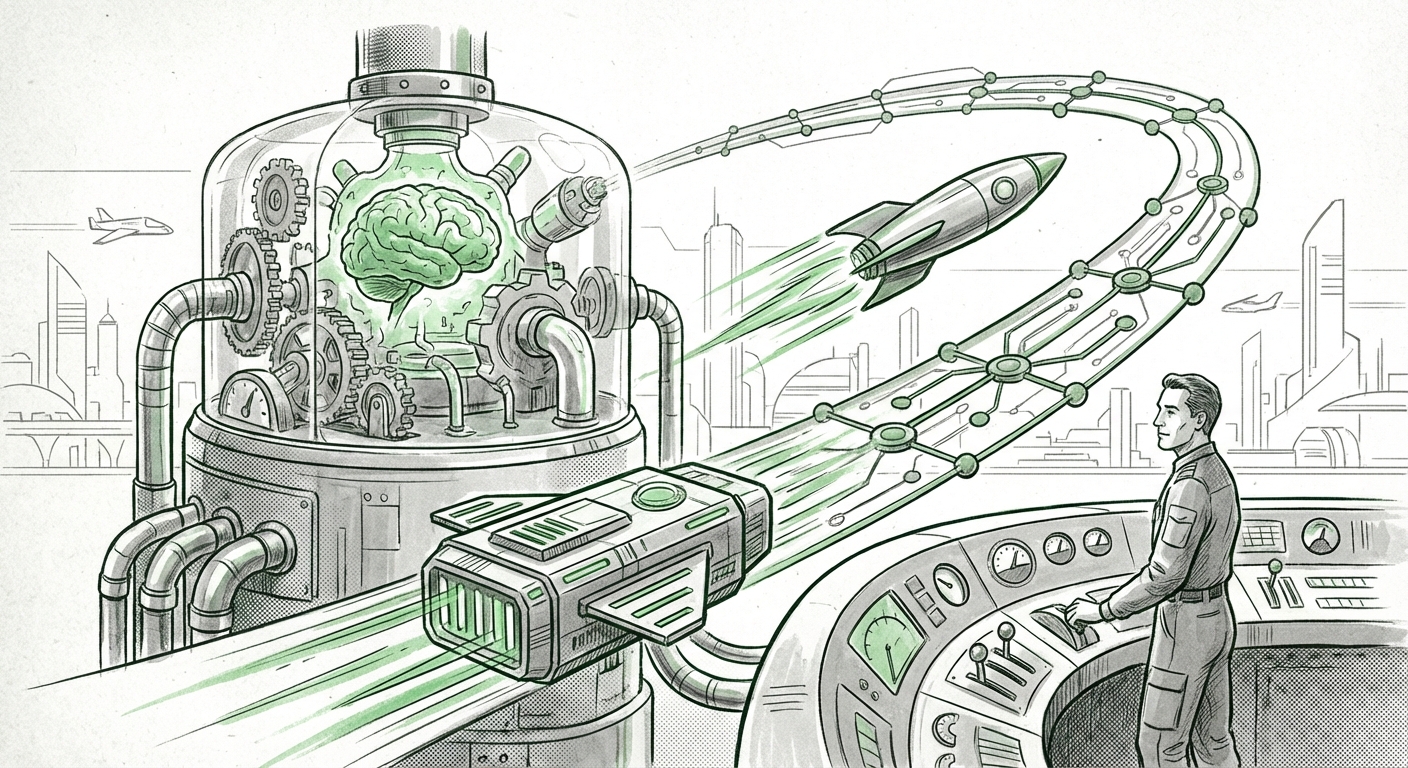
AI Moats in the Age of Scaling Laws: Why Raw Model Power Is No Longer Enough
Not long ago, the competitive story of artificial intelligence was remarkably simple: whoever built the smarter model won. That story is ending, and rather suddenly. In its place, a much harder question is taking over conversations in boardrooms and research labs alike, when almost every business can access roughly the same level of AI intelligence, what is actually left to fight over?
Part of the answer connects to a well-documented pattern researchers call scaling laws. In plain language, scaling laws describe what happens when you feed large AI systems more data and more computing power: their abilities tend to grow in steady, predictable steps. More ingredients, richer recipe, better result. That consistency is wonderful for human progress, but it is a nightmare for any company hoping to lock its advantage away behind closed doors.
Think of intelligence as a car engine. For a while, the winning move was clear, build something bigger and faster than your rivals. But if every mechanic in town can now build an equally powerful engine, and customers can buy one off the same shelf for about the same price, the race changes completely. The engine becomes the boring part. Victory moves to how the car handles, how comfortable the ride feels, and which destinations it can reach that other cars simply cannot.
Abundance Destroys the Old Playbook
This is the defining condition of the age of scaling laws: capability becomes abundant, and abundance is the natural enemy of competitive advantage. When a product becomes more commoditized with every doubling of computing power, the model itself quietly stops being a moat. By 2026, many of the most widely used AI systems already feel interchangeable to everyday users. Ask people which underlying model powers their favorite assistant and most will draw a blank. They are paying for the outcome, the well-written report, the faster diagnosis, the smarter supply chain, not the architecture producing it.
For customers, this abundance is mostly wonderful. Prices fall, quality climbs, and buyers gain a leverage they never enjoyed with traditional software. Suppliers face the opposite math. If a rival can ship a comparable model just a few months behind you, then momentary technical leadership is little more than renting a head start on expensive, borrowed land.
Why the Old Moat Strategies Are Crumbling
Much of the industry's early playbook was built around protecting the model itself. Keep the architecture secret. Control exclusive access to scarce hardware. Horde the world's most brilliant researchers. Each of those tactics still delivers some edge, yet the edge keeps proving temporary. People move between companies, research circulates, and clever techniques find their way into rival systems faster than ever.
Winning on secrecy in the age of scaling laws is like trying to keep a recipe hidden while cooking in a public square, knowledge escapes through too many open windows. The same pattern that lets everyone improve also guarantees that everyone's improvements eventually start to look alike. The things that cannot be replicated so easily are not technical at all. They are relationships, history, habit, and trust, and they all live outside the model.
The Moats That Actually Hold in the Age of Scaling Laws
So where does durable advantage actually get built? Looking at the businesses that have stayed sticky and profitable as the model layer commoditized, a consistent picture emerges. A real moat today is rarely a single asset. It is a cycle that strengthens with every use. Six strategies appear to matter most.
- The data flywheel: quietly getting smarter for each user. Every action a person takes with an AI system, every edit, correction, and moment of feedback, is a small lesson. A system that watches a doctor's decisions or an engineer's designs for months gradually learns their standards, vocabulary, and judgment in ways a generic competitor cannot. That history cannot be bought, downloaded, or copied. It can only be lived.
- Workflow integration: becoming the furniture of daily work. The strongest AI products rarely announce themselves as tools. They melt into routines. When a system becomes the place where work begins, the drafting, the scheduling, the code review, the diagnosis, leaving it costs time and energy that few users want to repay. Integration feels like comfort on the surface, but underneath it works like gravity.
- Distribution: owning the default position. In a world with many comparable models, visibility becomes decisive. The AI that is built into the tools people already open every morning will defeat the cleverer AI hiding in a separate tab. Selling a new AI product is hardest when you have to convince users to change their habits before they have ever experienced the value.
- Ecosystems: letting outsiders build walls for you. When third-party developers build on top of a platform, they extend its usefulness in directions the original creators never imagined. Every new integration raises the cost of switching for everyone involved. The platform becomes smarter and stickier precisely because it is surrounded by other people's ambition.
- Trust and accountability: the battery that takes longest to charge. In regulated fields like healthcare, banking, and government, trust is not a luxury. Institutions need auditable decisions, clear explanations, strong data protection, and providers who will still exist in a decade. Trust builds slowly, through boring consistency, and it is brutally hard to copy. It may prove to be the most durable defense of all.
- Real-world loops: data that only exists where you operate. Companies whose AI touches the physical world, warehouses, delivery fleets, energy grids, factory floors, collect information that purely digital rivals never see. These loops are narrower than the internet's open oceans of text, but they are deep, proprietary, and extraordinarily expensive to cross.
Notice what all six of these moats have in common. Each one grows stronger with usage. Each one converts ordinary daily activity into a compounding advantage that no amount of raw computing power can instantly erase. That is the crucial mental shift: in the age of scaling laws, defensibility is not something you build once and own forever. It is something you earn again every single day.
A New Formula for Defensibility
The arithmetic of competitive advantage has effectively been rewritten. The old formula said a moat equaled model quality plus secrecy plus scale. The new formula looks more like this: a moat equals the proprietary data you collect, multiplied by the depth of your workflow integration, plus the switching costs your users willingly accept, all compounding over time.
There is an even simpler way to spot a genuine moat in this era. Ask whether the product becomes noticeably better for a specific customer the longer that customer uses it. If the answer is yes, the moat is growing. If the answer is no, if every user gets the same generic experience on day one and day thousand, then a cheaper or flashier rival can eventually take that business away.
What Business Leaders Should Do Now
The strategic implications are urgent. Companies that still treat the model as their entire product are building on sand. Those that build the loop around the model are building for decades. Five practical moves separate the two groups.
- Sell outcomes, not architecture. Customers will not remain loyal to an engine they cannot see. They remain loyal to results: faster decisions, lower costs, fewer errors. Make the outcome the brand, not the underlying technology.
- Collect signals before they become scarce. Every interaction is a chance to learn something proprietary. Design products to capture feedback, corrections, and preferences openly and ethically, with clear consent, before those signals become the most valuable currency in your industry.
- Pick markets where data compounds. In crowded fields where every competitor reads the same public internet, advantage is thin. Vertical niches, a specific industry, profession, or geography, offer the chance to build deep, exclusive knowledge that no general model will ever match.
- Build switching costs users love. Memory, personalization, and saved context make a product genuinely more valuable the longer it is used. The goal is not to trap customers but to make leaving feel like losing their own history.
- Keep your model layer replaceable. Do not chain your entire business to a single AI provider. Architect your systems so models can be swapped, compared, and renegotiated. When the underlying intelligence becomes a commodity, the company that can buy it flexibly and integrate it deeply will hold the power.
What This Means for the Future of AI
If these trends continue, the future of AI will look less like a race to build one giant brain and more like a nervous system woven through the whole economy. The brain itself becomes something closer to a public utility, massively capable, widely available, and hard to monopolize. The real value shifts to the senses (the data), the reflexes (the workflows), and the organs (the industries and institutions that put intelligence to work). For society, this carries both promise and warning.
The promise is democratization. When frontier-level intelligence is affordable and accessible, a small startup can compete with giants on the strength of its ideas and its relationships rather than its compute budget. Innovation splinters outward into thousands of specialized applications that a single centralized lab could never imagine. The warning is concentration of a different kind: the companies that control the largest user surfaces may end up owning the accumulated memory of the digital economy, every preference, habit, and decision recorded over years. In the old era, whoever owned the best model won. In the new era, whoever owns the most trusted relationship may win even bigger.
That is why data portability, open standards, and honest competition rules matter so much for the next chapter of AI. The moats forming around proprietary histories are powerful and useful, but they must not become prisons. Society should encourage a future where users are free to leave a great AI service without surrendering the value of what they have taught it.
The Bottom Line
Scaling laws have handed the world an extraordinary gift, intelligence that keeps improving on a predictable schedule while its cost keeps falling. But that same gift quietly removes intelligence from the list of things that can protect a business. In the end, the future belongs to the organizations that surround powerful models with what cannot be downloaded: proprietary experience, daily usefulness, deep integration, and earned trust. In the age of scaling laws, your moat will not be inside the model. It will be in the life your customers live with it.