OpenAI Developer Says Astra Boosted Productivity by 6 Months: What It Means for the Future of Work and AI
Here is a number every business leader should sit with for a moment: six months.
When a developer at OpenAI recently described how an AI assistant called Astra changed the way they work, the most striking detail was not a benchmark score. It was not a percentage of time saved. It was time itself. The developer claims Astra boosted productivity so much that it pulled some plans forward by six months, compressing work that was expected to take far longer into a dramatically shorter window.
In the technology industry, six months is not a rounding error. Six months can be the difference between shipping first and shipping second. It can decide whether a company lands a major client, wins a standards battle, or gets remembered as the leader rather than the follower. And if stories like this become common, every roadmap, budget, and hiring plan we know will need a rewrite.
A comment like this deserves both excitement and healthy skepticism. One person's experience is not proof that every team will see the same gains. But even as an early signal, it tells us something important about where artificial intelligence is heading and how it will be used.
Why "Six Months Early" Is Different From "Ten Times Faster"
For years, companies have talked about AI productivity in terms of speed. "We wrote code twice as fast." "We created drafts in minutes instead of hours." These improvements are real, but they are also easy to ignore because speed alone does not always change the final outcome. A faster typist still ends up writing the same book.
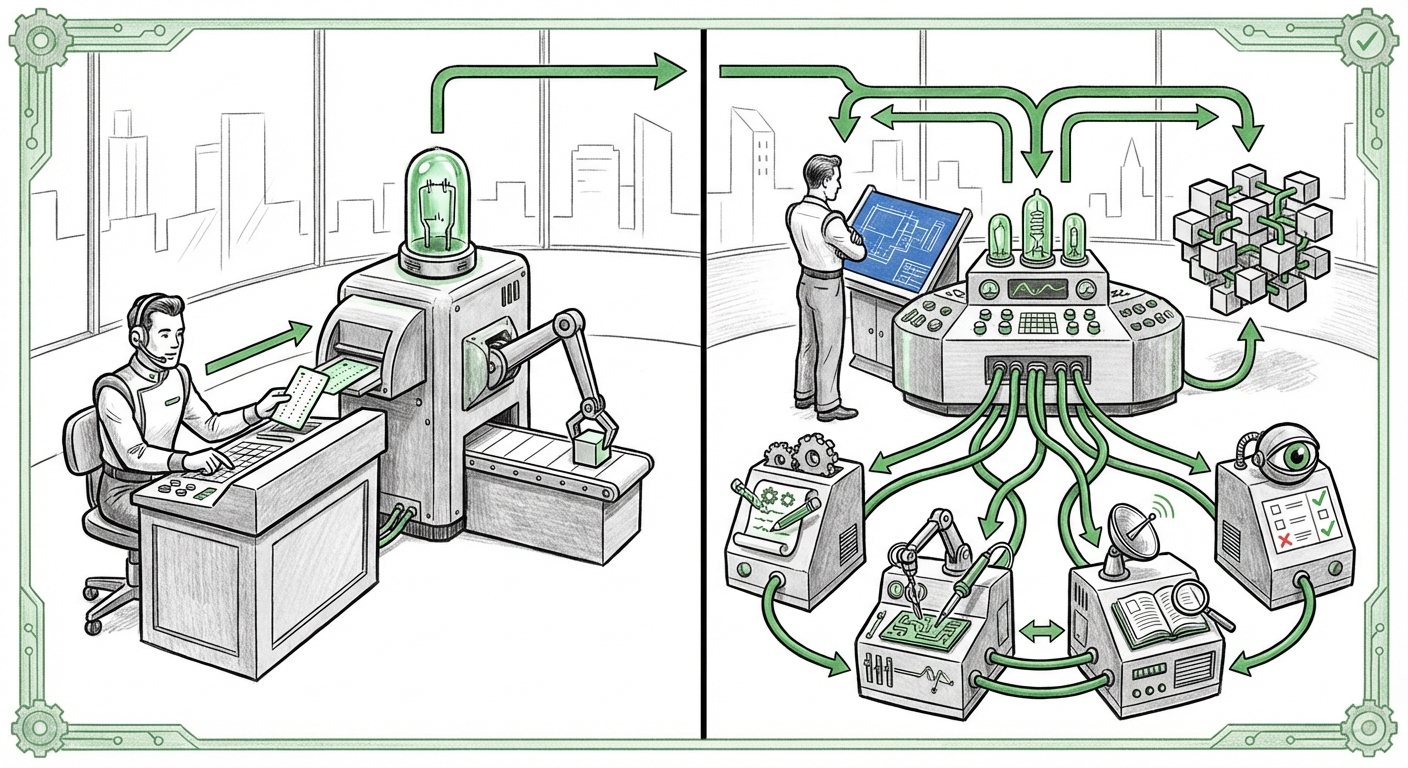
Moving a plan forward by six months is a different kind of claim. It is not just about doing individual tasks more quickly. It is about the whole sequence of work finishing earlier: research, design, building, testing, reviewing, and releasing. That only happens when bottlenecks disappear, not just keystrokes.
Think about how most projects really get delayed. Work does not take longer because people type slowly. It takes longer because people wait: waiting for approvals, waiting for answers, waiting for someone to check the work, waiting to understand a confusing requirement. AI tools like Astra appear to compress those waiting periods. They help developers explore options faster, generate quality drafts, catch issues early, and move from idea to working result without getting stuck.
The result is a schedule change, not just an effort change. And schedule changes affect everything downstream.
What Really Changes When Plans Move Ahead of Schedule
When an AI assistant pulls work forward by months, the effects ripple through an organisation in ways many leaders do not expect.
- Other projects move too. A team that finishes early does not simply stop. It starts the next thing on the list, which means the whole portfolio can shift forward.
- Deadlines become less certain in a good way. Plans no longer need to be built around how long humans take; they can be built around how quickly humans and AI can get there together.
- Competitive pressure rises. If one company can compress a two-year roadmap into eighteen months with AI, its rivals will feel forced to do the same.
- Planning assumptions break. Budgets, hiring plans, and marketing launches are usually anchored to fixed dates. Those dates may no longer hold.
This is why the OpenAI developer's claim matters beyond one team. It hints at a future where roadmaps become living documents, constantly pulled forward as AI capabilities improve. Instead of asking "When can we realistically deliver this?", teams may start asking "What could we deliver sooner if AI keeps getting better?"
What This Means for the Future of AI
If AI tools regularly help developers finish months ahead of schedule, the future of AI stops being about automation alone. It becomes about acceleration. And the most fascinating part is what happens when the builders of AI use AI to build AI.
OpenAI develops some of the most advanced models in the world. Its developers have access to frontier AI tools every day. If those same developers are using assistants like Astra to move faster, then the next generation of AI will be built by teams whose productivity has been supercharged. That creates a powerful loop: better tools lead to faster development, and faster development leads to even better tools.
People sometimes call this recursive acceleration. Each improvement in AI makes the next improvement come sooner. A developer who saves six months on one plan has more time to invest in the next breakthrough. Stack those gains across hundreds of projects and the entire field moves at a pace that traditional planning methods cannot track.
What does that future look like in practice? We are likely to see:
- AI assistants that do not just chat but complete. Instead of suggesting a solution, they implement it, test it, and explain it.
- Shorter feedback loops. Developers will catch problems in minutes, not in weekly review meetings.
- Smaller teams with larger output. A handful of people with strong AI tools may achieve what once required an entire department.
- Strategy dictated by AI maturity. Companies will time major launches not around fiscal quarters, but around what their AI systems are ready to do next.
The Business Ripple Effects Leaders Need to Prepare For
For business leaders outside the AI industry, this story is not just a curiosity. It is a preview of competitive dynamics that will reach every sector that builds software, runs operations, or serves customers digitally.
The first effect is on talent leverage. Historically, output was tied to headcount. If you wanted twice the work done, you hired twice the people. AI changes the equation by making every experienced employee dramatically more productive. Companies that invest heavily in AI adoption may find they need to hire less, or that they can take on ambitious projects without growing their teams.
The second effect is on time-to-market. If an AI-equipped competitor can compress its roadmap by months, it will reach customers first with new features and products. Being first still matters: it shapes brand perception, attracts early users, and sets the standards that latecomers have to follow.
The third effect is on planning culture. Most organisations are built around annual cycles: annual budgets, annual goals, annual reviews. An AI world moves in weeks and months, not years. Companies that refuse to update their planning rhythm will discover that their roadmaps are outdated almost as soon as they are printed.
The Risks Hidden Inside the Speed
For all the promise, we should not rush past the risks. A claim of six months of acceleration deserves scrutiny for a few reasons.
Quality can suffer in the sprint. When work moves faster, it is tempting to skip careful testing, security review, and user research. AI-generated output may look complete while still containing subtle errors. Every accelerated team needs even stronger review and quality practices, not weaker ones.
Verification becomes harder. When an assistant produces large amounts of work quickly, the bottleneck shifts to checking that work. Someone has to confirm that the code is safe, the content is correct, and the decisions make sense. If the human check becomes the new bottleneck, much of the time savings disappears.
Burnout is a real danger. A team that finishes one plan six months early will simply be handed another plan. If leaders treat AI speed as a reason to constantly raise expectations, employees may end up exhausted even as their output rises.
Anecdotes are not averages. This is one developer's story about one set of plans. It may reflect exceptional skill, unusually good tools, or a project that was well suited to AI help. The wise approach is to treat it as a promising signal, not a guaranteed outcome for everyone.
Actionable Advice for Leaders and Teams
So, what should you do with a story like this? Treat it as a map for experiments, not as a memo to copy. Here are practical steps to find your own version of the six-month gain.
1. Run a small, high-visibility pilot
Pick one project with clear milestones and hard deadlines. Give a strong team access to the best AI tools available, including assistants that can do work rather than just suggest it. Measure lead time from idea to delivery, and compare against similar past projects.
2. Measure cycle time, not just output
Track how long it takes to move a task from "started" to "done" and "reviewed." Reductions in cycle time are what create schedule compression. If you cannot measure it, you cannot manage it.
3. Make roadmaps flexible
Build plans that can be pulled forward. Rank work by value and keep a prioritized backlog ready so that when a team finishes early, they are immediately pointed at the next most important initiative.
4. Invest in review and governance
Speed without safety nets is a liability. Establish clear checkpoints for security, quality, and compliance. Make sure human experts review AI output where the cost of error is high.
5. Watch for burnout and reskill workers
The goal is sustainable acceleration, not a one-time sprint. Watch team load carefully, celebrate early delivery, and invest in training so more people can work effectively alongside AI. In an environment where everyone is expected to move faster, skills matter more than ever.
6. Ask the strategy question
Every leadership team should now ask: "If AI let us deliver our top three projects months earlier, what would we do with that time?" If you cannot answer that question today, you are not ready for the future this story points toward.
The Big Picture: Speed as a Strategic Decision
AI will not just make software smarter. It will make the teams that build software faster at every stage of the journey. The OpenAI developer's experience with Astra is an early, visible example of something that is probably happening quietly inside many companies: artificial intelligence is changing not only what gets built, but when it gets built.
Six months might sound like a simple scheduling detail. It is not. It is the difference between entering a market with a strong product and entering after the window has closed. It is the difference between setting the standard and chasing it. It is the difference between a roadmap that feels safe and one that feels exciting.
For business leaders, the lesson is urgent. Stop asking only "How much money does AI save?" Start asking "How much time does AI return to us, and what will we do with it?" The organisations that win the AI age will not necessarily be the ones with the biggest models or the largest data centres. They will be the ones that treat speed as a strategic asset, build flexible plans, and put their people in a position to compound early wins into lasting advantages.
The age of cautious experiments is ending. When a single developer can credibly claim that an AI assistant moved plans forward by six months, every company should wonder whether its competition is already taking that risk. The safest response is not to wait. It is to run the experiment yourself, measure honestly, and ask your own teams one simple question: What could we deliver sooner if we let AI help?