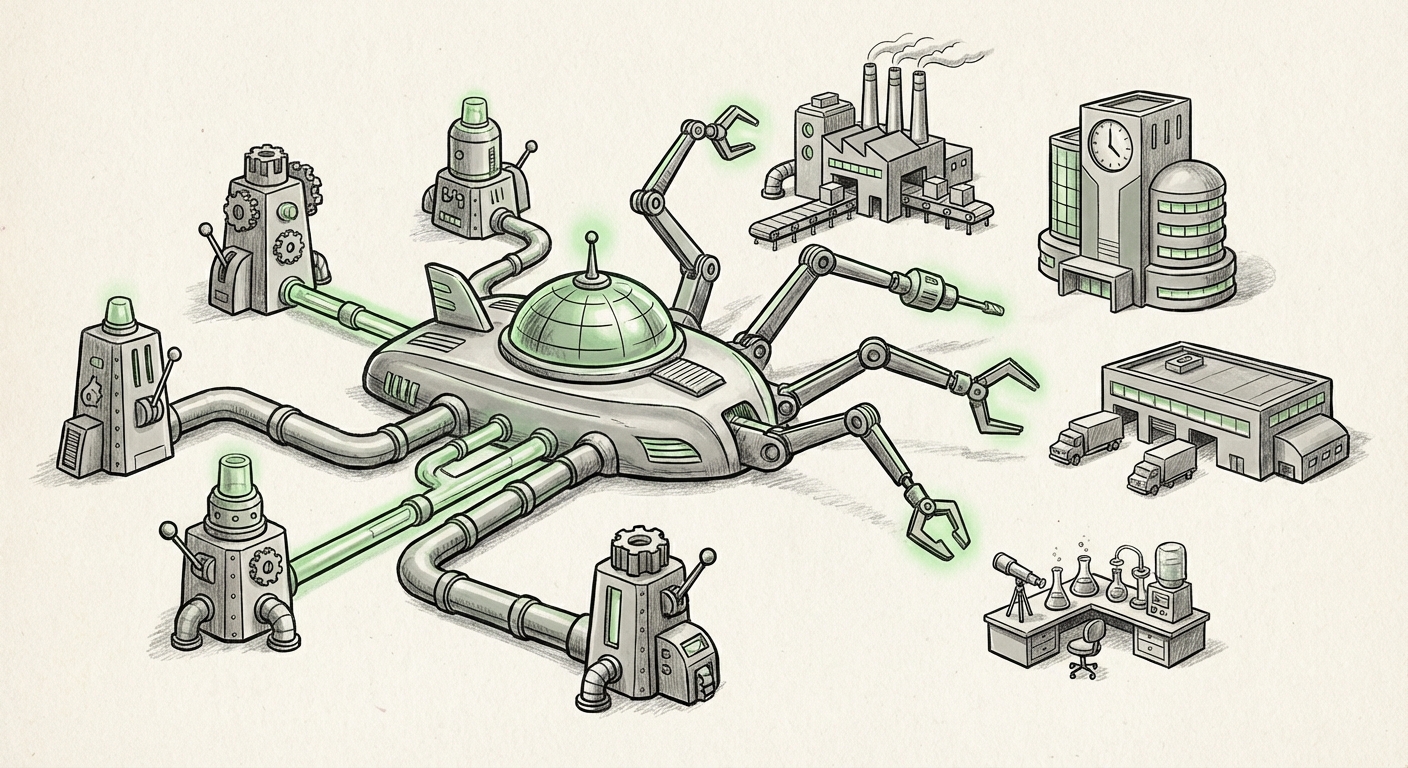
AI Wiped Out an Entire Industry in Nairobi, What That Means for the Future of Work Everywhere
Every few years, a new technology comes along that feels like a miracle. Every few generations, one arrives that behaves more like a storm. Nairobi, the beating heart of East Africa's fast-growing technology scene, is still picking through the wreckage of the most recent storm, and the rest of the world should be paying very close attention.
In a remarkably short window of time, an entire industry in the city simply ceased to exist. No factory burned down. No government banned it. No bank pulled its funding. Instead, something far more unsettling happened: artificial intelligence quietly learned to do the work better, faster, and at a fraction of the cost. The industry did not decline. It was erased.
This is not a story about one faraway city's misfortune. It is a preview of a global shift that is already moving toward every connected economy on Earth. To understand where AI is taking us, we first need to understand exactly what Nairobi had, and why it lost it so completely.
The Industry That Disappeared
For the better part of a decade, Nairobi had built a reputation as one of the developing world's most reliable sources of digital talent. The city earned its nickname as a technology hub by attracting a very specific kind of work: the world's digital chores. Young, educated, english-speaking workers filled their days labeling photos so self-driving vehicles could learn to see the road, transcribing voice recordings into text, moderating social media posts, answering customer emails for brands on other continents, and converting messy paperwork into tidy data.
On the surface, these jobs were modest. But underneath, they formed something powerful: a ladder. For thousands of families, that work paid school fees. It funded rent. It created a generation of young professionals who had looked for stable jobs for years and finally found them, not in an office tower, but through a laptop, a decent internet connection, and a global marketplace for tasks that machines could not yet handle.
That last detail turned out to be the catch. The industry existed only because AI was not yet good enough to do the work. The moment that changed, the foundation of the entire industry changed with it.
Why Nairobi Was Hit First, and Hit Hardest
The wipeout did not happen because Nairobi's workers were lazy. It happened because of three forces that lined up perfectly, and any city with a similar profile should consider itself warned.
First, the work was task-shaped. AI improves fastest on jobs that can be broken into small, repeatable, measurable pieces. Reading a receipt, sorting an email, answering a simple question, tagging an image, these are exactly the kind of discrete tasks that modern AI systems handle effortlessly. The industry in Nairobi was built on millions of tiny tasks. That made it a perfect target.
Second, the clients were far away. The companies buying Nairobi's digital labor were scattered across the globe. They had no emotional attachment to any particular neighborhood or workforce. When AI tools became cheaper and more consistent than human contractors, those distant buyers simply switched. There were no local factories to occupy, no local laws to slow the change, and no relationship strong enough to resist the cost savings.
Third, the timeline collapsed. Similar upheavals in history took decades. This one took quarters. One season, the contracts were flowing. A few months later, the flow slowed to a trickle. Language AI improved by leaps, suddenly able to speak, write, summarise, and translate with startling accuracy. Buyers who once hired human teams to hold customers' hands began to realize that software could handle entire conversations without ever sleeping, taking a break, or asking for a raise.
Most painful of all, some of the workers in Nairobi had been doing the grunt work that helped train those very AI models. They were the ones carefully labeling data so the machines could learn. They were, in a very real sense, building the tools that would eventually take their seats.
A Warning Written for Every Connected City
It is tempting to file the Nairobi story away as an African problem, something that could never happen in economies with stronger regulations, better education systems, or more established companies. That would be a dangerous mistake.
For decades, the global economy ran on a simple habit: companies moved work to wherever human effort was cheapest. Call centers went overseas. Data entry went overseas. Software development and design followed. It was a reliable system, but it quietly trained the entire business world to treat work as a commodity that could be bought and sold across oceans.
AI breaks that system in both directions at once. It doesn't just make cheap labor cheaper. It makes the labor itself unnecessary. If a machine can read a document, summarize a meeting, answer a client, or write a first draft of code for pennies, then it no longer matters whether the human alternative costs fifty dollars an hour in one country or five dollars a day in another. The economic logic of sending work across borders evaporates.
This is the deeper meaning of what happened in Nairobi. The city wasn't punished for being weak. It was punished for being perfectly connected. Its workforce was plugged directly into the global digital economy, which meant it was also plugged directly into every new advance in AI. The same openness that created the industry is what allowed the machine to swallow it whole.
Other hubs around the world, cities that handle outsourcing, remote customer support, freelance design, transcription, translation, and entry-level coding, are now staring at the same future. The Nairobi lesson is that the buffer of time people once assumed would protect them is thin. When a technology improves by leaps rather than steps, the ground can shift beneath an entire profession before its members have even agreed on what is happening.
What This Means for the Future of AI
So where does this leave us? The Nairobi catastrophe clarifies what the coming era of AI actually looks like in practice.
The future of AI is task elimination, not just task assistance. Early conversations about AI focused on how it might help people work faster, a suggestion engine here, an autocomplete there. The Nairobi story shows the more disruptive reality: when AI reaches a certain quality threshold, it stops being a helper and starts being a replacement. Entire categories of work can be automated at once, not one task at a time.
AI will compress time in every industry. What used to take a generation of economic pressure will now happen in a couple of years, sometimes months. Businesses are already learning to deploy AI that can handle whole workflows, not just answer a question, but receive an order, check availability, update a database, and send a confirmation. Each of those steps was once a human job somewhere in the world. Each of those jobs is now software.
Human value will flip toward judgment, presence, and trust. As machines get better at doing, humans will be rewarded for deciding. Employers will pay for people who know which questions to ask, which projects are worth pursuing, and which automated results can be trusted. They will pay for people who can show up in person, build relationships, calm a nervous customer, or fix a machine that breaks. In other words, the future belongs to work that cannot be delivered through a screen and measured by a checklist.
There will also be an explosion of new work around AI itself. Someone has to choose the training data, test the outputs, check for bias, adapt the tools to local languages and customs, and explain the results to nervous board members. The catch, and it is a cruel one, is that these new roles require more skill than the roles being eliminated. The workers who lose simple digital jobs do not automatically slide into complex AI careers. That gap between what is destroyed and what is created is the real challenge of the next decade.
What Comes Next for Nairobi
It would be easy to end the story there, with a city in mourning and a global warning issued. But the Nairobi that emerges from this upheaval matters just as much as the Nairobi that was lost.
The physical city did not disappear. People still need to move around, eat food, build homes, teach children, and care for the sick. Service jobs that require a human body in a human place remain largely intact. The tragedy is narrower than it feels: it is concentrated in the digital-gig layer that once seemed so promising. Still, concentrated pain is still pain, and the young professionals who invested years in skills that a machine now performs face a brutal question: what do I do with myself?
Early answers are emerging. Some workers are learning to operate the very AI tools that replaced them, offering themselves as supervisors of automated systems rather than performers of manual tasks. One skilled person can now manage a fleet of AI agents doing the work that once required a whole team, and companies are paying for that oversight because machines still make mistakes and still need a human who can take responsibility.
Others are pivoting toward work that depends on being local: training AI to understand Kenyan languages, accents, humor, and social context; building technology services for businesses in their own neighborhoods; and moving into hands-on trades that software cannot touch. None of these paths is easy, and none absorbs everyone. But they point to the shape of a possible second act.
What Businesses Should Do Right Now
The Nairobi story is not just a lesson for workers. It is a practical warning for every company that employs people to do digital tasks, and for every business that depends on such companies.
Start with an honest audit. Walk through your organization and ask a simple question: which jobs are performed entirely on a screen, following a defined process, producing a measurable result? Those are the roles most exposed to AI. You need to know where you stand before the market forces you to find out.
Next, shift your business model from selling time to selling outcomes. A client does not actually want to buy forty hours of your team's effort. They want their invoices processed, their customers satisfied, their content published. If AI can deliver that outcome faster and cheaper, the client will take it. Your job is to be the one who assembles the best mix of humans and machines to produce that outcome, not to defend a particular number of human hours.
Then invest aggressively in reskilling. The worst response to automation is to quietly lay off workers and hope the problem disappears. The better response is to treat every employee as someone who can be upgraded to work alongside AI. A customer-service agent who learns to handle the difficult cases while the bot handles the routine ones becomes more valuable, not less. A data analyst who learns to question the machine's conclusions becomes an asset no software can replace.
Finally, keep a human in the loop for anything that touches reputation, safety, or legal risk. AI can draft a contract, but a human should decide whether to sign it. AI can apologize to an angry customer, but only a human truly understands what went wrong. The organizations that thrive will be those that treat AI as a powerful junior partner, not as an unsupervised replacement for judgment.
What Governments and Communities Should Do
Societies cannot leave this transition to individual workers alone. The Nairobi wipeout shows what happens when the digital economy shifts faster than the social safety net. Communities that want to avoid the same fate need to act before the next wave hits.
AI literacy must become as basic as reading and writing. The next generation will not just use these tools; they will direct them. Schools should be teaching students how to prompt, question, verify, and critically evaluate AI output. The goal is not to make every child a programmer. It is to make every child the kind of person who can command machines instead of competing with them.
Safety nets need to be redesigned for a world of sudden job loss. Programs that tie support to a long employment history assume a stability that no longer exists. Portable benefits, direct support during retraining, and help with the cost of switching careers are not luxuries; they are the shock absorbers that keep a bad year from becoming a lost generation.
And local economies need to build ownership rather than mere participation. A city that only provides cheap labor, digital or otherwise, will always be vulnerable to the next leap in automation. A city that owns its AI tools, trains its own models, runs its own data centers, and builds services for its own people has a far more stable footing. Nairobi built one successful industry on borrowed global platforms. Its next industry should be built on its own ground.
The Pattern Beyond Nairobi
Look closely, and you can see the same pattern forming in other places. Coastal cities that built entire economies on call centers and back-office work are watching their pipelines thin. Freelance platforms are filling with far fewer simple gigs and far more AI-assisted projects. Even in wealthy countries, armies of remote workers in marketing, design, law, and accounting are quietly wondering how many of their tasks the machine has already mastered.
Nairobi matters because it happened there first and fastest. The city's digital workforce was young, connected, and perfectly matched to the strengths of modern AI, which made it the perfect early test site. The rest of the world has been given the rare gift of seeing the future in advance. Whether we use that gift wisely is entirely up to us.
The storm that hit Nairobi will reach every shore. The only question is whether we will have built shelters, learned to rebuild, and trained a generation to dance in the rain.
A Practical Path Forward
If you take only a few things from this analysis, make them these:
- Expose yourself. Every digital task you perform, or manage, is a candidate for automation. Figure out which of your tasks are routine patterns, and which require judgment that only you can supply.
- Become the supervisor, not the worker. The job of the future is directing, checking, and improving AI output. Start practicing those skills now, even informally, before you need them in a hurry.
- Invest in what a machine cannot do. Relationships, presence, empathy, physical skill, creative vision, and ethical judgment become more valuable as software absorbs routine work. Double down on those strengths.
- For business leaders: automate before your competitors do, but treat your workforce as an asset to upgrade, not a cost to cut. The companies that treat this transition as a team sport will win the next decade.
- For policymakers: move at the speed of technology. Waiting for a perfect plan means arriving after the damage is done.
A New Kind of Future
An entire industry in Nairobi was wiped out by artificial intelligence. That is a fact, and it should not be softened. Behind every lost contract is a young person who did everything right, learned the skills, showed up on time, delivered quality work, only to be outcompeted by software that never sleeps.
But the last chapter has not been written. The same technology that erased an industry is now making tools so powerful that a single determined person can do what a whole department once did. The city that lost its digital assembly line can become a city of digital engineers. The workers who lost their task-based jobs can become the people who decide which tasks are worth doing at all.
The future of AI was never going to be simply about machines. It was always going to be about what humans decide to do with the enormous power those machines place in our hands. Nairobi lost a battle. The war between human potential and human complacency is still being fought, and its outcome will shape every city, every company, and every career on this planet.
The machine has arrived, and it is not going back. The only meaningful question left is whether we will be its victims, its servants, or its masters. The answer will not be decided by the technology itself. It will be decided by the choices we make in the years ahead.