The Missing 5%: Why AI Distillation Is Harder Than It Looks, and What It Means for the Future of Smaller, Cheaper Models
There is a dream that keeps coming up in the world of artificial intelligence. It goes something like this: take the most powerful AI model on the planet, squeeze its brain into a package a hundred times smaller, and put that little model on a phone, a laptop, a factory robot, or a hospital workstation. Big-model intelligence, tiny-model cost. No cloud fees. No internet needed. Total privacy. AI for everyone.
That dream is built on a technique called knowledge distillation. And for many years, it has genuinely worked, up to a point. Distilled models routinely get close to their much larger teachers. They are fast, cheap, and surprisingly capable.
But "close" is not "equal." A stubborn gap remains. It is often described as the "missing 5%", the slice of performance that a student model just cannot seem to learn from its teacher, no matter how clever the training recipe. And here is the uncomfortable truth that is finally getting the attention it deserves: that missing 5% is not a small problem. It is the difference between "good enough for demos" and "trustworthy enough for the real world." It is also a window into why distillation is harder than it looks, and why the next phase of AI's future will be defined less by how big we can build models, and more by how much of that size we can safely give away.
The Dream of a Giant Brain in a Tiny Body
To understand what all the fuss is about, it helps to understand why distillation feels like magic in the first place.
AI models today are enormous. They are trained on vast amounts of text, images, code, and sound, using billions of parameters, the internal knobs that store what a model knows. The biggest models cost tens of millions of dollars to train and require enormous data centers just to answer your question. That is fine if you are a tech giant running a search engine. It is not fine if you are a small clinic that wants to analyze patient notes offline, or a tractor manufacturer that wants an assistant to work in a field without signal.
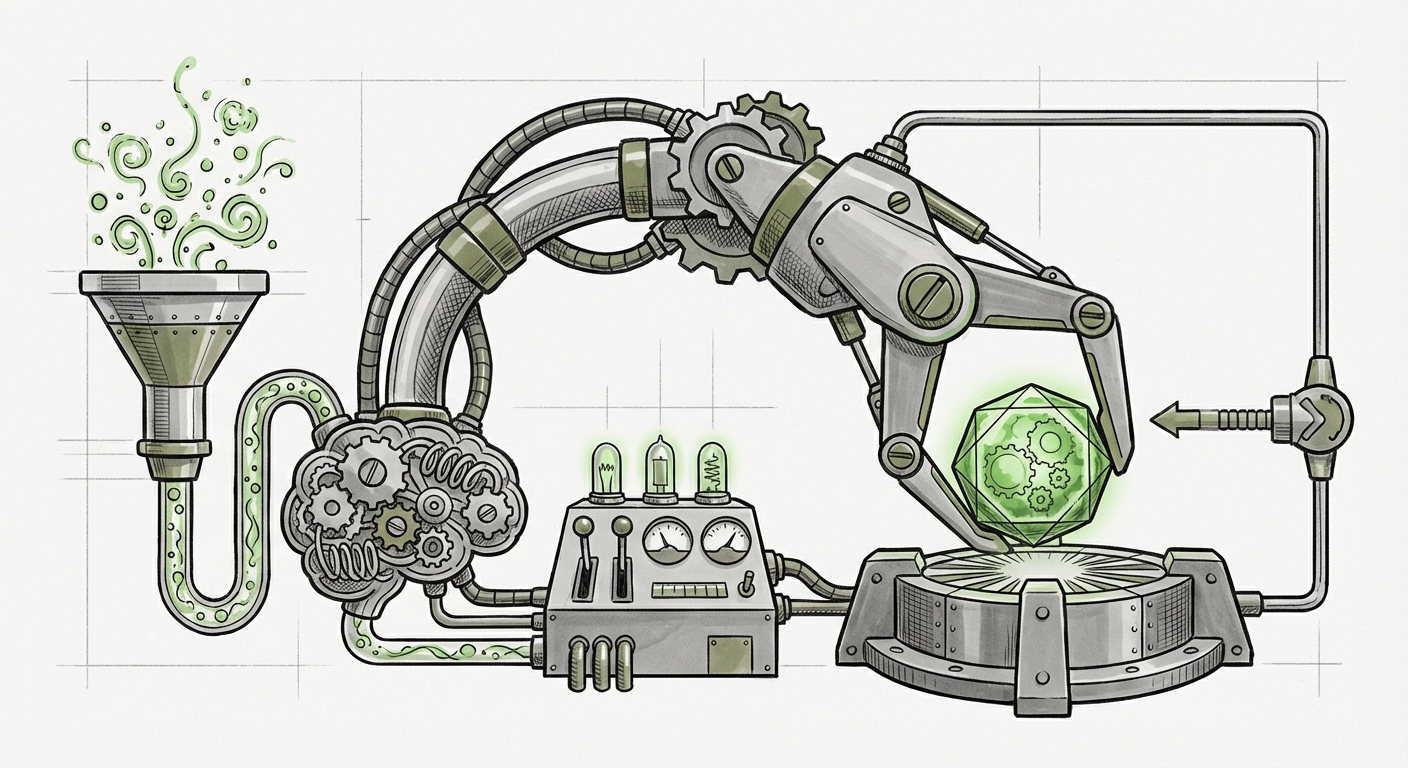
Distillation is the compression trick that makes this possible. The idea is simple: instead of teaching a small model directly from raw data, you let it learn from a big model's answers. The big model is the teacher. The small model is the student. The student studies thousands of examples of the teacher's best work and tries to imitate it. Over time, the student learns to produce similar answers, but with a fraction of the size and a fraction of the computing power.
Why does this work so well? Because the teacher does more than give correct answers. A great teacher reveals its thinking. When a large language model predicts the next word, it doesn't just pick one option, it carries a whole cloud of possibilities with precise probabilities. "Dog" might be highly likely, but "puppy," "pet," and "animal" are lingering nearby. That soft, detailed feedback is a goldmine. It tells the student things like: these two words are related, this concept connects to that one, and some wrong answers are more wrong than others. Raw data alone never offers that kind of guidance.
When it works, the results are genuinely impressive. Small models trained through distillation can run on hardware that would choke on their teachers. They respond quickly, use less electricity, and can live entirely on a device. They make AI more private, more affordable, and more democratic.
So where does the missing 5% come in?
The Stubborn Gap Nobody Can Quite Close
Here is where the story gets complicated. Again and again, researchers and engineers watch the same pattern unfold. They take a large, highly capable model. They distil it down into a smaller student. The student scores well on benchmarks. It handles everyday questions with ease. Then they probe deeper, testing the student on tricky reasoning, unfamiliar situations, and edge cases that require genuine judgment. And they find the same thing: the student has lost something, the last few percentage points of accuracy, the final layer of nuance, the subtle judgment that separates a merely good answer from a truly great one.
That loss is what practitioners have come to call the missing 5%. It is not a scientific term with a fixed number. In some tasks the gap is smaller than 5%. In others, it is much larger. But the phrase captures something real: distillation tends to produce models that are almost as good as their teachers, yet never quite there, and the closer you try to get to that final 5%, the harder every additional step becomes.
This matters more than it might seem. A 5% drop sounds small on paper. In practice, it can mean an AI assistant that confidently answers a patient's medical question incorrectly. It can mean a self-driving system that handles 95% of intersections perfectly and then hesitates at the one that truly matters. It can mean a code assistant that writes elegant functions but quietly introduces a security flaw. The missing 5% is where trust goes to die.
And the deeper problem is that distillation is harder than it looks not because engineers are trying hard enough, but because of reasons baked into the very nature of how student models learn.
Why Can't the Student Just Learn Everything?
If you have ever tried to copy a master's work, a painting, a piece of music, a recipe, you already know the core issue. The student does not have the same tools, the same experience, or the same internal space as the teacher. The gap is not about effort. It is about capacity, style, and blind spots.
The Capacity Ceiling
The most obvious reason a student can't match its teacher is simple physics. A small model has fewer parameters, fewer internal "neurons", to store what it knows. Imagine asking someone to memorize an entire encyclopedia while giving them only a few pages of notes. They can capture the main ideas, the chapter titles, the key dates. But they cannot possibly copy every nuance, every detail, every cross-reference. There is not enough room.
This is called the capacity gap, and it is fundamental. Distillation can organise knowledge efficiently. It can prioritize the most important lessons. But at some point, storage space runs out. The student has to choose what to keep, and those choices inevitably mean losses. The missing 5% is often simply the knowledge that did not fit.
The Dark Knowledge That Is Hard to Hand Over
The second challenge is subtler. A teacher model does not only know facts, it also carries "dark knowledge": thousands of tiny preferences, warnings, and patterns that never appear in its final answer. When a model says "the capital of France is Paris," it is hiding enormous uncertainty about related topics, alternative phrasings, and contextual clues.
Distillation tries to pass this dark knowledge along through soft probability signals. But students do not always absorb it. Think of a cooking student watching a master chef taste a sauce and add "a pinch of something." The master's hands know things the student's eyes cannot see. The subtle signal is real, but it is fragile. If the student's training is off by even a small amount, the nuance is lost.
The Student Inherits the Teacher's Blind Spots
There is an even more uncomfortable problem: a student that learns only from a teacher is limited by that teacher's weaknesses. If the big model has a hidden bias, an error pattern, or a topic it simply misunderstands, the small model will absorb those flaws too, and may even amplify them.
Freshly trained student models are often confident in ways their teachers are not. A teacher might hedge when it is unsure. A student that copies only the answers, without the full uncertainty behind them, can become overconfident. The result is a small model that makes the same mistakes as its teacher, but with more conviction and less ability to recognise its own limits.
Brittleness Outside the Training Lane
Another well-known frustration is that distilled students struggle when the real world wanders off-script. Teachers see enormous variety during their initial training. Students, by contrast, spend most of their time studying the teacher's answers on a narrower set of examples. When a user asks something that looks a little different from anything in that training set, a new slang phrase, an unusual format, a strange accent in speech recognition, the student has no foundation to fall back on. The teacher's hidden depth of experience simply cannot be transferred in a few training runs. Thus the small model may be excellent on familiar turf and surprisingly fragile just outside it.
The Gap Feeds on Itself
Finally, there is a frustrating feedback loop. In many attempts to close the gap, engineers try to train the student using the teacher's outputs on difficult new problems. But if the teacher itself makes mistakes on those problems, the student learns those mistakes. And if the student is then used to generate training data for the next round of smaller models, the errors get baked in more deeply. Each generation of distillation risks creating a model that is not just smaller, but also slightly blurrier, like a photocopy of a photocopy. Tiny losses accumulate across generations, making the missing 5% even harder to recover.
Why This Will Shape the Future of AI
If distillation were just an internal engineering curiosity, the missing 5% would not matter much to the wider world. But distillation is rapidly becoming the bridge between AI's present and its future. Almost every significant trend in the industry depends on small, efficient models succeeding:
- On-device AI: Privacy-focused assistants that run entirely on phones and laptops need distilled models small enough to fit in memory. The missing 5% is the difference between a genuinely useful personal assistant and a frustrating toy.
- Cost reduction: Businesses cannot afford to send every request to a giant cloud model. Smaller distilled models handle high-volume, routine tasks cheaply. But if those models quietly underperform, the hidden costs of errors can erase the savings.
- Energy and sustainability: A smaller model uses less electricity. Distributing intelligence to edge devices is one of the most promising ways to reduce AI's carbon footprint. Every percentage point of lost performance must be weighed against this real environmental benefit.
- Democratisation: Universities, hospitals, small companies, and developing nations will mostly interact with AI through distilled models they can run locally. If those models always miss the last 5%, then the "public version" of AI will permanently be a slightly worse version. That raises serious questions about fairness and access.
The future of AI is not only about building bigger brains. It is about figuring out how to make smaller brains do big things. And that means the world's most important unsolved problem may not be how to train the next giant model, but how to teach its knowledge to something a fraction of its size without losing what matters most.
What This Means for Businesses Right Now
For business leaders, the missing 5% is not an academic puzzle. It is a practical warning with three clear lessons.
First, do not assume a distilled model is a drop-in replacement for a full-size model. Many teams make this mistake. They test a distilled model on a few flattering examples, see strong results, and ship it to production. Weeks later, they discover that it fails on exactly the cases that matter most, the unusual customer request, the rare edge case, the moment someone asks a question in an unexpected way. Whenever you are considering a smaller model, evaluate it on your hardest real-world cases, not just on public benchmarks. Measure specifically where it differs from its larger teacher, and decide whether those differences are acceptable for your use case.
Second, choose the right tool for the right job. The hybrid approach is already becoming best practice. Use a full-size flagship model for complex reasoning, sensitive decisions, and high-stakes interactions. Use distilled models for high-volume, simpler, well-understood tasks where 95% performance is genuinely sufficient. A customer-service system might route routine questions to a fast small model and escalate anything unusual to a larger one. This is not a compromise, it is intelligent architecture. The missing 5% only matters if you do not know where it hides. If you design systems that know exactly when to trust the student and when to call the teacher, you can capture both efficiency and quality.
Third, plan for evaluation and monitoring as an ongoing cost. Distilled models need continuous checks. Their weaknesses may only show up in production, where real users ask strange questions that were never in the training data. Build systems that monitor confidence, flag suspicious outputs, and route them for human review or escalation. Think of your small model not as a finished product, but as a team member whose work is always spot-checked.
How Engineers and Researchers Are Fighting Back
The good news is that the missing 5% is not being ignored. The research community is attacking it from many directions at once. Some are developing better training methods that allow students to learn from multiple teachers, hoping that different perspectives can fill each other's gaps. Others are exploring ways to enlarge small models' effective capacity, techniques that make better use of the parameters they have. Still others are making the transfer process more honest, explicitly teaching students to recognise their own uncertainty so they know when to ask for help.
There is also a growing emphasis on iterative refinement rather than one-shot distillation. Instead of expecting a single training run to capture 100% of a teacher's magic, engineers are embracing cycles: distil, find the specific gaps, generate targeted training data to address them, and distil again. This resembles how human apprentices actually learn, not by watching the master once, but by practising, failing, and receiving correction on the specific areas where they are weakest. The gap may never fully close, but it can be pushed further than a single attempt ever manages.
Practical Steps to Navigate the Distillation Divide
Whether you are a technical leader, a product manager, or a founder looking to build with AI, here are actionable ways to put this understanding to work:
- Demand gap analysis, not just headline scores. When choosing between model sizes, ask your team: exactly which tasks lose performance, and by how much? Quantify the missing performance in your own domain before committing.
- Segment your workload. Identify which use cases really need the very best model. For everything else, small models can deliver excellent return on investment if you apply them where their limitations won't cause harm.
- Build escalation paths. Design user experiences so that a distilled model can recognise low confidence and hand off to a larger model or a human. The best small model knows when it is out of its depth.
- Invest in your own evaluation set. Public benchmarks will not tell you where the missing 5% lives in your business. Create tests from your most important, most unusual, real-world examples.
- Stay flexible. Expect the frontier to move quickly. Distillation methods are improving, and today's stubborn gap may narrow significantly in the coming years. Adopt architectures that let you swap in better small models as they arrive.
A More Honest AI Future
There is something healthy about admitting that distillation is harder than it looks. The AI field has spent years celebrating bigger and bigger models. But the transition to smaller models is not a step backward. It is a step toward maturity. Every technology goes through this cycle: it starts huge, expensive, and centralised, and then eventually someone figures out how to make it small enough to live in ordinary hands. The mainframes became personal computers. The giant cell towers became pocket phones. In exactly the same way, today's data-center-scale AI models are destined to have lightweight descendants that run everywhere.
The missing 5% says that this transition will not be free. We will not get to shrink intelligence without losing some of it. But we will not need to. The future is not about a perfect smaller copy of the biggest model. It is about a world where intelligence comes in many sizes, where the giant models handle the hardest problems, the mid-size models handle the everyday ones, and the tiny models sit in your pocket, whispering helpful answers under your instruction, always honest about what they know and what they do not.
Understanding the missing 5% today means you will not be surprised by it tomorrow. It means you will choose your models the way a wise manager chooses a team: not by demanding that everyone be the expert, but by knowing exactly who can handle which job, when to trust them, and when to call in the specialist.