Anthropic Built an Economic Model That Frames Its CEO's Bleakest Job Forecasts as an Outlier, Here's Why That Matters
The future of work is one of the most urgent conversations in technology. Almost every week, a new headline warns that artificial intelligence will wipe out entire professions, reshape the global economy, or leave millions of workers behind. And some of the loudest warnings come from the very people building the technology.
So when one of the world's leading AI companies takes a step back and builds something to test those warnings, it deserves serious attention. That is exactly what Anthropic has done. The company created an economic model designed to understand how AI might affect the economy and the labor market. And the most striking outcome so far is this: the model frames its own CEO's bleakest job forecasts as an outlier scenario.
That single phrase, "outlier scenario," carries enormous weight. It does not dismiss the possibility of major job disruption. But it does suggest that the darkest, most extreme versions of that future are not the most likely ones. Instead, the model places them on the far edges of many possible outcomes.
Why does this matter for the future of AI? Because the way we talk about AI's impact changes the way we plan for it. If the bleakest predictions are treated as the baseline, businesses may freeze, workers may panic, and policymakers may overreact. If they are treated as impossible, everyone becomes dangerously complacent. Anthropic's approach offers a third path: treating the future as a set of scenarios, some more probable than others, and using data and modeling to decide where attention should go.
What Anthropic Actually Did
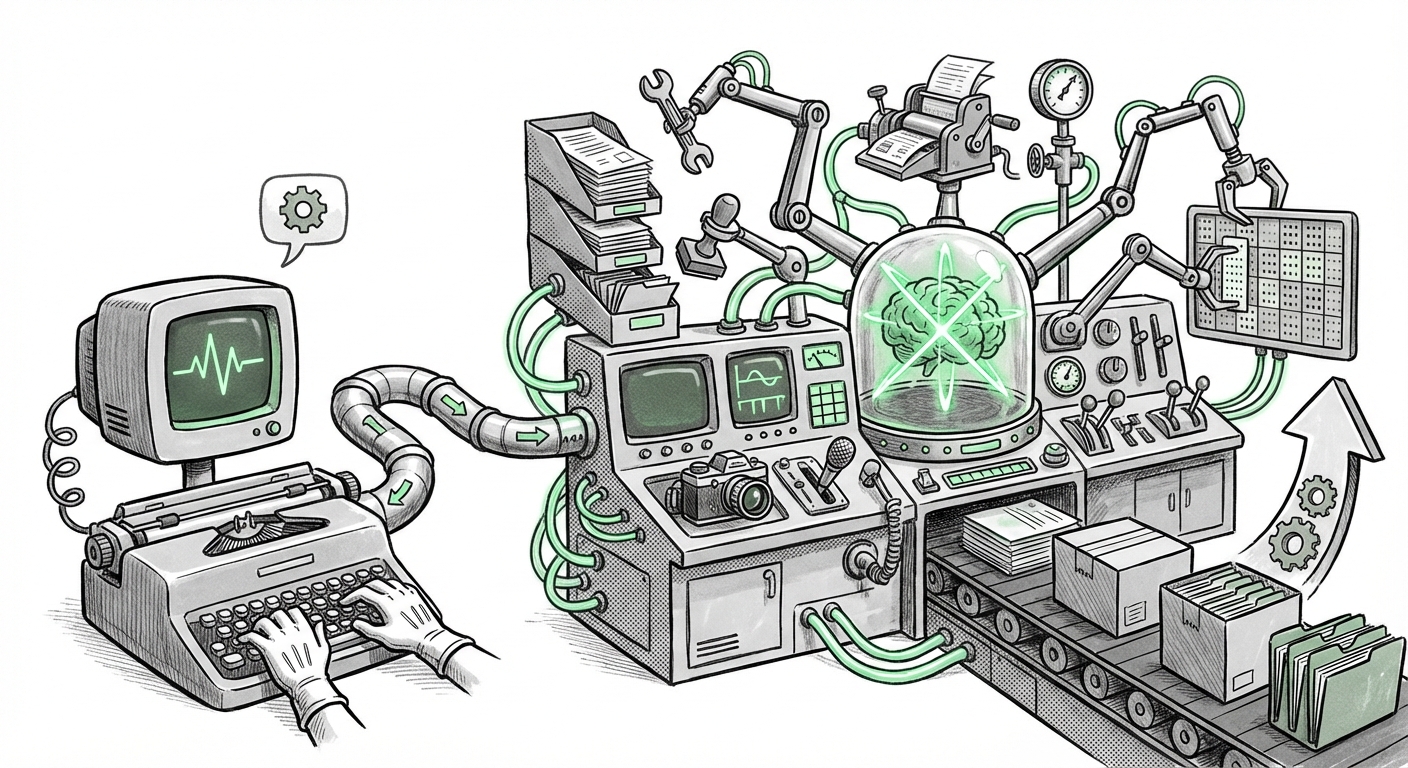
Anthropic has reportedly invested in building an internal economic model that simulates how AI could ripple through hiring, wages, productivity, and the broader economy. It was not built as a marketing exercise. It was built as a tool for understanding and planning.
What reportedly makes it notable is that the company's leadership decided to apply the model to their own public statements. The CEO has made repeated, sobering predictions about how many jobs could be disrupted or displaced by advanced AI. Rather than letting those statements stand as simple soundbites, the company ran them through its economic modeling apparatus. The result: the most extreme of those predictions landed in the "outlier" category.
Let's be precise about what that means. In statistics and forecasting, an outlier is a data point or possible outcome that sits far away from the central cluster of expectations. No responsible modeler ignores outliers. In fact, some of the most important events in history were outliers: financial crashes, pandemics, sudden technological leaps. But an outlier is still not the same as the most likely path.
By labeling the CEO's bleakest job forecasts this way, Anthropic is making a nuanced statement. The statement seems to be: "We take these risks seriously enough to put them in our model. But our analysis suggests that the most probable future involves significant change, not the collapse of work as we know it."
Why Would an AI Company Build an Economic Model?
At first glance, it might seem strange for an AI company to behave like an economics research department. Isn't that the job of universities, central banks, and government statisticians?
But the AI industry has reached a point where it cannot afford to outsource the most important questions about its own technology. There are several reasons why a company like Anthropic would build an economic model internally, and each reason tells us something about the future of AI.
1. Understanding Your Own Creation
If you are building a technology that could transform how millions of people work, you have a responsibility to understand its economic impact. A model gives the company a structured, testable way of thinking about that impact instead of relying on intuition or hype.
2. Testing the Message from the Top
When a CEO makes a dramatic prediction, it shapes public perception. It affects whether workers feel secure, whether investors reward or punish the company, and whether regulators call for new rules. A company that wants to be responsible needs to check those predictions against something more rigorous than gut feeling. Using an economic model to evaluate the CEO's own forecasts is a sign of intellectual honesty, and also of internal accountability.
3. Preparing for the Policy Debate
Governments around the world are grappling with how to regulate AI, retrain workers, and protect communities most exposed to automation. If AI companies want to participate credibly in those debates, they need analytical depth. An economic model provides a way to engage with policymakers on substance rather than slogans.
4. Building Better AI Roadmaps
Finally, the results of such a model can guide decisions inside the company. If the model suggests that AI adoption will be slower in certain industries, those industries may need different kinds of tools. If it suggests rapid disruption in others, the company may invest more in safety, deployment practices, and user support. The economic model is not just a communication device, it is a planning device.
There is, of course, a more skeptical interpretation worth naming. A company that profits from selling AI may be tempted to build a model that makes AI look less scary. If the most extreme job forecasts are labeled outliers, perhaps that conveniently calms the public and keeps regulators at bay. That skepticism is healthy. The best models are transparent, and the underlying assumptions should be open to outside scrutiny. The meaningful test is whether Anthropic shares enough detail for independent researchers to verify and challenge its conclusions.
What "Outlier Scenario" Really Means for AI and Jobs
The most important lesson from this move is about uncertainty. For years, the debate about AI and employment has been framed as a battle of dueling certainties. On one side, optimists insist AI will create more jobs than it destroys, just as previous technologies did. On the other side, pessimists warn that this time is genuinely different and that AI could hollow out the labor market within a generation.
Both sides share a common flaw: they speak with more confidence than the evidence supports. The honest answer is that nobody truly knows how AI will reshape work over the next decade. It depends on technical progress, adoption rates, corporate strategy, government policy, labor organizing, cultural attitudes, and even unexpected global events. That is precisely the kind of complex, interconnected problem that calls for scenario modeling.
Anthropic's approach models the labor market as a system with many interacting forces. AI raises productivity, which tends to grow the economy. It automates certain tasks, which displaces some workers. It lowers the cost of creating content, code, and analysis, which changes the value of human skills. It also creates entirely new kinds of work that are difficult to predict in advance. When all of these forces are simulated together, the result is not a single number. It is a distribution of possible futures.
In that distribution, most outcomes seem to involve significant adjustment, important skill shifts, and real pain for some workers. But complete, catastrophic labor displacement is sufficiently far from the center of the model's output that it earns the label "outlier." In plain language: the model is saying the most likely future is one of rapid change and uneven disruption, not the end of work.
This matters because it should change how we use AI forecasts. Instead of asking, "Will AI take my job?" the more useful question becomes, "Which parts of my job will AI change, how quickly, and what can I do to stay valuable?" The action shifts from fear-based reaction to deliberate preparation.
What This Means for Businesses
For business leaders, the takeaway is direct and practical: stop planning around a single dramatic prediction. Whether that prediction comes from an AI CEO, a consulting firm, or a think tank, single-point forecasts are dangerous. The future is a range of outcomes, and strategy should reflect that.
Anthropic's move suggests a better template. Companies should build their own scaled-down scenario analysis. That does not require a massive economics department. It requires asking three disciplined questions:
- What is our central case? If AI adoption proceeds at a moderate, steady pace over the next several years, how will our industry, our workforce, and our customers change?
- What is our downside scenario? If automation accelerates much faster than expected, which roles in our organization are most exposed, and what would we do?
- What is our upside scenario? If AI genuinely augments human capability, how do we capture that advantage rather than leaving it to competitors?
Once those scenarios are on the table, businesses can design investments that pay off across multiple futures. Training employees to work effectively alongside AI is a good hedge in almost every scenario. Redesigning processes to be more flexible and data-driven helps in every scenario. Building a culture of continuous learning protects the organization regardless of which future arrives.
The deeper message for executives is uncomfortable but important: you cannot delegate workforce strategy to technology vendors. AI companies, including Anthropic, have their own perspectives, incentives, and models. Their forecasts are inputs to your thinking, not substitutes for it.
What This Means for Workers
For individual workers, the news cuts both ways. If the bleakest forecasts are outliers, you do not need to assume your career is heading for extinction. Automation anxiety, while understandable, should not lead to a panic-driven career change based on the loudest headline of the week.
But an outlier is not a zero. Outliers happen. And even in the central case, the model's own CEO has consistently argued that disruption will be substantial. Roles will change. Tasks will shift. Some positions will disappear while others evolve into something barely recognizable.
The practical advice is almost boring because it is so familiar: build adaptable skills, learn to use AI tools in your field, stay curious, and maintain a professional network. The less obvious advice is to watch for leading indicators in your own industry. If the companies in your sector begin restructuring around AI in ways that affect hiring, those signals will arrive long before any grand economic forecast is revised.
The most empowering perspective is to think of yourself as a scenario planner for your own career. Do not bet everything on the optimistic future, and do not surrender to the pessimistic one. Keep options open, build skills that work across multiple possibilities, and treat your career as something to actively manage rather than predict.
What This Means for Governments and Society
Perhaps the most important implication is for public policy. If leading AI companies are building their own economic models, governments need comparable or better capabilities to evaluate them. A healthy democracy cannot rely entirely on private companies, with their commercial incentives, as the authoritative source of knowledge about one of the defining technologies of our time.
Policymakers should be asking their own questions. What assumptions about AI adoption rates are baked into national labor forecasts? Are statistical agencies tracking AI exposure at the occupation level, not just the industry level? Do workforce retraining programs move quickly enough to respond if an outlier scenario begins to emerge?
Anthropic's approach also offers a model for how governments might communicate about uncertainty. Instead of telling the public that AI will either save us or ruin us, institutions could present a transparent range of scenarios with clear indicators that would increase or decrease confidence in each one. That kind of honest, calibrated communication would reduce both panic and complacency.
Society also needs shared infrastructure. Independent researchers need access to labor market data, AI capability benchmarks, and the assumptions behind industry economic models. Funding for academic research on the future of work should be treated as national security, because economic stability depends on it.
A More Mature Way of Talking About AI
What Anthropic has done, in essence, is turn a strong opinion into a testable model. That is a meaningful step forward for the maturity of the entire AI industry. The technology sector has spent years making dramatic claims about the future. Now, at least one company is attempting to apply rigor to its own leadership's warnings.
The phrase "outlier scenario" should not be read as "don't worry." It should be read as "here is a future that is possible but unlikely, and here is a range of more probable futures that still demand attention." That is how responsible institutions think about nuclear risk, climate tipping points, and pandemics. It is how they should think about AI.
The future of AI will not be delivered as a single headline. It will be a messy, uneven, negotiated process shaped by millions of decisions made by executives, workers, consumers, and voters. Models help us understand the landscape of possibilities, but they do not remove the need for judgment, foresight, and preparation.
Every organization should take a page from this playbook: imagine several futures, question the loudest voices, test assumptions against data, and build strategies that work across multiple worlds. In doing so, we neither dismiss the dangers of AI nor become paralyzed by them. We simply become more ready for whatever comes next.