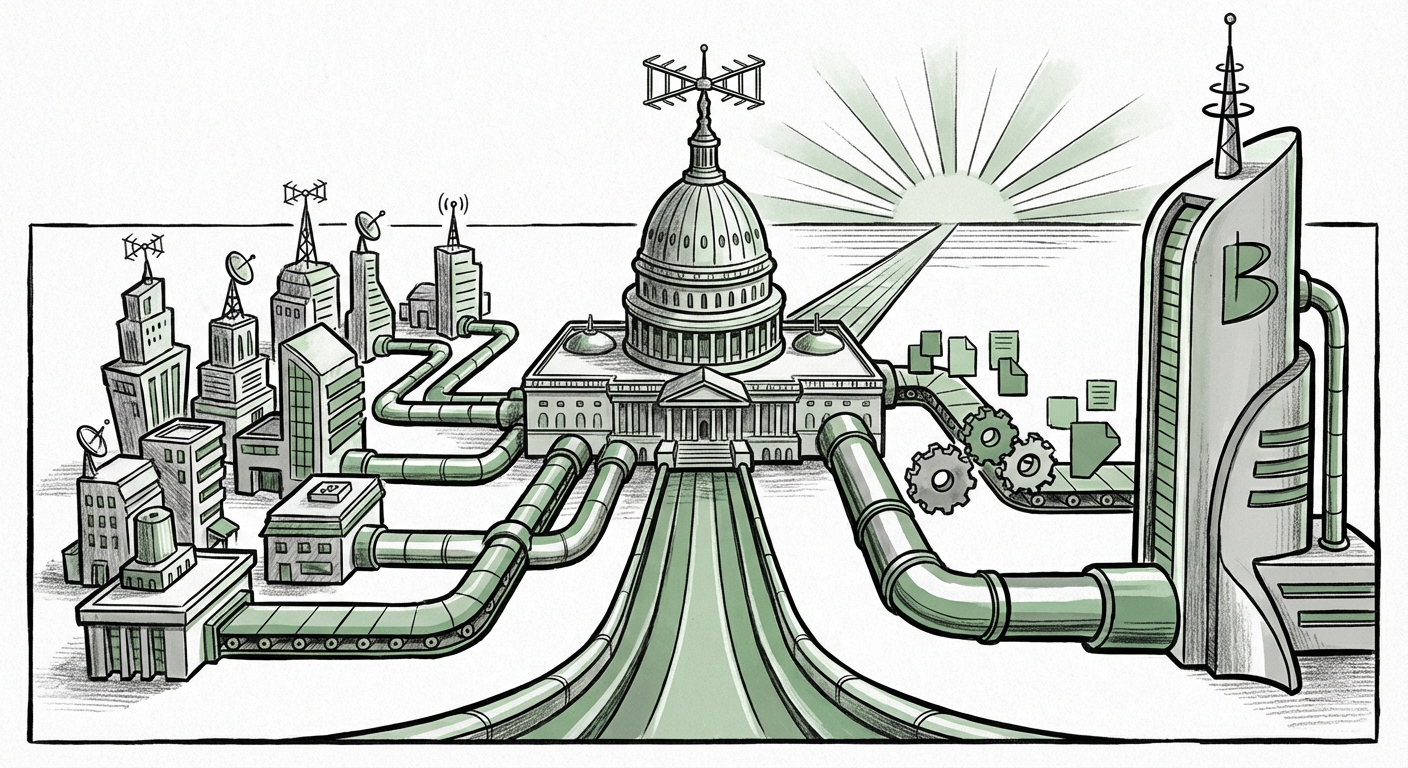
Nvidia and Palantir Team Up to Run Supply Chains With AI, Starting With Nvidia's Own Million-Part Operation
Two of the biggest names in American technology are joining forces to do something that sounds simple but is brutally hard: use artificial intelligence to run a global supply chain. Nvidia and Palantir announced a partnership in September 2026 to bring AI into the messy, high-stakes world of sourcing, manufacturing, and logistics. And the first customer is Nvidia itself, a company whose own supply chain involves roughly a million individual parts.
That last detail matters more than it first appears. When a company runs its own AI on its own operations, it is not selling a slideshow. It is stress-testing the technology on the hardest problem it owns. If the system works, the case study writes itself. If it breaks, everyone finds out.
This article breaks down what the partnership means, why supply chains have become the next big AI battleground, and what businesses of every size should take away from it.
What Was Announced
The deal pairs Nvidia's computing power and AI hardware with Palantir's strength in organising complex data and building decision systems. The goal: run supply chain operations with AI at the centre, rather than AI bolted on as a reporting tool after the fact.
The first deployment is inside Nvidia's own operations. That is a supply chain with a million parts spread across many countries, suppliers, factories, and shipping routes. It is the kind of environment where a single missing component, a chip substrate, a cooling component, a rare material, can stall production worth millions of dollars.
Nvidia is not just a customer here. It is also the company supplying much of the computing muscle that makes modern AI possible. So the partnership sits at an interesting crossroads: the AI hardware leader is using AI to protect its own ability to ship AI hardware.
Why Supply Chains Are the Perfect AI Proving Ground
Supply chains are a natural fit for AI, and there are a few clear reasons why.
- They are drowning in data. Purchase orders, shipping records, supplier emails, factory sensor readings, weather reports, the volume is enormous and messy.
- They are full of uncertainty. Ports close. Suppliers go bankrupt. Storms hit. Demand swings. Humans can't track all of it in real time.
- Small decisions cascade. Ordering too much of one part ties up cash. Ordering too little shuts down a line.
- Mistakes are expensive. Unlike a bad chatbot answer, a bad supply chain call can cost real money within days.
That combination makes supply chains a place where AI has a measurable return, if it works. It is also a place where AI's weaknesses get exposed fast. Models that hallucinate or misread a contract clause are dangerous when the consequence is a stalled factory.
The Million-Part Problem, Explained
Imagine a single product, a powerful AI chip, that requires parts from hundreds of suppliers across multiple continents. Now multiply that across an entire product line. That is roughly what Nvidia is dealing with.
No human team can hold that entire picture in their heads. Traditional software tools can show dashboards, but they mostly tell you what already happened. The promise of AI in this setting is different: systems that anticipate problems, weigh trade-offs, and suggest or even take action before a shortage becomes a shutdown.
That shift, from reporting to acting, is the heart of this partnership. It is also the direction the whole AI industry is moving.
What This Means for the Future of AI
From conversation to operation
The first wave of the current AI boom was about talking to machines. Chatbots, writing assistants, code helpers. Useful, but mostly sitting beside the real work.
The next wave is about AI doing the work. That means AI systems plugged directly into inventory systems, ordering tools, factory schedules, and shipping networks. This partnership is a clear signal that the industry's centre of gravity is shifting from AI that answers to AI that operates.
The operational AI stack is forming
You can already see the shape of a new technology stack:
- Compute, the chips and data centres that run the models.
- Data and ontology, a clean, connected model of the real world: what parts exist, who makes them, where they are.
- Models and agents, the reasoning layer that forecasts, plans, and acts.
- Workflow and control, the rules, approvals, and audit trails that keep humans in charge.
Nvidia is unmistakably a leader in the first layer. Palantir has built its reputation in the second and fourth. Together they cover a lot of ground, and that is exactly why the pairing is worth watching.
Enterprise AI gets its proof point
Many companies have experimented with AI and struggled to show results. Supply chain work is different because the payoff is concrete: fewer delays, less tied-up cash, faster recovery from disruptions. If the Nvidia deployment produces visible wins, expect a wave of copycats across manufacturing, aerospace, automotive, and electronics.
Practical Implications for Businesses
If you make or move physical goods
Your competitive edge may soon depend less on who has the best factory and more on who has the best model of their own operations. Companies with clean, connected data about their supply chain will be able to adopt these tools quickly. Companies with data trapped in spreadsheets and disconnected systems will spend years catching up.
If you are a mid-sized company
You will not build this yourself, and you do not need to. The realistic path is to buy or partner. But you do need one thing first: a clear map of your own supply chain data. That is the unglamorous work that decides whether AI is transformative or just expensive.
If you are worried about jobs
The likely near-term shift is not mass replacement but role change. Buyers, planners, and logistics coordinators spend much of their day chasing information and reacting to problems. AI is well suited to absorbing that chasing work. The human role moves toward judgement: negotiating, handling exceptions, and making calls where values and relationships matter, not just numbers.
Risks and What to Watch
It would be naive to treat this as a pure win. Several things could go wrong.
- Over-trusting the model. If people stop questioning AI recommendations, small errors can spread quietly until they become big ones.
- Data quality. Bad input data produces confident bad advice. This is the single most common reason enterprise AI projects fail.
- Concentration risk. If a handful of vendors power the supply chains of most major manufacturers, a problem at one vendor becomes an industry-wide problem.
- Opacity. When an AI system reroutes a shipment or switches a supplier, someone needs to be able to explain why, to auditors, regulators, and customers.
- Speed versus safety. Faster decisions are the goal, but supply chains touch national security, trade rules, and labour conditions. Speed without guardrails is a recipe for trouble.
Watch for three signals in the coming year: whether the internal deployment delivers measurable results, whether the partnership expands beyond Nvidia's own operations, and whether clear rules emerge for who is accountable when an AI makes a costly call.
Actionable Insights: What to Do Now
- Audit your data before you shop for AI. You cannot automate a process you cannot describe. Map your suppliers, parts, lead times, and known failure points first.
- Start with one painful bottleneck. Pick a single, well-defined problem, forecasting a tricky component, or spotting supplier risk, and prove value there.
- Keep humans on the decision. Let AI recommend and prepare. Let people approve the calls that carry real consequences. Loosen that grip only as trust is earned.
- Demand explainability. Any system making operational decisions should be able to show its reasoning and keep a record.
- Plan for the ecosystem shift. Suppliers and partners will soon be asked for cleaner, more structured data. Getting ahead of that request is a competitive advantage.
- Measure outcomes, not activity. Count avoided delays, reduced inventory, and faster recovery, not the number of AI features deployed.
The Bigger Picture
For years, the big question about AI was whether it could ever do anything genuinely useful in the physical economy. Chatbots were impressive, but they lived on screens. Supply chains are where digital decisions meet real trucks, real factories, and real money.
Nvidia and Palantir are betting that this is the moment AI grows up, moving from clever assistant to operational backbone. Launching on a million-part supply chain is a bold way to prove it. It is also a test the whole industry will be watching closely, because if AI can run something this complex, the list of things it cannot touch gets a lot shorter.
The companies that treat this as a data and governance problem, not just a software purchase, are the ones most likely to come out ahead.