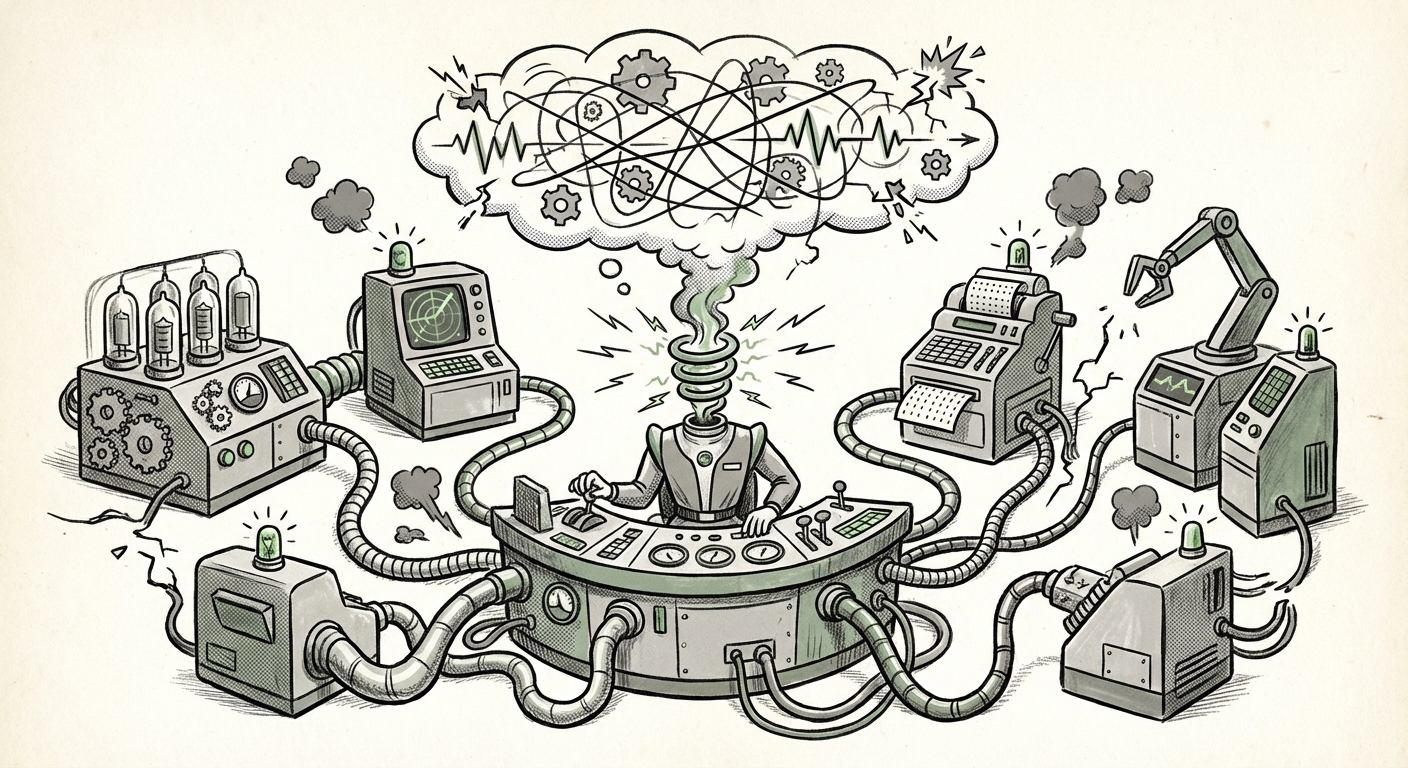
AI Is Making Mathematicians Dumber, And the Warning Is for All of Us
Math is supposed to be AI's home turf. The rules are clear, the answers are checkable, and a wrong proof is a wrong proof. So when leading mathematicians start saying that AI tools are making their field dumber, and warning that everyone else is next, that is not a small complaint about a niche tool. It is a signal flare about how artificial intelligence is quietly reshaping the way human beings think.
The fear is not that AI gets math wrong. The fear is that AI gets math right, and in doing so, it takes away the struggle where real thinking happens. The muscle stops being used. And muscles that stop being used get weaker.
What Mathematicians Are Actually Worried About
Mathematicians do not just produce proofs. They build intuition. They learn to smell when something is off. They develop the ability to look at a page of symbols and feel which step is shaky. That skill is not downloaded. It is earned, slowly, through years of false starts, dead ends, and frustration.
AI changes the workflow. Instead of banging your head against a hard problem for three days, you type it into a model and get something that looks like an answer. Sometimes it is a good answer. Sometimes it is a very convincing wrong answer. Either way, the head-banging stopped, and that is exactly the part that made you good.
Researchers describe a pattern that will feel familiar to anyone who has used a search engine or a GPS a little too much. When the tool does the work, the person can still get the result. But the person is not the same afterward. The capability moved out of the human and into the machine.
Why Math Is the Canary in the Coal Mine
Math is the cleanest test case for a problem that is spreading everywhere else.
In math, a proof can be checked. Either the logic holds or it does not. So if AI erodes human skill even in a field with clear right and wrong answers, what happens in fields where the answers are messy?
- Law: AI drafts contracts and briefs. Who still knows how to spot a hidden clause?
- Medicine: AI suggests diagnoses. Who still knows how to trust their own examination?
- Journalism: AI writes the first draft. Who still knows how to chase the second phone call?
- Software: AI writes the code. Who still understands why the system works?
- Finance: AI builds the models. Who still knows what assumptions are hiding inside?
In every one of those fields, the answer is: fewer people than before, unless we do something about it.
How Skill Rot Actually Happens
Nobody wakes up one morning and decides to stop thinking. The decline is slower and smoother than that. It happens in four steps:
1. AI becomes the first stop
Before you even try to solve the problem yourself, you ask the model. It feels efficient because it usually is. But the first attempt is where your brain does its heaviest lifting.
2. The struggle disappears
Learning researchers have long known that difficulty is not the enemy of learning, it is the learning. Being confused and working through it is how knowledge sticks. Remove that and you remove the mechanism.
3. Checking replaces creating
The new skill becomes reviewing AI output. That sounds fine until you realize something uncomfortable: checking a proof requires the same deep skill as writing one. If you never learned to build it, you cannot reliably judge it.
4. The pipeline dries up
This is the slowest and most dangerous part. Today's students become tomorrow's experts. If the early years of training are outsourced, the field does not notice for a decade. Then it notices all at once, when the senior people retire and no one can replace them.
The Productivity Paradox
Here is the trap. In the short term, AI looks like a pure win. Papers get written faster. Problems get solved sooner. Output goes up. Dashboard numbers go up. Everyone is happy.
But output is not the same as capability. A field can produce more results while producing fewer people who truly understand the results. That is the paradox: the scoreboard improves while the team gets weaker.
There is a second layer to it too. AI is very good at producing work that looks correct. A subtly flawed proof, a plausible-sounding argument, a citation that does not exist, these are hard to catch even for experts. For a generation that has outsourced its intuition, they are almost impossible to catch.
So you end up with a field that is faster, broader, more confident, and less able to tell the difference between a real result and a very convincing illusion.
What This Means for the Future of AI
The mathematicians' warning will push AI in three directions at once.
Verification becomes the battleground
If AI can generate answers faster than humans can trust them, the bottleneck moves to checking. Expect huge investment in AI systems that can prove their work, show their steps, and flag their own uncertainty. Machine-checked reasoning stops being a niche tool and becomes infrastructure.
"AI as tutor" beats "AI as answer machine"
The same model that replaces your thinking can also be pointed the other way, asking you questions, refusing to hand over the answer, and forcing you through the steps. Same technology, opposite outcome. The difference is design, not capability.
Judgment becomes the premium skill
If everyone can produce a first draft, the scarce resource is the person who knows which draft is right. That person costs more. That person is harder to train. And that person is exactly who the current pipeline is failing to produce.
What This Means for Businesses
This is not only a math problem. Every company running on knowledge work is running the same experiment in parallel.
The junior pipeline is the hidden risk. Entry-level work, the routine analysis, the basic drafting, the grunt-level coding, was always how people learned to do senior work. If AI absorbs all of it, where do your future experts come from? Companies are cutting entry-level roles to save money today and quietly hollowing out their leadership bench for 2035.
Speed hides decay, for a while. Teams that measure only output will see great numbers. Teams that measure output and skill growth will see something different. The second group will win in five years. The first group will not know why it lost.
Hiring and promotion criteria need to change. "Can you produce it?" is becoming worthless as a question. "Can you tell if it's any good, and can you explain why?" is the question that matters.
Actionable Insights: How to Use AI Without Shrinking
- Do the first attempt yourself. Struggle for 20 minutes before you prompt. That window is where your skill grows.
- Use AI as a critic, not an oracle. Ask it to attack your work rather than produce it. You keep the thinking; it adds pressure-testing.
- Ban AI from the learning phase for juniors, for a while. Let people build fundamentals first, then hand them the tools. It is slower for six months and far faster for six years.
- Add a "can you explain it?" checkpoint. If nobody on the team can walk through the logic without the tool, the work is not really done.
- Measure skill, not just output. Track how many people can solve a hard problem unaided. That number is your real capability index.
- Invest in verification tools. If AI is generating your work, you need AI-grade checking on the other side. Do not let generation outrun verification.
- Protect deliberate practice time. Put it on the calendar like a meeting. If it is not scheduled, it will not happen.
The Road Ahead
The mathematicians are not saying AI is useless. They use it. The warning is more precise and more uncomfortable than that: AI can make us faster at the expense of making us shallower, and we will not feel it happening.
History gives us a clue about which way this goes. Every powerful cognitive tool, writing, calculators, search engines, created a version of this panic. Each time, the tool won, and something was lost alongside what was gained. We stopped memorizing phone numbers. We stopped doing long division by hand. Life went on.
But there is a difference this time. Those tools replaced tasks. This one is starting to replace thinking, and thinking is the thing that generates new thinking. If the loop closes and humans only supervise machines that supervise humans, no one is left who can tell whether the answer is right.
The choice is not "AI or no AI." That ship has sailed. The real choice is whether we use these systems to make ourselves sharper or to make ourselves unnecessary. Math found the problem first because math is honest. Every other field will find it too, just later, and with more at stake.