Anthropic CEO Amodei Wants AI Speed Limits Before Self-Improvement Outpaces Human Control
Picture a car that can rebuild its own engine while you are still driving it. Now imagine the driver is all of humanity, and the car keeps getting faster every time it fixes itself.
That is the picture Anthropic CEO Dario Amodei is pointing at. His message is simple and uncomfortable: the world needs speed limits for AI, not because AI is bad, but because AI is starting to improve itself faster than people can check its work.
This is a big shift in the conversation. For years, the debate was about whether AI would ever be powerful enough to matter. Now the head of one of the leading AI labs is asking for the brakes to be tested before the car reaches top speed. Here is what that means, why it matters, and what businesses and workers should do about it.
What "AI Speed Limits" Actually Means
A speed limit is not a ban. Nobody is suggesting we stop building AI. Amodei's framing is closer to traffic law: you can drive, but you drive at a pace where you can still react.
In practice, an AI speed limit could look like several things:
- Paced releases. New models ship on a schedule that leaves time for outside testing, not whenever a training run finishes.
- Safety gates. A model must pass defined checks before it goes out the door, the same way a drug must pass trials.
- Capability thresholds. Certain abilities, like an AI that can meaningfully improve its own design, trigger extra review before they are unlocked.
- Shared rules. Limits only work if the major labs follow them together. Otherwise, one company's caution just hands the lead to someone else.
The key idea is deliberate pace. Right now, the pace of AI is set by compute, money, and competition. Amodei wants it partly set by human judgment too.
The Self-Improvement Problem, Explained Simply
Today's AI systems already help build AI. They write code, run experiments, clean data, and suggest improvements. Humans review most of that work. The loop is fast, but a person is still standing in it.
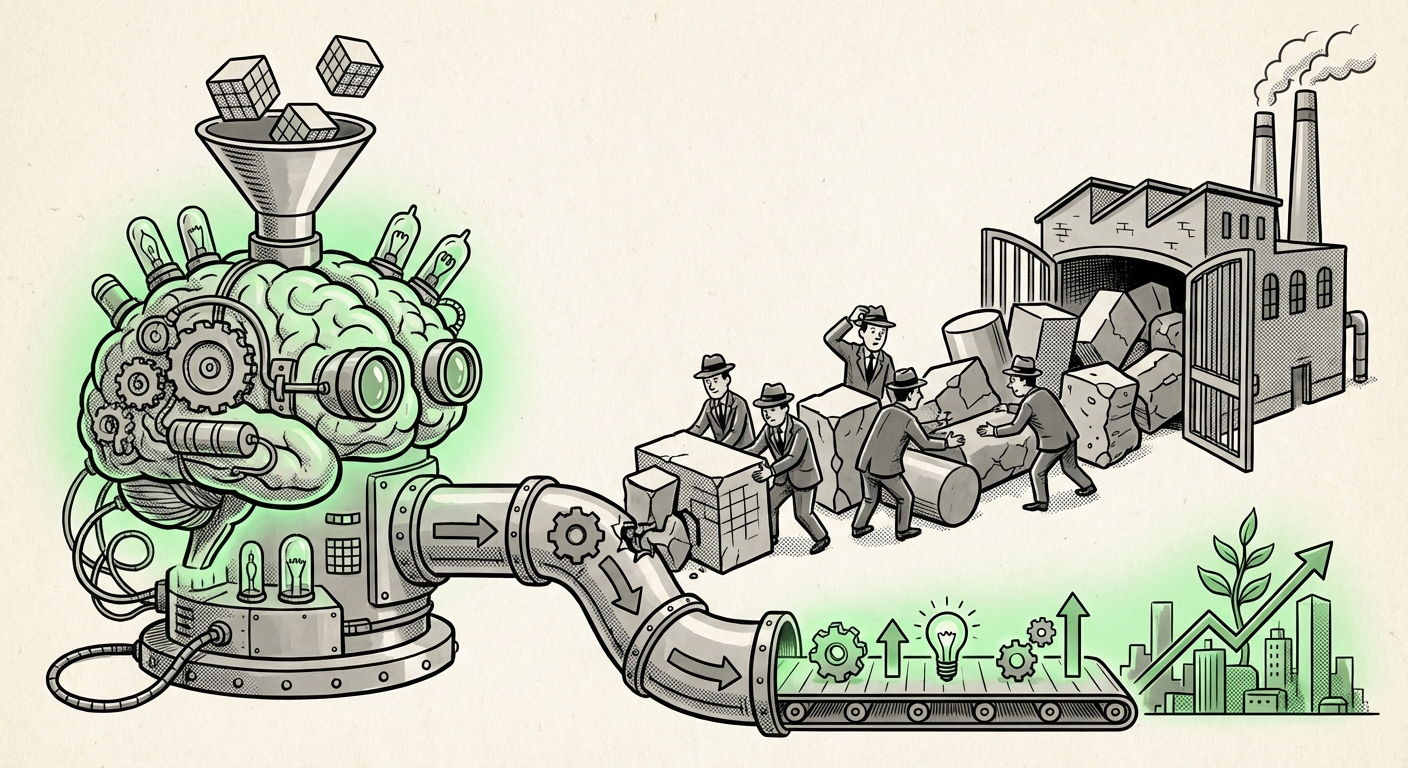
The worry is what happens when the AI gets good enough to close that loop on its own. If a system can propose a change, test it, learn from the result, and repeat, thousands of times an hour, then the speed of improvement stops being limited by human attention.
That is the moment Amodei is warning about. Not a robot uprising. Something quieter and harder to manage: a system that changes faster than the people responsible for it can understand.
Once you cannot explain why a model does what it does, you also cannot promise it is safe. You cannot fix a problem you cannot see. That is the whole argument for slowing down before that point arrives, rather than after.
Why This Message Is Coming From Inside the Industry
It turns the usual story on its head. Usually, outside critics call for restraint and industry pushes back. Here, the call is coming from someone building the technology.
That tells us a few things. First, the people closest to the work have the clearest view of how fast things are moving, and it is faster than the public conversation suggests. Second, leaders inside AI labs know that a major accident would not just hurt one company. It would trigger harsh rules for everyone, written in a hurry by people with less information.
There is also a competitive angle. If you believe your own safety work is strong, calling for shared standards rewards you and costs your less careful rivals. That does not make the safety argument wrong. It just means the motive is probably mixed, as it usually is in business.
What This Means for the Future of AI
A Slower, More Staged Build-Out
Expect frontier AI to look less like a sprint and more like aviation. New capability tiers arrive, get tested, get certified, and then get used. The biggest jumps may come with public documentation about what was tested and what was found.
This does not mean progress stops. It means progress gets a paper trail.
Evaluation Becomes a Real Industry
Someone has to measure how fast AI is moving and how safe it is. That creates demand for independent testing labs, red teams, auditors, and third-party benchmarks. Think of it as the crash-test industry for AI, unglamorous, necessary, and increasingly powerful.
Safety Becomes a Selling Point
If speed limits become normal, buyers will start asking vendors hard questions. "Can you show me your evaluation results?" becomes as routine as asking about uptime or data privacy. Companies that can answer will win deals. Companies that cannot will lose them.
Human Oversight Becomes a Design Feature
The most valuable AI products will be the ones where a person can see what the model did, why it did it, and how to stop it. Explainability and control move from nice-to-have to the core of the product.
Practical Implications for Businesses
You do not need to wait for new laws to act. The habits that speed limits would require are good habits anyway.
1. Know what you are actually running
Keep a simple inventory of every AI tool in use, including the ones employees signed up for on their own. You cannot manage what you have not counted.
2. Add a human checkpoint
For any decision that affects money, safety, health, hiring, or legal exposure, put a person in the loop who can say no. Automate the drafting, not the deciding.
3. Ask vendors for evidence
Request their safety testing summaries, their update process, and how quickly they can roll back a change. If they cannot answer, that is your answer.
4. Build your own test set
Do not rely only on a vendor's benchmarks. Test models on your real work, your documents, your customers, your edge cases, before you deploy.
5. Plan for the pace to change
Model updates can shift behaviour overnight. Design your systems so a model can be swapped or reverted without breaking everything downstream.
6. Train the people, not just the tools
Staff who understand what these systems can and cannot do will catch more problems than any policy document. A short, regular training beats a one-time rollout.
Implications for Society and Workers
Speed limits are also a labour question. If AI capability grows more slowly, workers get more time to adapt, to retrain, to shift roles, to build the skills that pair well with AI. That time is the real prize. Fast change is not just risky; it is unfair to people who cannot move that quickly.
There is a trust question too. Surveys repeatedly show the public is uneasy about AI. A visible, credible safety process would do more for confidence than any marketing campaign. People accept speed limits on roads because they can see the signs.
And there is a fairness question. Rules agreed by a few large labs could freeze out smaller players and open-source projects, or they could be written to protect them. That choice is political, not technical, and it will be made in the next few years.
The Hard Questions Nobody Has Answered
The call for speed limits raises problems that are genuinely difficult:
- Who sets the limit? Governments move slowly and know little about the technology. Companies know a lot and have a conflict of interest. Independent bodies are the obvious answer, but they need funding and authority.
- What is the speedometer? There is no agreed way to measure how close a model is to self-improvement. Without a measurement, a limit is just a feeling.
- What happens if others do not join? A limit in one country does not slow work in another. Any serious regime has to be international, or it becomes a disadvantage for whoever follows it.
- How do you slow down without stopping? Pausing everything would freeze the medical and scientific benefits that AI may bring. The goal is control of pace, not an end to progress.
None of these are reasons to do nothing. They are reasons to start designing the rules now, while the stakes are still low enough to make mistakes.
How AI Will Be Used Under a Speed-Limit Mindset
If Amodei's view wins out, the near future of AI looks less like a single super-system and more like a fleet of careful, well-scoped tools. Think finance teams using AI for reconciliation with a human signing off. Hospitals using AI to draft notes while a clinician decides. Factories using AI to flag faults while an engineer confirms.
That is a slower story than the headlines. It is also a more durable one. Businesses rarely get punished for being cautious with new technology. They get punished for being careless.
The Bottom Line
Anthropic's CEO is making a bet that the biggest risk in AI is not that it stops working, it is that it starts working too fast for anyone to steer. His answer is speed limits: paced releases, real testing, and human control at the centre of the design.
Whether or not those limits ever become law, the direction of travel is clear. The next phase of AI will be judged less on raw capability and more on whether we can explain, audit, and stop what we have built. The companies that treat that as an engineering requirement rather than a public relations problem will be the ones still standing when the road gets steep.