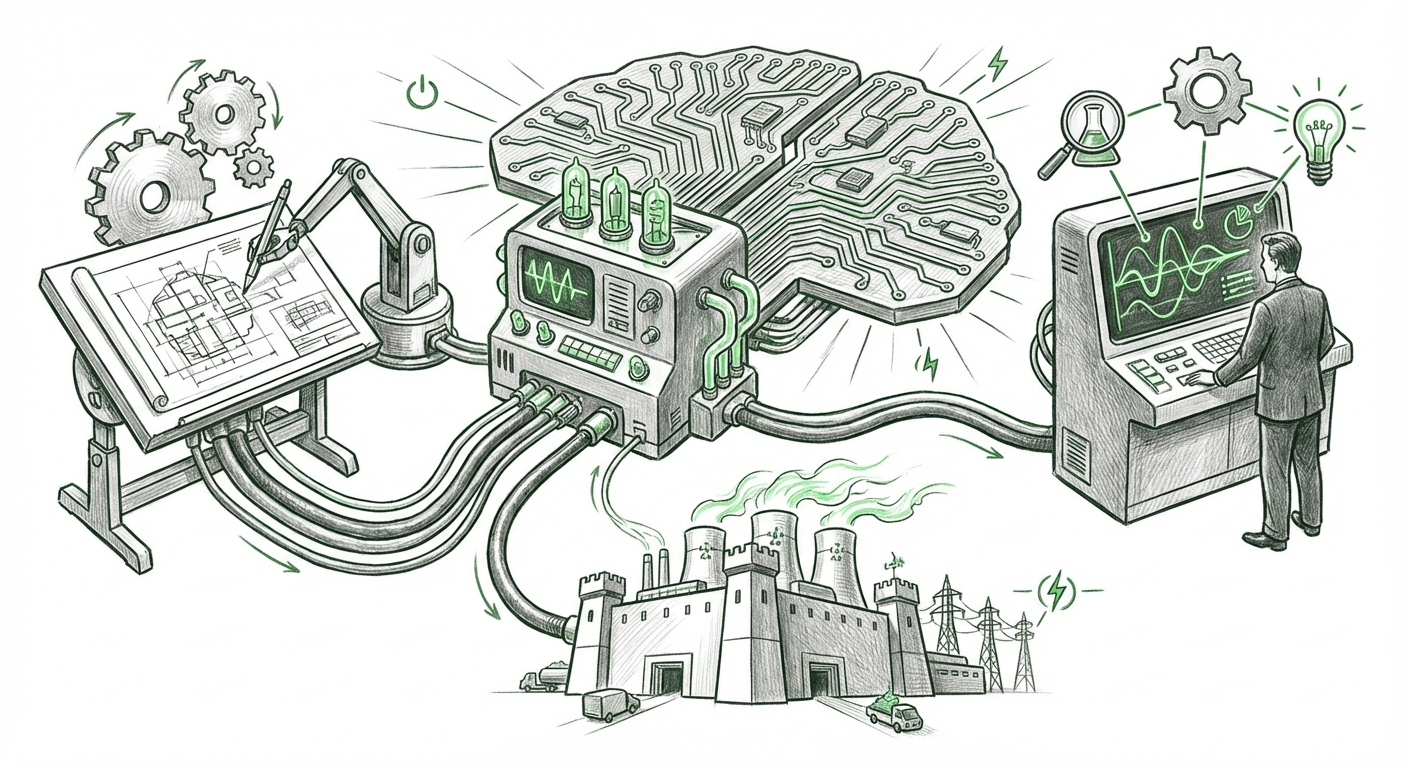
Google's New AI Model Predicts the Future From Sales Data, Weather, and Discount Schedules
Imagine running a store and knowing next week's sales before you decide how big the discount should be. That is the promise behind Google's new AI model, which predicts future outcomes by reading sales data, weather, and discount schedules together. Instead of looking at one number at a time, the model looks at many signals at once and turns them into a forecast.
That sounds like a small step. It is not. Forecasting is one of the oldest jobs in business, and for decades it has been done with spreadsheets, gut feel, and simple math. A model that blends sales, weather, and promotions points to a bigger shift: AI is moving from describing what already happened to predicting what will happen next, and eventually to deciding what to do about it.
The Big Idea: Many Signals, One Prediction
Businesses have always collected separate streams of information. Sales records live in one system. Weather feeds come from another. Promotion calendars sit in a marketing spreadsheet that nobody else can see. Each stream is useful on its own, but the real story lives in the connections between them.
Think about a simple example. Ice cream sales go up when it is hot. But they also go up when a store runs a two-for-one deal. If you only look at sales, you cannot tell whether a spike came from sunshine or from a coupon. If you only look at weather, you miss how much the discount mattered. Google's model takes all of it in at once, so it can separate the effects and predict what happens when they combine.
This is what makes the approach interesting. It is not just a faster calculator. It is a model that understands that context changes outcomes. A discount during a heat wave behaves differently from a discount during a rainy week. Weather changes how many people show up. The discount changes how much each of them buys. Together, they decide the final number.
Why Mixing Signals Matters More Than Any Single Data Set
Most forecasting failures happen for one reason: something important was left out. A retailer plans inventory based on last year's sales, then a cold snap arrives, or a competitor runs a flash sale, and the plan falls apart. Adding more relevant signals reduces that blind spot.
There is a second reason this matters. Weather and discounts are not just extra data, they are two very different types of data. Weather is something you cannot control. Discounts are something you can. A model that handles both is really answering two questions at the same time:
- What is likely to happen? A forecast based on things you cannot change, like weather and season.
- What happens if I do this? A simulation based on things you can change, like price cuts and promotions.
The second question is where the money is. Predicting the future is useful. Predicting the future under different choices is what lets a business actually make a better decision.
This is also part of a wider trend in AI. Rather than building a separate model for every narrow task, researchers are building general models that can handle many kinds of sequences and signals, numbers over time, text, images, sensor readings. A general model can learn patterns that a single-purpose tool would never spot, like the way a payday, a rainy weekend, and a markdown can line up to create a very specific kind of sales bump.
What This Means for the Future of AI
From Dashboards to Decisions
For the last twenty years, business software has mostly told people what already happened. Dashboards show yesterday's revenue. Reports show last month's traffic. The human then has to figure out what to do.
Predictive models flip that. They start with what is likely to happen next, and the human's job becomes judgment rather than calculation. This is a real change in the shape of work. Planners, buyers, and marketers spend less time building spreadsheets and more time choosing between options a model has already sketched out.
The Rise of the "What If" Machine
Once a model can predict outcomes from controllable and uncontrollable inputs, it becomes a testing ground. A merchandising team can ask: what if we discount by ten percent instead of twenty? What if we wait a week? What if we only discount in stores where rain is forecast?
Each of those questions used to require a costly real-world experiment. Now it can be run as a simulation first, with the real experiment saved for the option that looks best. That does not remove risk, but it makes risk cheaper to explore.
Foundation Models for Numbers
Language models learned to handle words. The next wave learns to handle time series, numbers that move and change. Sales, traffic, energy use, inventory, web clicks, delivery times. If these models become as general and reusable as language models have, every company with a data history gains access to forecasting power that used to require a specialist team.
That is the bigger story here. Not one forecast, but a new category of tool that treats prediction as a general capability rather than a bespoke project.
Practical Implications for Businesses
Retail and Consumer Goods
This is the most obvious home for the technology. Demand planning, stock levels, markdown timing, and promotion calendars all depend on guessing what shoppers will do. Better guesses mean less wasted inventory and fewer missed sales. Fewer stockouts on hot days. Fewer pallets of unsold goods after a warm winter.
Supply Chains
Supply chains are built on forecasts. If demand predictions get sharper, companies can hold less safety stock without risking empty shelves. That frees up cash and warehouse space. It also makes supply chains more resilient, because planners can see trouble coming earlier, a demand spike, a slow week, a promotion that is about to oversell.
Marketing and Promotions
Discounts are one of the most expensive tools a business has. You are trading margin for volume. A model that predicts how much extra volume a given discount will actually produce can stop companies from over-discounting products that would have sold anyway. It can also point to the moments when a small discount does a lot of work.
Finance and Planning
Budget planning, revenue targets, and cash flow forecasts all lean on the same question: what is coming next? When forecasting improves, planning cycles get faster and budgets get more realistic. That has a knock-on effect across hiring, purchasing, and investment.
Workforce and Operations
Staffing is a forecast problem too. If you can predict foot traffic and order volume, you can schedule people better, enough coverage on busy days, fewer wasted hours on slow ones. That is good for costs and, done well, good for employees who want predictable hours.
The Risks Nobody Should Ignore
Better forecasting is not automatically better outcomes. Several risks come with the territory.
- Feedback loops. If a model predicts low demand and the company responds by cutting stock, the shelves go bare, sales fall, and the prediction "comes true." The forecast helped cause the result it predicted.
- Weather is not a plan. Weather data is powerful, but it is also noisy and local. A model that leans too hard on it can produce confident forecasts that swing wildly.
- Discount dependency. Systems that optimize for volume can push companies toward constant promotions, training customers to wait for sales. Short-term gains, long-term margin damage.
- Bad data in, bad answers out. Promotions recorded in one format, sales in another, and weather at the wrong location all quietly poison the results.
- Over-trust. A precise-looking number invites people to stop thinking. Forecasts are probabilities, not promises, and treating them as facts is how organizations get hurt.
- Unequal access. If top-tier forecasting becomes a tool only large companies can afford, the gap between big and small players widens.
How to Get Ready: Actionable Steps
You do not need to wait for a specific product to show up in your industry. The groundwork is the same.
- Clean your history. Make sure sales, promotions, pricing, and calendar events are recorded consistently and linked by date and location. This is boring and it is the single highest-value step.
- Start capturing weather and events. Even if you cannot use them today, start storing them alongside your sales. Future models will want them.
- Track your discounts properly. Record when a promotion started, when it ended, how deep it was, and where it ran. Vague promo data makes forecasting almost impossible.
- Pick one decision to improve. Choose a single, high-value decision, weekly replenishment, markdown timing, staffing, and measure how much a better forecast would be worth.
- Keep a human in the loop. Use the forecast as an input, not an order. Have someone accountable who can override it and explain why.
- Run small tests. When a model suggests a change, test it in a limited set of stores or regions before rolling it out everywhere.
- Watch for drift. Shopper behavior changes. Models need to be re-checked and retrained, not left to run for years.
The Road Ahead
The most likely next step is that prediction turns into action. Once a model can forecast outcomes from controllable inputs, it can also search for the best combination of them, the discount, the timing, the stock level, the staffing plan. That is the move from forecasting to what many call decision intelligence, and it is where the value concentrates.
After that comes a harder question: who gets to press the button? Letting a model suggest a promotion is one thing. Letting it change prices automatically, in real time, across thousands of products is another. Companies will need clear limits, audit trails, and rules about what AI is allowed to decide on its own.
There is also a real chance this technology spreads well beyond retail. The same logic applies anywhere you combine things you control with things you do not. Energy companies balancing demand against weather. Airlines matching seats to storms. Hospitals staffing wards around flu season. City planners preparing for heat waves. Once models learn to read mixed signals, the list of places they can help grows fast.
The Bottom Line
Google's new model is a signal, not just a product. It shows that AI is getting good at the messy, real-world problem of predicting what happens next when many forces act at the same time. For businesses, the practical message is simple: the companies that win the next few years will be the ones whose data is clean enough and whose decisions are structured enough to take advantage of forecasts like these.
The future of AI is not only about smarter chatbots. It is about systems that quietly sit inside everyday operations, turning scattered signals into better choices. Weather, sales, and discounts are just the beginning.