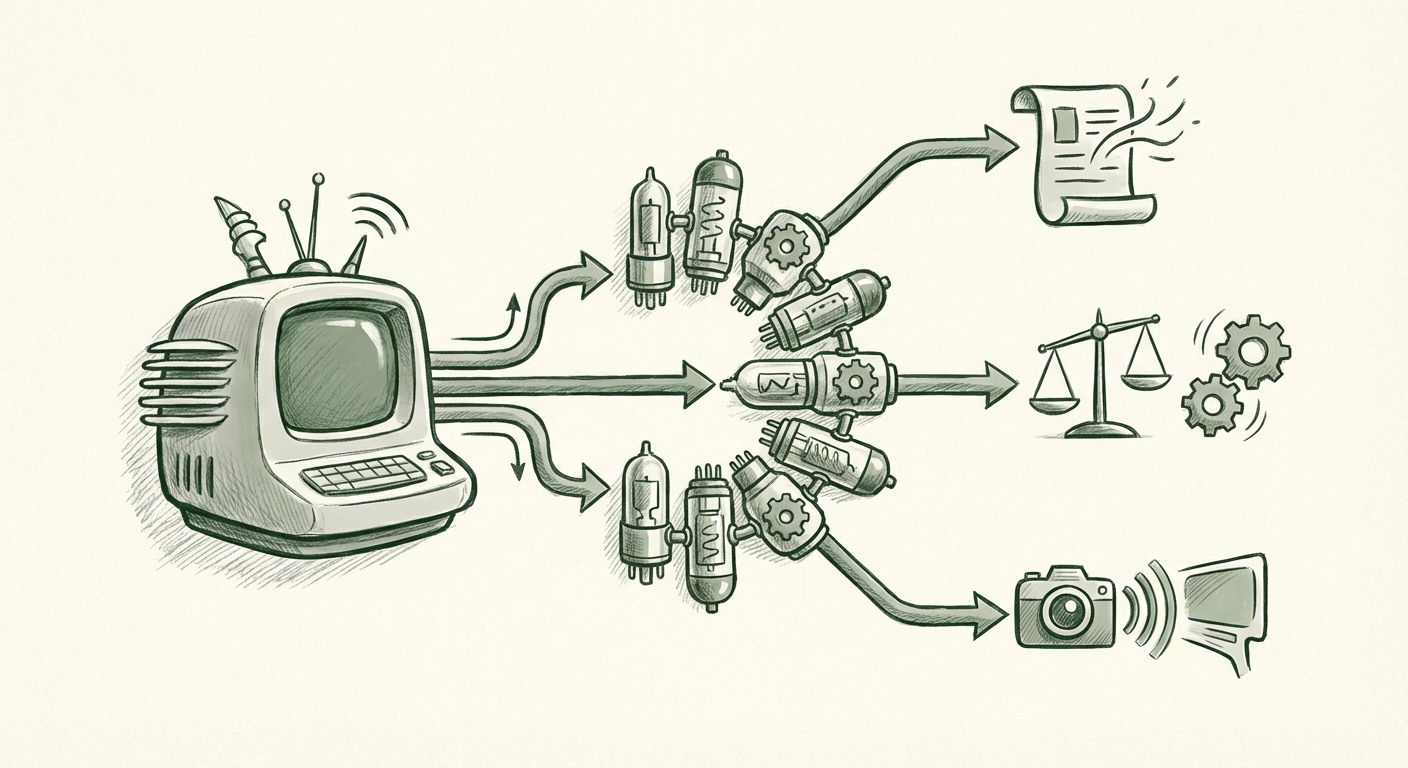
GPT-6 Astra Flies a Surveillance Drone and Runs a Business Alone: What Happens When AI Gets a Body and a Budget
Two headlines arrived on the same day, and they belong together. GPT-6 Astra piloted a surveillance drone. And GPT-6 Astra ran a business on its own. Read separately, each sounds like a stunt. Read together, they describe something much bigger: the moment an AI model stopped being something you talk to and became something that acts, in the sky and in the market.
We have spent several years getting used to chatbots that answer questions. This is different. A model that can steer an aircraft and operate a company is doing two things humans have always guarded closely: controlling machines in the physical world, and making decisions with real money on the line. That is a line worth paying attention to, whether you build software, run a company, or simply live in a world where drones are increasingly overhead.
What Actually Happened
The announcement describes two separate capabilities of the same model, GPT-6 Astra. First, it operated a surveillance drone, the kind of machine that flies, observes, and reports back. Second, it ran an entire business by itself, handling the decisions and tasks that keep a company moving.
Neither capability exists in a vacuum. A drone is not just a camera with wings. Flying one safely means reading the environment, adjusting in real time, making judgment calls when conditions change, and understanding when not to do something. And running a business is not one skill, it is dozens layered together, from planning and scheduling to pricing, communication, and follow-through. Holding both of those in a single model is the real story here.
The Shift Nobody Can Ignore: AI With Hands
For most of the past few years, AI has been a conversation partner. You asked, it answered. That model is passive. It waits.
What GPT-6 Astra represents is the opposite: an AI that is active. It doesn't wait for the next prompt. It watches a situation, decides what to do, and then does it. This is what people in the industry mean when they talk about "agents", AI systems that don't just respond, but carry out multi-step work toward a goal.
The jump from agent to operator of real-world hardware is the part that should make everyone sit up. Software mistakes can be undone. A drone in the sky is a different category of consequence. Speed, altitude, location, weather, battery, signal, all of it is now part of the AI's problem to solve, in real time, with no human hand on the stick.
Why the Drone Matters More Than It Looks
Surveillance drones are already used for inspecting power lines, watching farmland, monitoring wildlife, checking roof damage, and patrolling borders and factory perimeters. Today, most of that flying involves a human pilot on the ground making the hard calls.
If an AI model can genuinely fly one, several things change at once:
- Cost drops hard. One operator can supervise many aircraft instead of flying one.
- Availability jumps. Flights don't wait for a licensed pilot to wake up. Coverage can run continuously.
- Precision improves. An AI that never gets tired and never gets bored may follow a route or track a subject more consistently than a human shift.
- Autonomy expands. Missions that were too remote, too dull, or too dangerous for people become routine.
The flip side is just as real. A drone that flies itself and watches itself is a camera network that never blinks. The privacy and oversight questions that already surround surveillance don't go away with better technology, they get louder. Deciding who is allowed to deploy an autonomous eye in the sky, and under what rules, becomes one of the defining policy fights of the next few years.
Why the Business Matters Even More
The second capability sounds less dramatic, but it may be the more disruptive one. A model that runs a business on its own is doing something no chatbot has ever done: it is exercising economic judgment without a person in the loop.
Think about what a small business actually requires. Deciding what to sell and at what price. Replying to customers. Ordering supplies before they run out. Tracking what's selling and what isn't. Handling the accounts. Chasing the paperwork. None of these tasks is glamorous, and that is exactly the point, they are the tasks that consume the majority of a small operator's day.
An AI that can handle that loop end to end changes the math on who gets to start a company. The barrier was never just money. It was attention. One person can only watch so many moving parts. If a model can watch most of them, a single founder suddenly has the reach of a small team.
The uncomfortable question underneath
Once an AI can run a business, the natural next question is: what stops it from running many? And what does it mean when software can be a competitor, a supplier, and a customer all at once? These are not science fiction questions anymore. They are business planning questions, and they will shape how companies get built over the next several years.
Bodies and Budgets: Why Together Is Different
Here is the part worth sitting with. A model with a drone has reach into the physical world. A model with a business has access to resources and money. Put those two together and you have something new: an AI that can sense, decide, act, and fund its own next move.
That combination is powerful, and it is exactly the combination that calls for guardrails. The steps that make autonomous systems useful, perception, planning, action, feedback, are the same steps that make them hard to supervise. The faster and more independent they become, the more the human oversight has to be designed into the system rather than bolted on afterward.
Practical Implications for Businesses
If you run anything, a shop, a firm, a department, the message here isn't "replace your people with Astra." It's that the shape of work is shifting. Here is what that looks like in practice.
1. Decide what should never be fully automated
Not every decision should be handed over. Set clear limits on what an AI agent can do alone and what needs a human signature. Money movement above a set amount. Anything safety-critical. Anything that touches a customer's trust.
2. Build oversight that fits the speed
A system that acts in seconds cannot be supervised by a person checking in once a week. If your AI operates continuously, your review process has to operate continuously too, automated logs, alerts, and hard stops.
3. Expect your competitors to get faster
When small teams can operate with the reach of larger ones, competition intensifies. Speed of execution becomes a bigger advantage than size of headcount.
4. Rethink which jobs you're hiring for
The work that grows in value is judgment, relationships, and accountability, the things that decide whether the machine's output was actually good. That's the human layer that stays.
Practical Implications for Society
Two areas deserve early attention.
Governance of autonomous machines. A self-flying surveillance drone raises questions that engineers cannot answer alone: Who owns the footage? How long is it kept? Can a machine make the call to follow a person? Rules tend to arrive after the technology, but the window to shape them is now.
Accountability for autonomous businesses. If an AI-run company makes a mistake, a bad charge, a broken promise, a missed payment, who is responsible? The model, the owner, the platform? Clear answers are needed before these operations become common, not after.
The Road Ahead
What makes this moment important isn't that a model flew something or that it managed something. It's that both happened at once, in the same model. That tells us where the technology is heading: out of the chat window, into the world, with real consequences attached.
The history of powerful technologies follows a pattern. First comes wonder. Then comes widespread adoption. Then comes the hard, unglamorous work of making it safe and fair. With GPT-6 Astra demonstrating control of a drone and operation of a business, we are leaving the wonder stage quickly. The work of the next stage is already due.
For businesses, the practical answer is to start small, set limits early, and treat AI agents like new employees with unusual powers and no common sense about consequences. For everyone else, the answer is to pay attention. The distance between an AI that answers your questions and an AI that acts on your behalf just got a lot shorter.