Agility Robotics Digit 5 Goes Fenceless: What Humanoid Robots Working Beside People Means for AI
On September 15, 2026, Agility Robotics said something that sounds like a small product update but is actually a line being crossed. The company says its new Digit 5 robot can work next to people without safety fences.
Read that again, because it changes more than one spec sheet. For fifty years, the deal between humans and industrial robots has been simple: the machine lives behind a cage, and you stay out. The cage is not there because engineers are lazy. It is there because robots have historically been blind, rigid, and fast in exactly the wrong combination, strong enough to hurt you and too simple to notice you.
Remove the cage and you are no longer selling a machine. You are selling a coworker. That is a different product, a different risk profile, and a different business case. It is also, quietly, one of the biggest tests artificial intelligence has ever faced outside a data center.
The Fence Was Never Really About the Robot
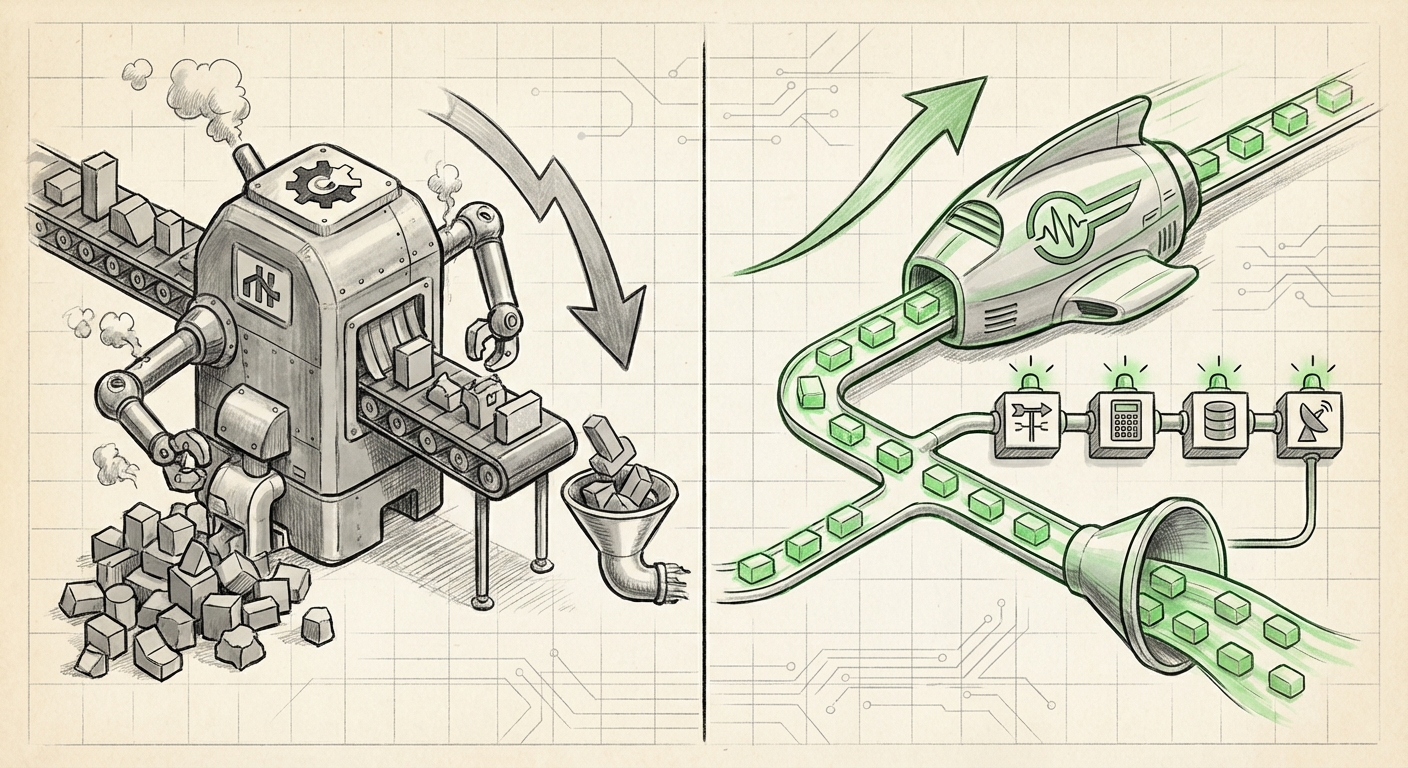
To understand why fenceless matters, it helps to see what the fence actually does. It is a physical admission of ignorance. When a robot cannot reliably tell the difference between a cardboard box and a person's arm, you build a wall and call it safety.
That wall costs money in ways most people never count. Fenced cells eat floor space. They force a specific layout. They slow down maintenance because every human entry means a shutdown. They make it expensive to change a process, because moving the fence means re-engineering the safety review. And they lock automation into big, fixed, single-purpose installations that only make sense at very high volume.
Fenceless operation is the opposite of all that. It means the robot is expected to notice a person, understand what that person is likely to do, and behave safely, every second, without a supervisor watching. That is not a mechanical achievement. It is an intelligence achievement.
What Has to Be True Before a Robot Loses the Cage
For a machine to share open floor with people, several things have to work at once, and they all have to work together:
- Perception that does not blink. The robot has to see people, track them, and keep tracking them even when they are partly hidden behind a cart, a shelf, or another worker.
- Prediction, not just detection. Knowing where a person is right now is trivial. Knowing where they will be in two seconds, and whether they are walking toward you or past you, is the hard part. This is where modern AI earns its keep.
- Motion that yields. When uncertainty rises, the robot must slow down or stop. Safe systems are designed to fail gently, not to win the argument.
- Hardware that can be trusted. Brakes, sensors, joints, and power systems need redundancy. A robot that depends on one sensor to avoid hurting someone is a robot with a single point of failure and a legal department's worst nightmare.
- A story you can defend. Safety certifiers, insurers, and regulators want to see a documented case for why the system is safe, not just a demo that happened to go well.
Notice how much of that list is software and judgment, not metal. The legs, the arms, the battery, those get the headlines. The thing that decides whether you can deploy a thousand of these or ten is whether the robot's brain can be trusted around a tired warehouse worker at the end of a night shift.
Why "Fenceless" Is a Bigger Deal Than Walking
Humanoid robotics has spent years winning applause for the wrong reasons. Backflips, parkour, picking up a suitcase, these are great videos and poor business cases. Balance is impressive, but balance is largely a solved engineering problem with well-understood physics.
Sharing space safely with unpredictable humans is something else entirely. People do not move in straight lines. They stop suddenly, turn without signaling, carry things that block sight lines, and take shortcuts through places they should not be. A robot that can only handle the average case is a robot that will eventually meet the exception.
So when a company says its robot can operate without fences, it is really making a claim about its AI stack. It is saying the perception, prediction, and decision layers are good enough to make safety a property of the system rather than a property of the building.
From Chatbots to Physical AI
This is the part that matters beyond warehouses.
The last few years of AI progress have mostly happened on screens. Models that write, summarize, code, and answer questions. Valuable, but contained. The next phase, the one this announcement points toward, is AI that has a body, a location, and consequences.
Call it physical AI. The moment a model controls a machine that weighs as much as a person and moves with force, three things change:
- Mistakes have a cost that cannot be rolled back. You cannot undo a bad output with a regenerate button.
- The world becomes the training ground. Real environments are messy in ways simulations never fully capture. Every deployment teaches the system something no lab can.
- Trust must be earned in public. A chatbot that fails is embarrassing. A robot that fails is a news story and a lawsuit.
That pressure is exactly what makes fenceless robots such an important test case. It forces AI researchers to build systems that know what they do not know, and behave conservatively when they are unsure. That skill, sometimes called calibrated uncertainty, is one of the most valuable and least glamorous abilities an AI system can have. A robot that confidently misjudges a person's path is dangerous. A robot that slows down when confused is merely cautious.
What Fenceless Robots Change for Business
If the fence disappears, the economics of automation shift in several directions at once.
Layout stops being destiny
Fixed cells force fixed processes. Remove the cage and you can move a robot to where the work is, retrain it for a new task, and shift the line without a construction project. That flexibility is worth more than raw speed in most real facilities, where demand changes faster than buildings do.
The break-even point drops
Big automation has always been a volume game: expensive to install, so you need years of steady, high-volume work to justify it. A fenceless robot that can be redeployed across tasks lowers that bar. It opens automation to mid-sized operations that were never big enough for a traditional cell, and that is a much larger market.
Humans and robots stop competing for space
The most wasteful part of a fenced facility is the duplication. You need people to do the flexible work and robots to do the repetitive work, but you cannot mix them, so you build two flows. Fenceless operation lets you run one flow with both. That is where the real productivity gain lives, not in replacing a person, but in removing the wall that made their job harder.
Maintenance and uptime improve
Every time a human needs to enter a fenced cell, production stops. Remove the fence and routine checks, adjustments, and interventions become ordinary work instead of scheduled events. Uptime goes up almost for free.
The Workforce Question Nobody Can Skip
Whenever a robot gets more capable, the same argument restarts. One side says jobs are disappearing. The other says automation creates new roles. Both are partly right, and both usually miss the detail that matters most: it is tasks that get automated first, not jobs.
A warehouse job is not one thing. It is walking, lifting, scanning, sorting, checking, deciding, and coordinating. Fenceless robots are good at the repetitive, physical, location-bound parts. Humans remain far better at handling the weird case, the damaged package, the last-minute change, the judgment call.
The realistic near-term outcome is a shift in job content, not a sudden disappearance of job titles. The tasks that get handed off tend to be the most physically punishing ones, the ones that cause injuries and burnout and high turnover. That is not a small thing. In many operations, the hardest problem is not labor cost. It is labor retention.
The risk is different and more subtle. If a robot can work anywhere a person can, companies gain the ability to redesign jobs around the robot's strengths rather than the human's. That can be genuinely good, or it can mean people spend their shifts feeding a machine at its pace. Which version happens depends far more on management choices than on the technology.
Safety, Liability, and the Rules That Come Next
Fenceless robots will not be governed by a single new law. They will be governed by a patchwork: existing workplace safety rules, industry standards for collaborative operation, insurance requirements, and, eventually, the memory of the first serious accident.
That last one is the wildcard. Industrial safety culture is built on incident data, and there is not much data yet on humanoid robots working in open floor space at scale. Early deployments will be watched closely. A single well-publicized injury could slow the entire category, no matter how good the underlying technology is.
Smart operators will treat this as a design constraint, not a public relations problem. That means logging everything, being conservative about speed near people, defining clear zones of expected behavior, and building the kind of safety record that lets insurers price the risk comfortably. The companies that get certification and insurance early will move faster later, because they will have already answered the question everyone else is still arguing about.
Actionable Insights: What to Do Now
- Audit your floor for fenceless potential. Find the tasks where a fence exists purely for safety rather than for process control. Those are the first candidates.
- Measure the hidden cost of your cages. Floor space, downtime for entry, layout rigidity, re-engineering cost. Most teams have never added these up, and the number is usually bigger than expected.
- Start with the worst job, not the easiest one. The strongest early business case is usually the task nobody wants, high injury rate, high turnover, hard to staff.
- Demand evidence, not videos. Ask vendors for safety documentation, failure modes, and how the system behaves when it is uncertain. A demo shows the best case. Safety lives in the worst case.
- Talk to your insurer early. Coverage terms will shape what you can deploy long before any regulator does.
- Plan for retraining, not just installation. The humans who work alongside these systems need to understand what the robot will and will not do. Confusion about that is a safety issue, not a training nicety.
- Keep your data. Every hour of real operation is training data and safety evidence at the same time. It compounds in value.
What to Watch Next
A few signals will tell you whether this is a real turning point or a well-timed announcement:
- Independent safety certification for fenceless operation, not just a company claim.
- Named deployments at scale in facilities that are not pilot programs.
- Incident data. The absence of reported injuries over time is the strongest possible argument.
- Copycats. When competitors rush to make the same claim, you will know the floor has genuinely moved.
The Bigger Picture
The most important thing about a fenceless robot is not the robot. It is what the claim reveals about where AI is heading.
We have spent years teaching machines to talk. The next decade is about teaching them to behave, to move through our world, understand our intentions, and know when to stop. That is a harder problem than generating text, because the feedback is slower, the stakes are physical, and there is no undo.
Agility Robotics saying its Digit 5 can work beside people without a fence is, in that light, a bet on a future where AI is judged not by how clever it sounds but by how safely it shares a room with us. The fence was always a confession that we did not trust the machine. Taking it down is the first real proof that we might.
For businesses, the message is to start measuring now, floor space, injury rates, turnover, flexibility. For everyone else, the message is simpler. The robots are not coming for your job this year. But the wall that kept them away from you is starting to come down, and everything about how work is organized sits on the other side of it.