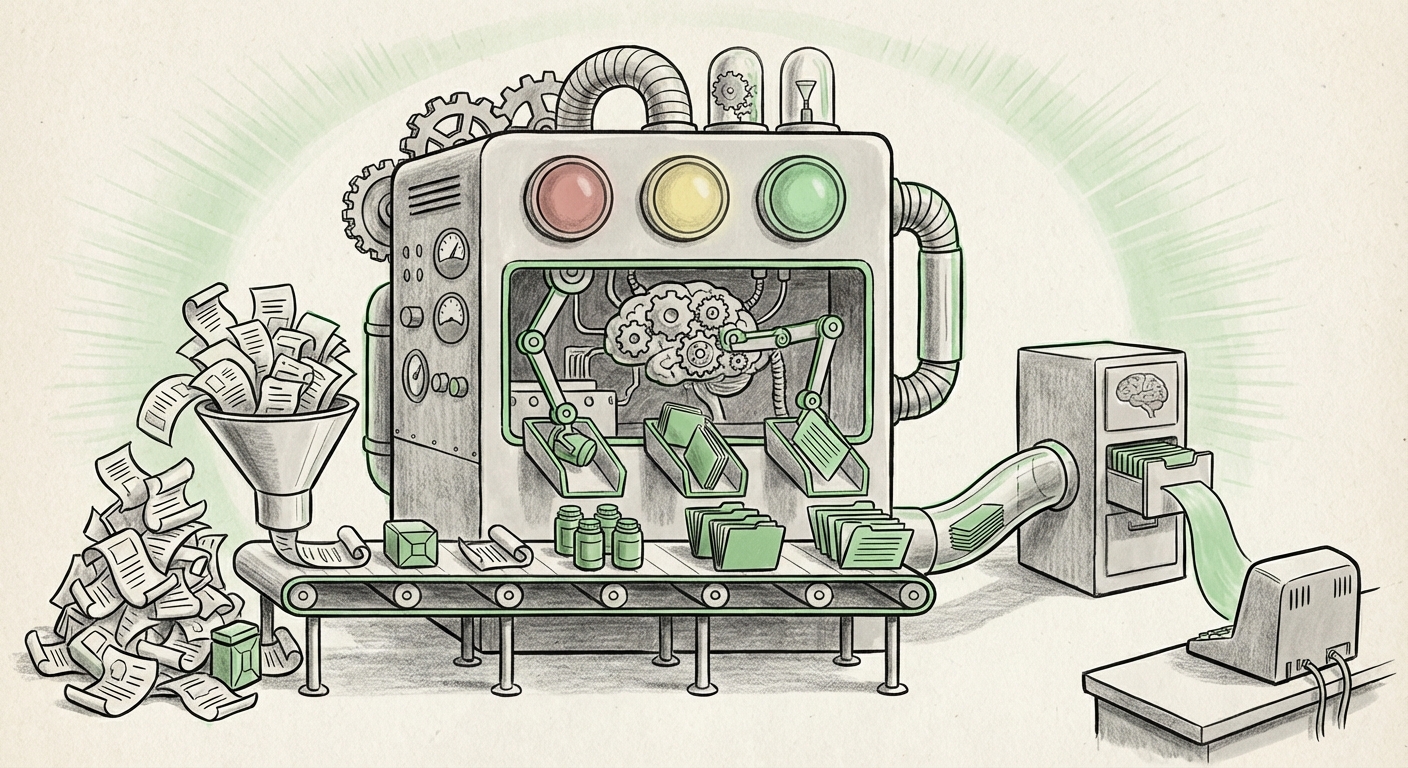
When the Factory Starts Building Itself: What Self-Improving AI Means for the Future
The most important shift in artificial intelligence right now is not a bigger model or a faster chip. It is something stranger and much more consequential: the tools we build are starting to build the next generation of tools. The question driving the next phase of the industry is no longer "how smart can a single model get?" It is "what happens when the loop that creates intelligence starts to close on itself?"
That is the theme summed up in the idea of the factory that starts building itself. It is a powerful picture, and it captures something real about where AI is heading. It also hides a lot of detail that businesses and ordinary people need to understand, because the difference between a self-improving system that quietly compounds and one that quietly breaks is mostly about the boring parts, verification, incentives, and trust.
The Core Idea: Closing the Loop
Nearly every technology in history has followed the same pattern. Humans design a tool. The tool makes the next tool slightly easier to build. Progress moves forward, but always with people standing in the middle of the flow, doing the hard, slow, creative work.
AI changes the shape of that pattern because the "tool" is general purpose. Software that can write software can, in principle, help design a better version of itself. A robot that can assemble a machine can, in principle, help assemble the machines that build more robots. When you take humans out of the middle of that loop, you get something that looks less like a straight line of progress and more like a curve that bends upward on its own.
This is often called recursive self-improvement. The name sounds dramatic, and it is, but it describes something mechanical. Each turn of the loop produces a small gain. The gain is fed back in. The next turn is a little faster. Nothing about any single step is magic. The magic, if there is any, is in the compounding.
Three Layers Where the Loop Is Closing
It helps to think about self-improvement in layers, because each layer moves at a different speed and carries different risks.
1. Software improving software
This is the layer moving fastest. AI systems now routinely write code, suggest optimisations, generate test suites, and translate research ideas into working prototypes. The key change is that AI is increasingly used to improve the AI stack itself: data pipelines, training infrastructure, evaluation harnesses, and even the design of new experiments. When the system that runs experiments can suggest the next experiment, the pace of iteration stops being limited by how many humans you can hire.
2. Software improving hardware
The second layer is slower but arguably more important. Chip design, materials discovery, and manufacturing process tuning are all domains where search is expensive and human intuition has limits. AI-driven design tools shorten the cycle between an idea and a tested physical part. Because hardware has to be fabricated, validated, and manufactured at scale, this layer moves in months and years rather than days, but it feeds directly back into the first layer by making compute cheaper and more capable.
3. Factories improving factories
The third layer is the one the metaphor points at most directly. Automation has existed for decades, but it has usually been fixed automation: a machine does one task, forever, and humans reconfigure it when the product changes. The newer pattern is flexible automation, systems that sense, adjust, and retask themselves, with AI coordinating robots, scheduling, quality control, and supply flow. When the plant that makes the machines is also run by the machines, the cost of adding capacity falls, and the loop between design and production tightens again.
Put the three layers together and you get a system where better AI helps design better chips, better chips run better AI, and better automation builds more of both.
Why Compounding Changes the Business Conversation
Business leaders are used to thinking about technology adoption as a project: pick a tool, roll it out, measure the return. Self-improving systems break that model in three ways.
Cost curves bend. When part of the improvement work is automated, the cost of getting better at a task falls faster than the cost of doing the task. Capabilities that were premium-priced last year become table stakes. Any strategy built on "we have access to the good model" has a short shelf life.
Moats move. If raw capability becomes widely available, advantage shifts to things that are hard to copy: proprietary data, distribution, workflow integration, regulatory licences, customer trust, and, critically, the ability to verify that an output is correct. Verification is the new bottleneck, and it is where most of the value will sit.
Planning horizons shrink. Forecasting tools two or three years out is dangerous when the underlying capability curve is being pushed by an accelerating loop. The practical answer is not to predict better. It is to build systems that can be re-pointed quickly when prediction fails.
The Friction Points Nobody Should Skip
An upward-bending curve is not the same as a smooth one. Several forces push back hard.
- The verification gap. A system that generates a thousand candidate designs is only useful if you can cheaply tell which ones are good. In many domains, checking the work is as expensive as doing it. This is why evaluation and testing infrastructure is quietly becoming one of the most valuable parts of the AI stack.
- Error compounding. Loops amplify whatever is inside them. Small biases, bad data, and sloppy feedback become systematic drift when they are fed back over many cycles. Self-improvement without strong correction mechanisms is just faster decay.
- Physical limits. Energy, land, water, rare materials, and fabrication capacity cannot be recursed away. Software loops run at the speed of electrons; the physical world runs at the speed of supply chains.
- Human bottlenecks relocate. Automation does not remove human involvement; it moves it. When generation becomes cheap, judgement, taste, accountability, and liability become the scarce inputs. Those do not scale by adding servers.
- Governance lag. Rules, safety norms, and accountability frameworks are written on political timescales. Technical capability is not. That gap is where most of the social risk lives.
What It Means for How AI Will Actually Be Used
The practical takeaway is that AI will increasingly be deployed not as a tool you pick up, but as a process that runs. That changes the job description of the technology inside an organisation.
Expect AI to be embedded in the parts of a business that are repetitive, high-volume, and measurable, the places where a system can generate options, test them, and learn from the results without waiting for a meeting. Expect humans to concentrate on setting objectives, defining what "good" looks like, handling exceptions, and owning the consequences. Expect the org chart to flatten in the middle, where coordination work used to live, and thicken at the top and bottom, where judgement and execution live.
For individuals, the useful mental model is not "will a machine take my job?" It is "is my work mostly generation or mostly verification?" Generation is being automated quickly. Verification, knowing what is right, safe, legal, and worth doing, is being automated slowly, and it is where durable careers will be built.
An Actionable Playbook
If the loop is closing, the sensible response is not to guess the future. It is to position yourself so that you benefit whichever way it bends.
- Invest in evaluation before you invest in generation. If you cannot tell good output from bad at scale, more automation just makes you wrong faster.
- Own your feedback data. The loop needs a signal. Whoever controls the signal that tells the system what "better" means controls the direction of improvement.
- Build for re-pointing, not for permanence. Design workflows so the model underneath can be swapped without rebuilding the business process around it.
- Map your human bottlenecks honestly. Find the steps where a person must approve, interpret, or take responsibility. That is your real constraint, and it is where you should spend your improvement budget.
- Watch the physical layer. Energy, chips, and fabrication capacity are the limits that software cannot wish away. They will set the ceiling on how fast any of this actually happens.
- Keep a human accountable for the loop. Systems that improve themselves still need someone who can stop them. That is not a limitation of the technology, it is the point of it.
The Bigger Picture
The image of a factory building itself is compelling because it suggests a world where effort is no longer required. The reality is more interesting. What is actually happening is that effort is being relocated, away from producing things and toward deciding what should be produced, checking that it was produced correctly, and taking responsibility when it was not.
That is a genuinely new economic arrangement, and it will not arrive all at once. It will arrive as a series of unremarkable upgrades: a better test harness here, an automated design pass there, a plant that retasks itself overnight. Each step will look small. The compounding is what will make it look sudden in hindsight.
The organisations and people who do well in that world will be the ones who treated self-improvement not as a sci-fi event to argue about, but as an engineering property to manage, with good measurement, clear ownership, and an honest understanding of where the loop is real and where it is still just a metaphor.