Your AI Factory Is Running, But What Is It Actually Producing?
A factory can run all day and still lose money. The lights are on. The machines are humming. The workers are busy. And at the end of the month, the warehouse is full of something nobody wants to buy.
That is the exact moment many organizations have reached with artificial intelligence. The question being asked now is not whether the AI factory is running. It is. The question is what is coming off the line, and whether anyone can name it, measure it, or sell it.
This is the shift that will define the next phase of AI. Not "can we do it?" but "what did it produce?" Everything about how AI gets built, bought, and used is about to reorganize around that single, uncomfortable question.
The Factory Metaphor Stopped Being a Metaphor
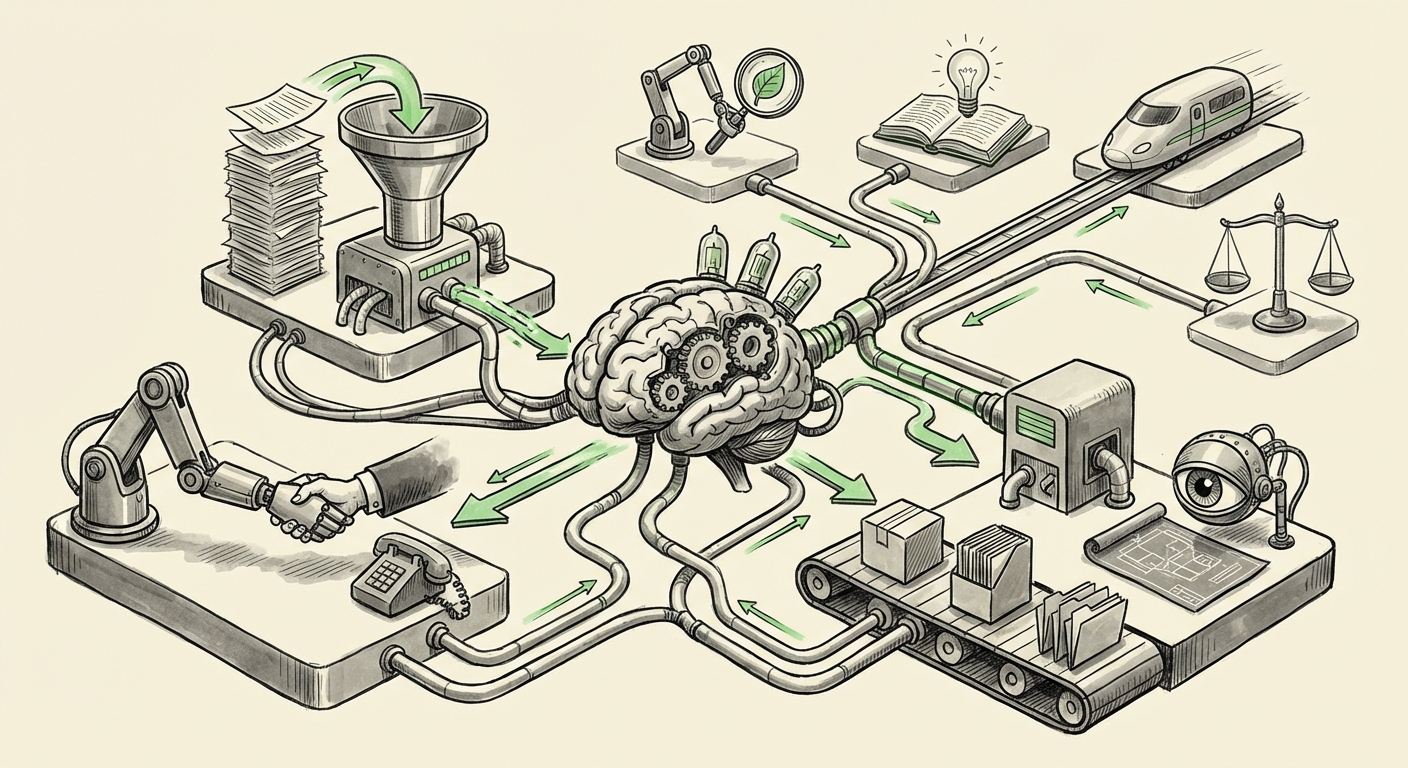
For years, "AI factory" was a nice way to describe a data center full of specialized chips. It was a marketing phrase. It is no longer.
Modern AI operations have all the parts of a real industrial plant:
- Raw materials: data, electricity, cooling capacity, and floor space.
- Machinery: compute clusters that train models and serve answers to millions of requests.
- Labor: engineers, data teams, and the people who clean and label the inputs.
- Output: predictions, text, images, code, decisions, and scores.
Once you see it that way, you can no longer avoid the question every plant manager has to answer: what is the yield, and what is it worth?
Inputs Are Easy. That Is the Problem.
Here is why so many AI programs feel successful while producing very little. Inputs are visible, countable, and easy to approve. Outputs are messy, delayed, and hard to attribute.
So organizations default to measuring what is easy:
- How many chips are running?
- How many people are on the AI team?
- How many prompts or requests were handled?
- How much of the budget was spent?
- How many pilots were launched?
Every one of these is an input measure. None of them answers the only question that matters: what changed in the business because this thing exists?
This is the classic trap of any industrial build-out. When you are pouring concrete and installing machines, activity feels like progress. It is not. Progress is what the machine makes.
Tokens Are Not Products
The most common mistake right now is treating generated content as output. It is not. It is a unit of work, like the number of turns a lathe makes. The lathe turning is necessary. It is not the product.
A system that produces a million words nobody reads has produced nothing. A system that produces one sentence that stops a fraudulent payment has produced something real. Volume and value live in completely different places.
The same goes for speed. Faster is only better if the thing being made faster is worth making at all. Making the wrong thing twice as fast simply means you get to the wrong place sooner.
Four Kinds of Output an AI Factory Can Actually Produce
When organizations do the hard work of naming their output, it almost always falls into one of four buckets.
1. Replacement Output
Work that people used to do, now done by a system. The value is measured in hours returned, cost avoided, or errors removed. The test is simple: if the system vanished tomorrow, would the work go back to a human?
2. Speed Output
The same work, done faster. Value shows up as shorter cycle times, a contract reviewed in minutes instead of days, a support ticket closed before the customer gives up. Speed is measurable, which makes it one of the easiest outputs to prove.
3. New Capability Output
Work that simply could not be done before at any price. Reading every document in a contract archive. Scoring risk across a catalog too large for humans to review. This is where the biggest wins hide, and where most measurement frameworks break down, because there is no "before" number to compare against.
4. Decision Output
Better choices made at scale. This is the hardest to measure and often the most valuable. A slightly better decision, repeated a million times, compounds into something enormous, or catastrophic if the decision is wrong.
For each of these, the sharpest question is the counterfactual: what would have happened without it? If you cannot answer that, you do not have a product. You have activity.
Why This Question Defines the Future of AI
Every major technology wave moves through the same three stages. First comes capability, can it be done? Then comes capacity, can it be done at scale? Then comes value, is it worth doing at scale?
AI has moved quickly through the first two. The build-out of compute, the rush to deploy, the endless stream of new capabilities, that is the factory being constructed. The third stage is where we are arriving now, and it is far less forgiving.
Capacity without value does not survive. Capital is patient for a while. Then it is not. Boards ask for returns. Budgets get reviewed. Programs that cannot say what they produce get cut first, regardless of how impressive the demos were.
This is not a failure of AI. It is a normal maturation. The companies that win the next phase will not be the ones with the biggest machines. They will be the ones that can point at a number and explain exactly how it got there.
The Three Traps That Keep Factories Idle
Pilot Purgatory
Endless small experiments that never reach production. Each one teaches something. None of them ships. The factory stays warm and produces nothing you can sell.
Demo-Driven Development
Optimizing for the impressive moment in front of an audience rather than the boring Tuesday afternoon when the system has to work reliably for real users. Demos measure the ceiling. Production measures the floor.
Volume as a KPI
Reporting usage numbers because they always go up. Usage is a leading indicator at best. It can rise while value falls, more requests, more cost, more noise, no improvement in outcomes.
What This Means for Society and Work
The output question is not just a business concern. It shapes what happens to jobs, communities, and trust.
If the real output is replacement, the conversation is about retraining and role redesign, and it needs to happen before the system ships, not after. If the real output is speed or new capability, the conversation is usually about growth, teams doing more, not fewer, of the things that matter.
Knowing which one you are building changes everything about how you manage the transition.
There is also the physical side. An AI factory consumes real power and real water and sits in real places. Communities notice. The output question applies there too: what is this facility producing for the region that hosts it? That question will only get louder as build-outs continue.
And then there is accountability. When a decision comes off the line, someone has to own it. A factory with no quality control does not stay in business long.
How to Audit Your Own AI Factory
If you want to know what your AI investment is actually producing, start with these questions. They are uncomfortable, which is why they work.
- Name the single output. Not the technology. The thing that comes off the line. If you need more than one sentence, you are describing a project, not a product.
- Name the consumer. Who receives this output and acts on it? If nobody acts on it, it is not an output.
- State the counterfactual. What happens today without this system? Write it down before you build.
- Calculate cost per outcome. Not cost per request. Cost per real result. This number is the only one that gets better with scale in a meaningful way.
- Define the failure signal. How would you know within a week if this stopped working? If the answer is "we wouldn't," you do not have monitoring. You have hope.
- Check the day-90 test. Will this still be running and used three months from now, without a special team pushing it? If not, it is a demo wearing a product's clothes.
Teams that can answer these questions move faster, not slower. They kill bad projects early, double down on the ones that work, and stop arguing about AI in the abstract.
The Road Ahead
Expect the next phase of AI to look less like a research race and more like manufacturing operations. Fewer announcements about what is possible, more reporting on what was delivered. More focus on reliability, cost per outcome, and quality control. More pressure to prove that the machine earns its keep.
That is healthier for everyone. It forces clear thinking. It rewards organizations that pick narrow, valuable problems instead of chasing every new capability. And it separates the real factories from the expensive showrooms.
The AI factory is running. The only question left is the one every plant manager has always had to answer: what did we make today, and who is buying it?