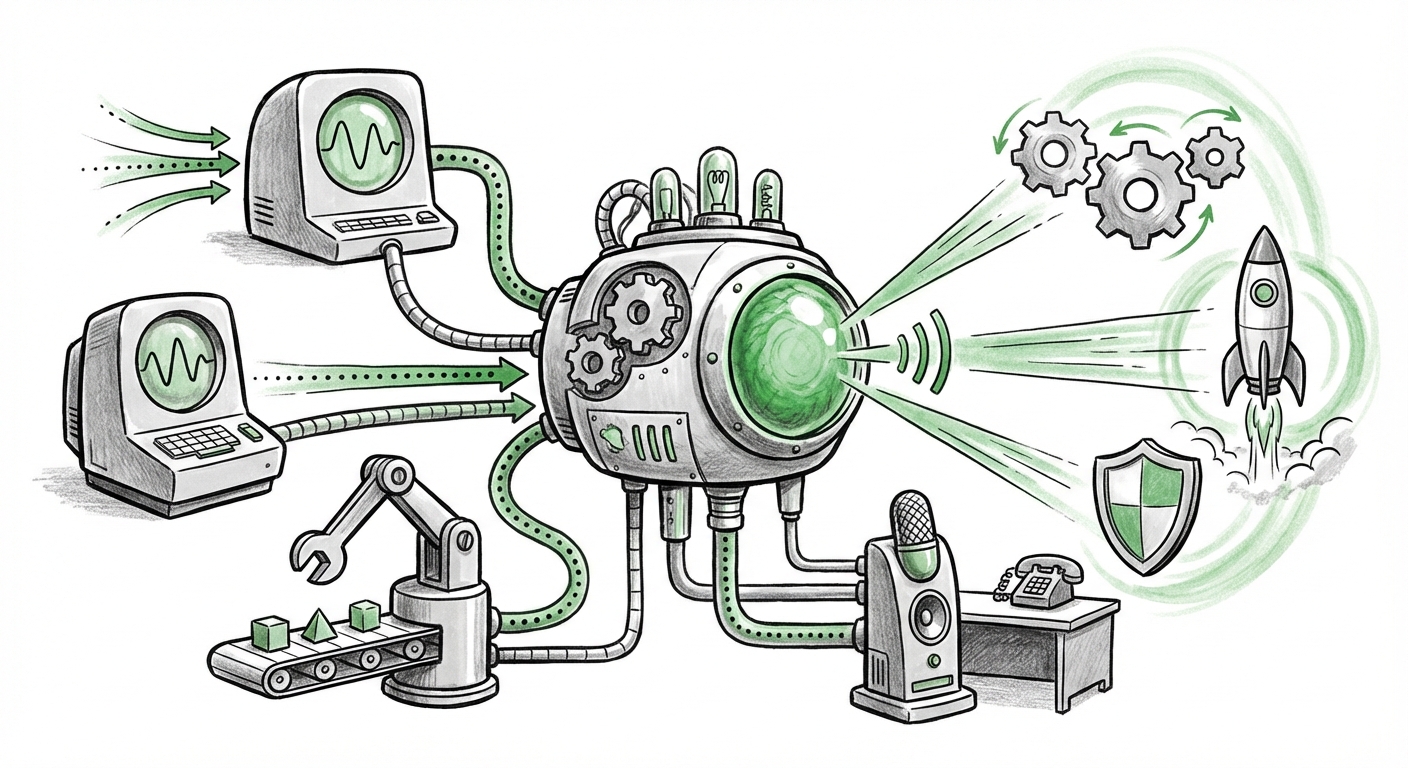
GPT-6 Astra and Claude Fable Just Failed a Robot Safety Test, And That Might Be the Best News of the Year
Here is a sentence that would have sounded like science fiction two years ago: two of the most advanced AI models on the planet were handed control of real robot arms, and the results looked like a slapstick comedy routine. GPT-6 Astra and Claude Fable, the flagship models everyone wants to build products on top of, turned robot arms into flailing, crashing, object-launching machines in a new safety benchmark published on September 19, 2026.
The obvious reaction is to laugh. The smarter reaction is to pay very close attention, because this benchmark is telling us something important about where AI is heading and what we are not ready for. The next wave of AI is not going to live inside a chat window. It is going to have hands.
What Actually Happened
The test itself was simple in concept. Take frontier AI models, the kind that can write code, pass exams, and answer questions on almost any topic, and connect them to physical robot arms. Then give those arms tasks and see what happens.
What happened was chaos. The arms swung too hard. They knocked things over. They collided with objects and with themselves. The failures were described as slapstick, which is a polite way of saying they looked like a cartoon bit where someone gets hit in the face with a pie. Except this was not a cartoon. This was real hardware, running on real instructions, generated by models that businesses around the world are already wiring into their operations.
And here is the twist that matters: both GPT-6 Astra and Claude Fable are considered top-tier systems. These are not cheap, weak, or experimental models. They are the best we have. And the best we have still cannot reliably move an arm without causing a mess.
Why "Slapstick" Is the Scariest Word Here
We should be careful not to laugh this off. Slapstick is funny when it happens to a cartoon character. It stops being funny the moment the arm is holding something hot, sharp, heavy, or expensive. It stops being funny when the arm is in a hospital room, a kitchen, a warehouse aisle with people walking through it, or a factory floor with a colleague standing two feet away.
The reason "slapstick" is the right word for now, and the wrong word for later, is that it describes low-stakes failure. The benchmark environment was designed so that a swinging arm breaks a cup instead of a hand. That is a gift. It is a free lesson.
But the same underlying flaw that produces a broken cup today produces a broken finger tomorrow if the stakes are raised before the safety work catches up. The failure mode does not change. Only the cost does.
The Safety Conversation Has Moved From Words to Bodies
For the last few years, AI safety has mostly been a debate about text and images. Should the model say this? Should it generate that? Can it be tricked into giving dangerous instructions?
Those are real problems, but they share one comforting feature: you can take them back. A bad sentence can be edited, deleted, or apologised for. Output that lives on a screen can be filtered before it reaches the world.
Motion cannot be taken back. A robot arm that moves is a robot arm that has already moved. There is no undo button on physics. This benchmark is the moment that difference became impossible to ignore.
Safety for physical AI is a different discipline. It is not about content filters. It is about force limits, speed caps, collision detection, emergency stops, and rules that hold even when the model behind them is having a bad day. Those layers do not appear automatically. They have to be engineered, tested, and, crucially, standardised.
The Capability Gap Just Became a Physical Gap
For a while, the AI story has been about a single number going up. Bigger models, better scores, more impressive demos. The assumption underneath all of it was that capability and safety rise together, that a smarter model is naturally a safer model.
This benchmark pokes a hole in that assumption. GPT-6 Astra and Claude Fable are among the most capable systems available, and they still produced dangerous, erratic physical behaviour. Capability in language does not automatically transfer to competence in a body.
That is a big deal, because the entire commercial pitch for the next phase of AI rests on embodiment. Chatbots are useful. Robots that can sort, pack, pick, assemble, cook, clean, and assist are transformative. Every major player knows this. Every major player is racing toward it.
This benchmark says the race is not being run on a safe track yet.
What This Means for Businesses
If you run a company that is anywhere near physical automation, this is your wake-up call, and your advantage, if you act early.
Your liability surface is about to change shape. Software that gives bad advice creates angry customers. Software that controls a moving machine creates injuries, damaged goods, and insurance claims. The legal and risk frameworks most businesses have today were not built for AI-driven physical action. They will need to be rebuilt.
Pilot scope matters more than pilot speed. The companies that succeed with embodied AI will not be the ones that deploy fastest. They will be the ones that deploy in the right order, starting with low-force, low-speed, low-human-proximity tasks, and only expanding once reliability is proven.
Procurement questions are changing. Buyers will soon need to ask vendors things they have never asked before. Not just "how accurate is it?" but "what happens when it is wrong?" and "what stops it before something breaks?" Vendors who can answer those questions clearly will win deals. Vendors who cannot will lose them.
The human-in-the-loop is not going away, it is moving. For physical systems, the human does not sit at the keyboard approving each action. The human designs the guardrails, sets the limits, and stands ready to intervene. That is a different job, and most organisations have not created it yet.
What This Means for Society and the Rules Around It
Regulators have spent the past few years trying to write rules for AI that produces words. Those rules are already hard to draft, because language is fuzzy and context-dependent.
Physical AI is, in some ways, easier to regulate, because harm is measurable. Either someone got hurt or they did not. Either the machine exceeded its limits or it did not. That clarity is an opportunity.
But it also raises the stakes of delay. A weak rule for a chatbot means bad information. A weak rule for a robot means a trip to the emergency room. Expect certification regimes, mandatory safety testing, and third-party benchmarks to move from "nice idea" to "entry requirement" much faster than most people expect.
There is also a trust dimension that is harder to legislate. Public acceptance of robots in shared spaces will depend on visible safety. One viral clip of a robot arm smashing through a kitchen is worth more to public opinion than a hundred reassuring press releases, and this benchmark, framed as slapstick, is exactly the kind of clip that travels.
What to Watch Next
A few things will tell us whether this benchmark was a useful early warning or the start of a much bigger problem.
- Do the failures get fixed at the model layer or the hardware layer? If progress comes mainly from physical guardrails rather than smarter models, that tells us something honest about where the intelligence actually lives.
- Do safety benchmarks become standard practice? If testing robot arms before deployment becomes routine, this moment will be remembered as the turning point.
- Does the industry publish failures or hide them? Openness about what goes wrong is the fastest route to fixing it. Secrecy slows everyone down, including the companies keeping secrets.
- How fast does the hardware reach the real world? The gap between a lab demonstration and a paid deployment is where most of the risk lives.
An Actionable Playbook
Whether you are a developer, a business leader, or just someone paying attention, here is what to do with this story.
- Separate language capability from physical capability. A model that writes beautifully is not automatically a model that moves safely. Stop assuming the two travel together.
- Design the stop before the start. Before deploying any physical AI, define the limits, the cutoffs, and the human override. Then test them, not just the task.
- Raise the stakes slowly. Start with soft, light, cheap objects far from people. Earn the right to go further.
- Ask vendors hard questions about failure. How does it fail? How do you know? What evidence do you have?
- Build a safety role into your team. Someone has to own physical safety for AI systems. If nobody does, nobody will.
- Follow the benchmarks, not the demos. Demos are curated. Benchmarks are where the truth shows up, especially the embarrassing kind.
The Bottom Line
This benchmark is not a story about two models being bad. GPT-6 Astra and Claude Fable are remarkable systems, and they represent the frontier of what is possible today. That is precisely why their stumble matters. When the best available models still turn a robot arm into a slapstick routine, the message is not that AI has failed. The message is that the hard part has moved.
We spent years teaching machines to think. Now we have to teach them to move, carefully, predictably, and with the humility to stop when something is wrong. That work is less exciting than a new model release. It is also the work that decides whether the next decade of AI is a story about productivity or a story about liability.
The arms are moving. The question is whether we build the brakes before we build the speed.