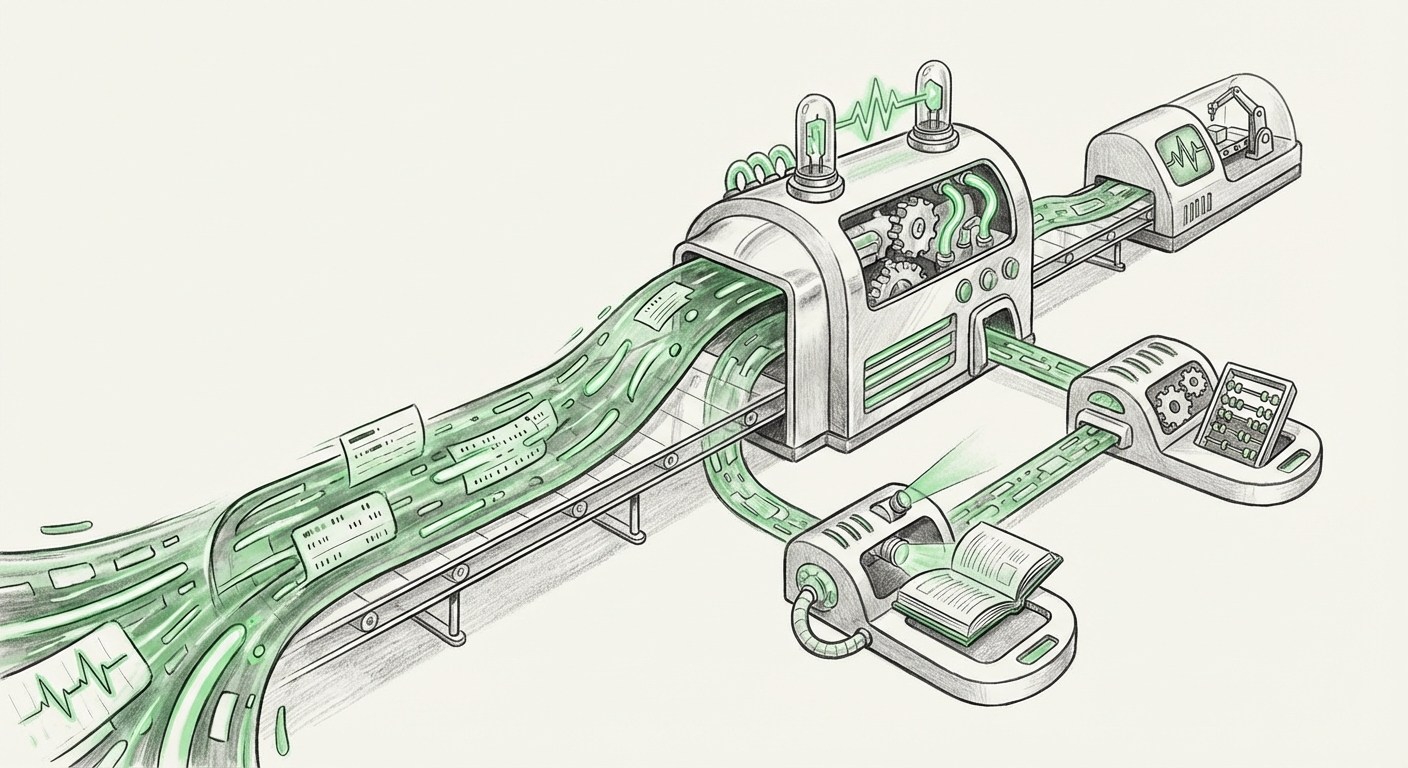
Inside Basecamp Research: How Evolution Itself Is Becoming AI Training Data
Every big leap in artificial intelligence has been powered by a bigger pile of data. First it was text scraped from the web. Then images, code, audio, and video. Now a new kind of company is asking a much stranger question: what if the best training data on Earth was never written down at all? What if it was grown, evolved, and encoded in living things over billions of years?
That is the idea at the heart of Basecamp Research, an AI startup built around a simple but radical premise. Instead of feeding models more human writing, it is feeding them biology. Nature, in this view, is not just inspiration for AI. It is the dataset.
Nature Already Solved Problems We Are Still Working On
Think about what evolution actually is. It is a search algorithm that has been running for roughly four billion years. It has tested countless designs, discarded the failures, and kept what worked. The results are everywhere: enzymes that break down plastic-like compounds, proteins that survive in boiling water, microbes that thrive in salt, acid, and crushing pressure.
Each of those solutions is stored in DNA. That means every living organism is a kind of record, a compressed file describing a design that passed the test of survival.
Basecamp Research's bet is that this record can be turned into training data for machine learning. If a model learns the patterns behind millions of natural proteins, it can start to predict new ones. Not just copy what exists, but generate designs that nature never got around to making.
This is a meaningful shift. Most large AI models today learn from what humans have already said, written, or built. Biological AI learns from what life has already survived. That is a different kind of knowledge, and in some ways a more reliable one, because it has been validated by reality rather than by consensus.
From Web Scraping to World Sampling
The web gave AI an incredible head start. But it has limits. Text is finite, messy, and increasingly locked behind paywalls, copyright fights, and platform rules. More importantly, the internet describes the world secondhand. It is a summary of a summary.
Biological data is different. It is first-party. It comes from samples collected in real environments, soil, hot springs, deep ocean, extreme deserts, and sequenced directly. Nothing is paraphrased. Nothing is opinion. It is raw measurement of what actually exists.
This has a big strategic consequence. If the value of an AI model depends on the quality and uniqueness of its training data, then owning access to rare biological samples becomes a moat. You cannot scrape a glacier. You cannot download a hydrothermal vent.
That is why the "data layer" of AI is becoming the battleground. Compute can be rented. Talent can be hired. Truly novel data often cannot be copied.
Why This Matters Beyond Biology
The pattern generalizes. We are entering an era where the most valuable AI datasets are not the biggest ones, but the ones nobody else has. Expect to see the same logic play out in materials science, chemistry, weather, agriculture, and industrial sensor data. The next wave of AI companies may look less like software firms and more like field research operations.
What This Means for the Future of AI
If biological training data works at scale, several things change.
Models get grounded in physical reality. A language model can be confidently wrong. A model trained on real biological measurements has a harder time making things up, because its outputs can be tested in a lab. That is a big deal for trust.
AI moves from predicting to designing. The first phase of AI was about understanding what already exists. The next phase is generation: new proteins, new enzymes, new materials. Biology is a natural fit because the design space is enormous and the rules are consistent.
Data partnerships become as important as model architecture. If a company needs samples from many countries and ecosystems, it must build relationships, not just pipelines. That turns data sourcing into a diplomatic and ethical exercise, not just a technical one.
Scientific AI gets its own playbook. General-purpose chatbots are trained on everything. Scientific models are trained on something specific. That specialization tends to produce better results in narrow, high-value domains.
Practical Implications for Business
You do not need to be a biotech company to learn from this story. The lessons apply broadly.
- Your data advantage is your real advantage. If your training data is something anyone can buy or scrape, your model will be easy to match. Ask what you own that others cannot easily get.
- Look for "unwritten" data. Every industry has knowledge that exists only in practice, in sensors, in workshop floor experience, in unlogged process outcomes. That is the biological data equivalent for your field.
- Design for verification. The strongest AI use cases are ones where outputs can be tested against the real world. Prediction plus a lab test beats prediction alone.
- Plan for the data supply chain. Sourcing rare data involves contracts, consent, logistics, and rules. Treat it like procurement, not like an engineering task.
- Expect specialized models to beat general ones in high-value niches. A general model is a great assistant. A focused model with rare data can be a genuine competitive weapon.
The Hard Questions Nobody Can Skip
Turning nature into data raises real concerns, and they deserve straight answers.
Who owns biology? Genetic material comes from specific places and often from communities with deep ties to that land. If companies profit from it, fair benefit-sharing is not optional. The history of bioprospecting is full of cautionary tales, and repeating those mistakes would be both wrong and commercially risky.
What about biosecurity? Models that can design proteins could, in the wrong hands, be misused. Responsible release practices and screening of generated designs will matter as much as model performance.
Is the data actually representative? If samples come from a small set of environments, the model learns a narrow slice of life. Coverage matters. A model trained on one ecosystem may fail badly in another.
Can results be trusted? AI predictions in biology must be validated experimentally. The hype cycle often skips this step. Serious players build the validation loop into the product from day one.
Actionable Takeaways
For leaders trying to figure out where this is heading, here is a practical shortlist.
- Audit your unique data. List the datasets you have that competitors do not. That list is your AI roadmap.
- Start small with a testable use case. Pick one problem where you can measure whether the model is right.
- Build the data pipeline before the model. Clean, structured, permissioned data beats a flashy architecture almost every time.
- Get the legal and ethical framework right early. Consent, licensing, and benefit-sharing are much cheaper to set up before scale than after.
- Partner where you cannot collect. Universities, research institutes, and local organizations often hold access you cannot replicate.
- Watch the science-to-product gap. A model that designs a promising protein is the beginning of the process, not the end of it.
The Bigger Picture
The most interesting thing about this trend is not any single company. It is the direction of travel. For a decade, AI progress was mostly about scale, more parameters, more compute, more text. That race is maturing. The next race is about where the data comes from, and whether anyone else can get it.
Biology is the clearest example because the data is ancient, vast, and genuinely irreplaceable. But the same logic is spreading. The AI systems of the next few years will increasingly be judged not by how much they read, but by how much of the real world they actually understand.
That reframes what a modern AI company is. It is no longer just a software lab. It is a data company, a field operation, a partnership builder, and a scientific research group rolled into one. Companies that master this combination will build models that are hard to copy, because the raw material behind them cannot be copied either.
Evolution spent billions of years generating training data. It took an AI startup to realize it was sitting there the whole time, waiting to be read.