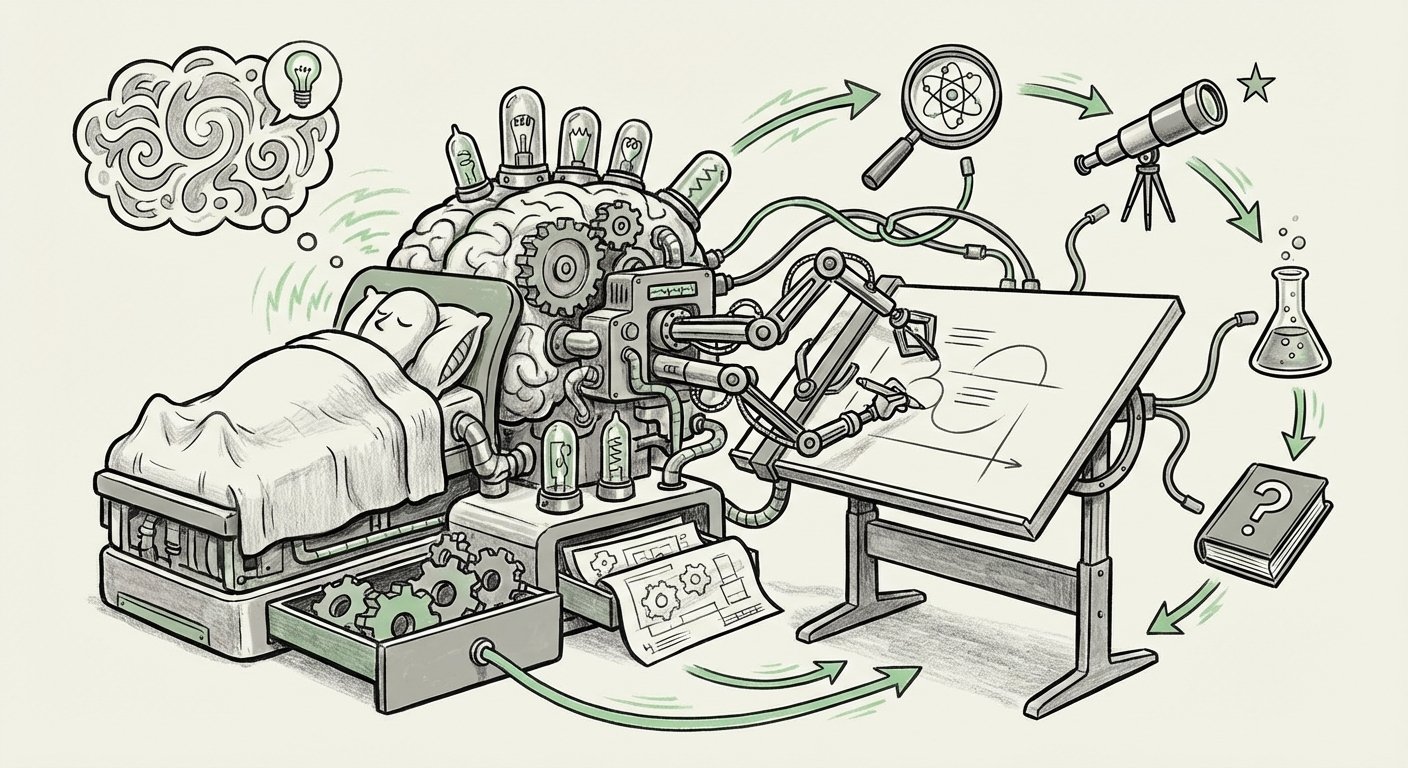
Beyond the Next Token: Why AI's Next Big Leap Isn't About Predicting the Next Word
For most of the last several years, the story of artificial intelligence could be told in one sentence: a model reads some text, and it guesses what word comes next. Do that billions of times, at enormous scale, and something that looks a lot like thinking starts to appear. That was the bet, and it paid off in ways almost nobody predicted.
But in 2026, the conversation has shifted. The most important work in AI is no longer about getting better at predicting the next token. It's about what happens after prediction, the part where a system has to plan, check its own work, use tools, remember what it learned a minute ago, and decide when it's done. That is the frontier now, and it is a very different kind of problem than the one that built the current generation of AI.
This shift matters far beyond research labs. It changes what AI can do, how much it costs, where it runs, and how businesses should plan around it. Here's what's actually happening and what it means for you.
What "Next Token" Really Means
A token is a small chunk of text, roughly a word or part of a word. When you type a question into an AI chatbot, the model doesn't read your sentence the way a person does. It breaks your words into tokens, then calculates probabilities for which token should come next. It picks one, adds it to the sequence, and repeats. Every answer you've ever gotten from a large language model was built one token at a time, left to right, like someone writing a sentence without ever being able to go back and rewrite the beginning.
This approach turned out to be shockingly powerful. It scaled. More data plus more computing power plus a simple prediction goal produced systems that can summarize contracts, write code, translate languages, and hold conversations. But the same simplicity that made it scale is also its ceiling.
Why Prediction Alone Hits a Wall
Predicting the next token rewards fluency, not correctness. A model that generates a smooth, confident, believable sentence gets the same training signal whether that sentence is true or false. That is the root of hallucination, the model isn't lying, it's doing exactly what it was trained to do: producing the most likely-sounding continuation.
There are other limits too:
- No real planning. Writing one token at a time means the model can't look ahead at the shape of a whole solution before starting.
- Weak self-checking. Once a wrong token is written, it becomes part of the context the model builds on. Errors compound.
- Wasted compute on easy problems. A model spends roughly the same effort on "what's 2+2" as on a genuinely hard multi-step reasoning task.
- Brittleness on multi-step work. Tasks that need ten correct steps in a row expose every weak link in the chain.
In other words, next-token prediction is a fantastic engine for language. It is a shaky foundation for reliable work.
What Comes After: Reasoning Before Answering
The core idea replacing pure prediction is simple to state: give the model room to think before it speaks. Instead of generating an answer directly, the system works through intermediate steps, evaluates options, discards bad paths, and only then produces the final response. This is often described as moving from token prediction to reasoning, from producing the next likely word to producing the next useful thought.
This shows up in several ways:
1. Deliberate thinking time
Models are increasingly trained and tuned to spend more effort on harder problems. A simple question gets a fast answer. A complex question triggers a longer internal process. This idea, spending compute at the moment of use, not just during training, is one of the biggest changes in how AI systems are built. It means capability can come from thinking longer, not only from training bigger.
2. Searching over solutions instead of settling for the first one
Rather than committing to the first plausible answer, systems can explore multiple candidate approaches, score them, and pick the best. That's much closer to how a careful human works through a hard problem: try, check, adjust.
3. Learning from feedback rather than just text
Prediction learns from raw text. Reasoning systems also learn from reward signals, did this answer actually work? Did the code run? Did the plan achieve the goal? That feedback loop lets models get better at tasks where there's no single "correct next word," only a better or worse outcome.
From Talking to Doing: The Rise of Agents
The clearest practical result of this shift is the agent, an AI system that doesn't just answer, but acts. An agent breaks a goal into steps, uses tools, reads results, corrects course, and keeps going until the job is done.
For a business, the difference is enormous. A chatbot tells you how to file an expense report. An agent files it, checks that it went through, and flags the ones that need a human signature. That is a different category of value.
Agents also change the failure modes. A wrong sentence is annoying. A wrong action can cost money. That's why so much attention is now going into guardrails, permissions, audit trails, and human checkpoints at the moments that matter most.
Memory, Context, and the Long Game
Another piece of "beyond the next token" is memory. A model that only predicts the next token has no persistent sense of you, your project, or last week's decision. Systems that remember, that retain useful context across sessions and tasks, behave very differently. They stop repeating questions. They build on prior work. They start to feel less like a tool you pick up and put down, and more like a colleague with a history.
The hard part isn't storing information. It's deciding what deserves to be remembered, what should be forgotten, and how to keep stale facts from poisoning new decisions. Expect this to be one of the most contested areas in the next few years, especially in regulated industries where "what does the system know about me, and why?" is a legal question, not just a technical one.
Why This Matters for Businesses Right Now
If the shift from prediction to reasoning holds, several practical consequences follow.
Costs change shape
Training a giant model is a huge upfront expense. Reasoning systems move more of the cost to use. That means budgets shift from one-time training runs to ongoing inference spend. Companies will need to decide which tasks deserve expensive deep thinking and which should be handled cheaply and instantly.
Evaluation gets harder, and more important
You can't grade a reasoning system with a simple accuracy score. You have to test whether it achieved the goal, whether it took a sensible path, and whether it behaved safely when it got confused. Teams that build strong evaluation practices early will move faster than teams that don't.
Data advantage becomes workflow advantage
When everyone has access to similar base models, the differentiator stops being the model and starts being the process around it. Who has the cleanest workflow data? Who knows which decisions are safe to automate? Who has humans in the right places? Those questions now matter more than which model you picked.
Smaller, specialised systems get a bigger role
Not every task needs a frontier-scale reasoner. Focused models, tuned for a narrow job and paired with good tooling, can deliver more reliability at a fraction of the cost. The future of enterprise AI likely looks less like one giant brain and more like a team of specialists with clear job descriptions.
What This Means for Society
The move beyond next-token prediction changes the public conversation in a few ways.
Trust becomes measurable, not mystical. When systems can show their work, users can audit it. That's good news for adoption in medicine, law, finance, and government, fields where "it sounded confident" has never been an acceptable standard.
Work shifts toward supervision. As agents take on more execution, human value concentrates in defining goals, judging outputs, and handling edge cases. That's a real skill change, and it needs real training investment, not just new software.
The energy and infrastructure question gets sharper. Reasoning uses more compute per answer. If that becomes the default, the pressure on data centres, power grids, and supply chains intensifies. Efficiency research is no longer a nice-to-have; it's a strategic constraint.
Accountability gets harder to dodge. An AI that acts can be held to account in ways a chatbot can't. Expect clearer rules about who is responsible when an automated decision goes wrong.
Actionable Insights: What to Do Now
- Map your tasks by reasoning depth. Sort work into "instant answer," "needs careful thinking," and "needs an agent that acts." Treat them as three different products with three different budgets.
- Build evaluation before you scale. Define what a good outcome looks like in measurable terms. Without that, you can't tell improvement from drift.
- Start agents in low-risk, high-volume work. Internal research, ticket triage, data cleanup, and document processing are good first homes. Keep a human checkpoint before anything irreversible.
- Invest in the boring layer. Permissions, logging, and data hygiene decide whether your AI projects survive contact with reality.
- Watch inference economics closely. The team that can route easy work to cheap models and hard work to expensive ones will quietly outperform everyone else.
- Keep people in the loop on purpose. Decide deliberately where humans review, not by accident after something breaks.
The Road Ahead
The next-token era gave us AI that could talk. The era now beginning is about AI that can think through a problem and then do something about it. That's a bigger deal than it sounds. It moves these systems from the realm of impressive demos into the realm of dependable infrastructure.
It also raises the stakes. A system that reasons can be wrong in more interesting ways. A system that acts can cause harm faster. A system that remembers can hold onto mistakes longer.
None of that argues for slowing down. It argues for building carefully, measuring honestly, and being clear about which decisions should always have a human at the table. The token-by-token guessing game built the foundation. What we build on top of it, planning, memory, action, judgement, is what will decide whether AI becomes genuinely useful at scale, or just very articulate.