A Private-Sector Robot Army? What Fedorov's Pitch Means for the Future of AI
Fedorov, the former Ukrainian Defense Minister, is pitching a private-sector robot army. Not a government program. Not a state factory. A fleet of fighting machines built, owned, and operated by companies, the same way we build planes, satellites, and delivery networks today.
That idea is bigger than one country or one conflict. It is a hint about where artificial intelligence is heading next: out of the chatbot window and into the physical world, where machines move, decide, and act on their own. And it raises a question that every business leader and policymaker will soon have to answer: who should be allowed to build and run intelligent machines that use force?
Let's break down what this pitch really means, why it is happening now, and what it tells us about the next decade of AI.
The Core Idea: Defense as a Product, Not a Project
For most of modern history, militaries built their own weapons through slow, government-run contracts. A new tank or fighter jet could take a decade to design and years more to produce. That model moves at the speed of paperwork.
Software does not work that way. A company can ship a new version of an app on a Tuesday and fix it by Friday. Fedorov's pitch borrows that rhythm and applies it to machines that drive, fly, and operate in dangerous places.
The idea has a few moving parts:
- Private companies own the fleet. Instead of a government buying hardware outright, firms build and maintain the robots.
- Software updates are continuous. Each new version learns from the last one, the same way consumer AI products improve.
- Robots replace people in the most dangerous roles. That lowers the human cost of conflict, at least in theory.
- Competition replaces central planning. Many vendors, many designs, and the best ones win on performance.
Whether or not this specific model gets adopted, the pitch signals a shift. Defense is being reframed as a market. And markets move fast.
Why AI Makes This Possible Now
Three things have changed in the last few years, and they all point the same direction.
1. Cheap sensors and cheap brains
A camera that once cost thousands of dollars now costs a few dollars. A chip that can recognize what it sees costs even less. When sensing and thinking get cheap, machines that can act on their own get cheap too.
2. Software learns faster than hardware
A new physical machine takes years to design and build. A new AI model can be retrained in days. That mismatch pushes the whole field toward platforms, flexible bodies that get smarter through downloads instead of factory rebuilds.
3. Data is the new fuel
Autonomous systems improve when they are trained on real-world conditions. The more machines you run, the more data you collect, and the better your next version becomes. That is a powerful loop. It is also a loop with serious consequences, which we will get to.
The Feedback Loop That Changes Everything
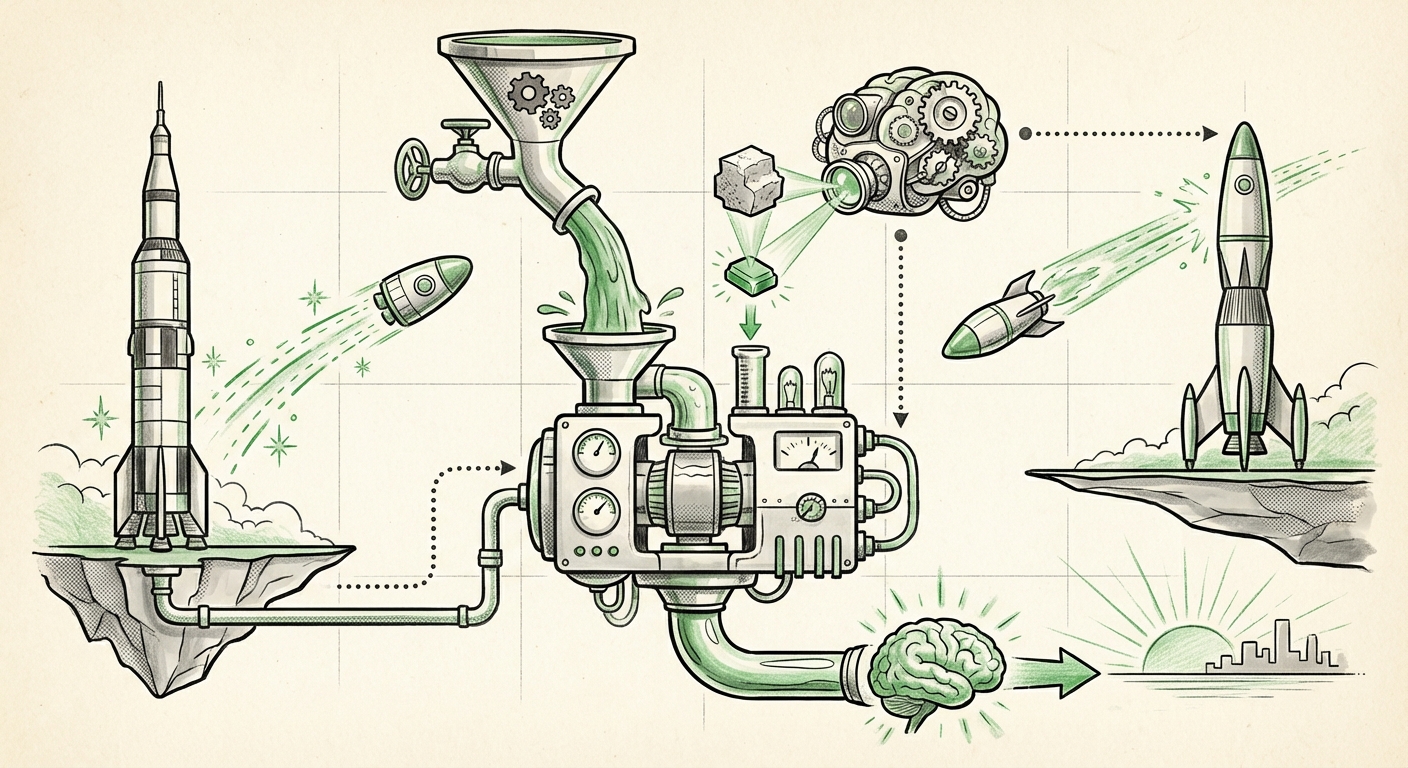
Here is the part that should interest every technology leader, not just defense analysts. Fedorov's pitch is an extreme version of a trend that is already reshaping normal business: deployed AI improves deployed AI.
When a company runs thousands of delivery robots, it collects millions of hours of real-world driving. That data makes the next model better. Better models win more contracts. More contracts mean more machines. More machines mean more data.
This is a winner-take-most dynamic. It rewards whoever deploys first and widens the gap fastest. In consumer tech, that produced a handful of dominant platforms. In robotics, it could produce a handful of dominant fleets.
The same logic applies far from any battlefield:
- Warehouses: fleets of picking robots that get better at grasping every week.
- Agriculture: machines that learn to spot disease in crops from thousands of fields at once.
- Construction and mining: autonomous haulers that learn terrain and safety patterns from every site.
- Emergency response: ground and aerial robots that enter buildings humans cannot safely enter.
In every case, the company with the most deployed units learns fastest. That is the real lesson in Fedorov's pitch. It is not just about robots. It is about compounding advantage.
What Businesses Should Take From This
You do not need a defense contract to learn from this story. A few practical ideas apply to almost any company working with AI.
Deployment beats theory
The gap between companies that use AI and companies that talk about it is now the gap between leaders and laggards. Real-world data is the scarcest asset. Get systems running in the field, even at small scale, and let the feedback loop do the work.
Design for updates, not perfection
Build systems that can be improved after launch. A machine that gets better every month is worth far more than one that is perfect on day one and frozen forever.
Think about the whole stack
Autonomous fleets need more than software. They need power, maintenance, connectivity, spare parts, insurance, and trained people. The companies that quietly own those pieces may end up more valuable than the ones building the robots.
Prepare for the trust question
The moment machines act without a human in the loop, customers and regulators start asking who is responsible. Companies that can show clear logs, clear rules, and clear accountability will move faster than those that cannot.
The Hard Problems Nobody Can Ignore
A private-sector robot army sounds efficient. It also creates risks that are genuinely new.
The accountability gap
If a machine makes a wrong decision, who answers? The company that built it? The company that operated it? The government that hired it? Right now, the law in most places has no clean answer. That gap is not just a legal headache. It is a trust problem that can stall an entire industry.
Speed versus control
The main selling point of private robotics is speed. But speed is exactly what makes oversight hard. If a fleet can be updated overnight, someone has to decide what rules are baked into that update, and who gets to check.
Proliferation
Cheap autonomous machines are hard to keep contained. The same components that power a delivery drone can power something far more dangerous. Once the technology is broadly available, export rules, licenses, and monitoring become the front line of policy.
The data question
Training on real-world conflict data is powerful and ethically complicated. What happens to that data afterward? Who owns it? Can it be reused elsewhere? These are not abstract questions. They will shape contracts, laws, and public trust.
What Governance Could Actually Look Like
We are not starting from zero. There are already well-understood building blocks that could be applied here:
- Meaningful human control. Rules that define where a human must stay in the decision chain.
- Audit trails. Systems that record what happened, why, and under whose authority.
- Certification. Independent testing before a system is allowed to operate in high-stakes settings.
- Clear liability. Laws that say who pays when something goes wrong, so companies can plan ahead.
- Export controls. Rules that slow the spread of the most sensitive capabilities.
None of this is easy. All of it is necessary. The countries and companies that build these guardrails early will likely move faster in the long run, because trust is what turns a demo into a deployment.
The Bigger Picture: AI Is Leaving the Screen
For the past few years, most public debate about AI has been about text, images, and chat. That phase is ending. The next phase is physical: machines that move, sense, and act in the real world.
Fedorov's pitch is a loud signal of that shift. It suggests a future where autonomous systems are not just products but infrastructure, owned, operated, and improved by private companies, with governments as customers rather than builders.
That future is not guaranteed. It depends on rules, public trust, economics, and how the next few years of conflict and competition play out. But the direction is clear. The companies that understand the feedback loop, design for updates, and treat accountability as a feature rather than a cost will be the ones that shape it.
The question for every leader reading this is not whether robot armies are coming. It is where else this model will show up first, and whether you are building for it or reacting to it.
Conclusion: The Real Story Is the Business Model
Strip away the drama, and Fedorov's pitch is a business model story. It asks a simple question: what happens when the fastest, most competitive part of the economy starts building machines that act in the world?
The answer is that everything speeds up. Software cycles. Learning loops. Competition. Risk. And with that speed comes a choice. We can treat accountability, safety, and oversight as taxes on progress, or as the foundation that lets progress scale.
Fedorov has put a bold idea on the table. Whether or not it becomes reality, it tells us where AI is heading next: into the physical world, at speed, with all the promise and all the problems that come with it.