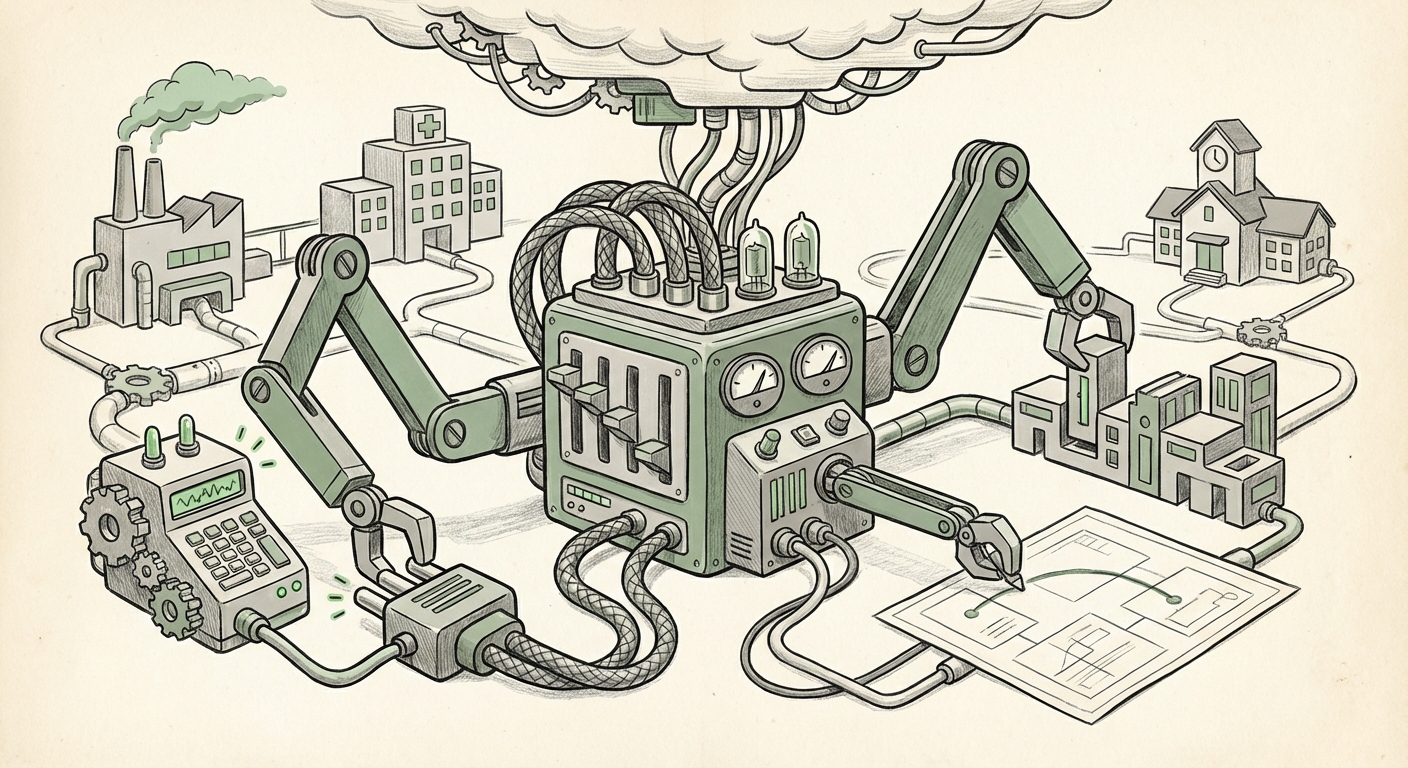
Hacker Smacker: How AI Is Turning the Tables on Cyberattackers
For years, the story of artificial intelligence and cybersecurity has been a scary one. Attackers got smarter, faster, and cheaper. Defenders got buried under alerts they could never clear. Something called a "Hacker Smacker" now points to a shift that matters far more than any single tool: AI is finally being aimed at the people doing the breaking, not just the systems being broken into.
This is a 2026 story about defense catching up. And it tells us a lot about where AI is heading next, not as a novelty, but as a core piece of the world's digital plumbing.
The Arms Race Nobody Asked For
Think of cybersecurity as an arms race. Every time defenders build a wall, attackers find a ladder. For most of the last decade, the attackers have had the better technology. They only need to succeed once. Defenders have to succeed every single time, across thousands of machines, every hour of every day.
AI changed the attacker's math first. A machine can probe thousands of targets at once, write convincing phishing messages in perfect language, and adapt when something stops working. It never sleeps, it never gets bored, and it can be run at a scale a human team simply cannot match.
Defenders, meanwhile, were drowning. The average security team sees far more alerts than it can possibly investigate. Human analysts get tired. They miss things. The result was a lopsided fight: machine-speed offense against human-speed defense.
The arrival of what people are calling a "Hacker Smacker" flips that assumption. It says: if machines are going to attack us, machines are going to defend us, and the defenders are going to move at the same speed.
What an AI "Hacker Smacker" Actually Has to Do
The name is playful, but the job is brutal. To genuinely smack back at hackers, an AI system has to do several hard things at once, and do them without human hand-holding.
- Spot the pattern before it becomes a breach. Attacks rarely announce themselves. They look like normal traffic, normal logins, normal file activity, until they don't. AI is good at noticing the "that's slightly odd" signal buried in billions of ordinary events.
- Triage at machine speed. Instead of dumping ten thousand alerts on a human, the system has to decide which three actually matter right now, and say why.
- Respond in seconds, not days. Contain a compromised account, isolate a machine, block a connection. The gap between detection and action is where damage happens.
- Keep learning. Attackers change tactics constantly. A static defense is a dead defense. The system has to update its understanding of "normal" as the environment changes.
- Explain itself. This is the part people overlook. If a security tool shuts down a critical system, someone has to justify that decision to a business leader, a regulator, or a customer. "The AI said so" is not an answer.
That last point is where most AI security projects live or die. A tool that is right but unexplainable will get switched off by the first nervous executive. A tool that is explainable but slow gets ignored by the engineers who have to live with it.
Why This Matters Beyond Security
It is tempting to file "Hacker Smacker" under "IT problem." That would be a mistake. Cyber defense is becoming the clearest, highest-stakes example of a much bigger shift in AI: the move from AI that talks to AI that acts.
Think about the difference. A chatbot that drafts an email can be wrong, and you just fix the email. An AI system that detects an attack and then takes action, blocking, isolating, shutting things down, is making real decisions in the real world, in real time, with real consequences.
That is the direction all of AI is moving. Customer service agents that issue refunds. Coding agents that ship changes. Operations agents that reroute supply chains. Every one of those steps increases the value of the AI and the cost of getting it wrong.
Security is where this pattern shows up first, because the stakes are obvious and the enemy is relentless. But the lessons learned there, how much autonomy to grant, how to audit decisions, how to keep a human in the loop without making them the bottleneck, will apply everywhere else.
The Business Case: Speed Becomes the Product
For business leaders, the practical takeaway is simple. Security used to be a cost center you funded to avoid embarrassment. Increasingly it is a speed enabler.
Here is why. Companies that cannot detect and contain an intrusion quickly have to slow everything else down. They restrict what employees can do, delay launches, and lock down systems out of fear. Companies with fast, AI-assisted defense can move faster on everything else because they are not spending their energy on damage control.
There is also a talent angle that rarely gets the attention it deserves. There are far more security jobs than there are skilled people to fill them. AI does not replace those people, it changes what they do. Instead of chasing alerts, analysts spend their time on the hard calls: strategy, hunting for threats, and judgment calls the machine cannot make.
Three questions every leader should be asking
- How fast is our response, really? Not how fast we detect. How fast do we act once we know?
- Can we explain our automated decisions? If a system acts on its own, who reviews it, and how?
- Are we training people for the new job? The analyst role is shifting from triage to judgment. That is a skill you have to build on purpose.
The Risks Nobody Should Ignore
An AI that fights hackers is still an AI. That means the usual problems come along for the ride, plus a few new ones.
False alarms with real teeth
A security AI that acts quickly can also act wrongly. Shut down the wrong server during a busy trading day or a hospital shift, and the cure becomes the disease. Autonomy and accuracy have to grow together, or you are just automating your own outages.
Attackers will target the defender
Any system powerful enough to defend you is powerful enough to be worth attacking. Attackers will try to poison what the AI learns, feed it false signals, or trick it into ignoring a real intrusion. The security AI becomes a target in its own right.
The accountability gap
When a machine makes a call, who is responsible for the outcome? This question is not going away. Regulators, customers, and boards will all want an answer. Organizations that build clear audit trails and human oversight now will be far better positioned than those that bolt it on later.
Concentration risk
If most of the world runs the same defensive AI, a single weakness becomes a global weakness. Diversity in defense, different tools, different approaches, layered checks, is not paranoia. It is basic resilience.
What This Means for the Future of AI
Look past the name and the "Hacker Smacker" moment tells us four things about where AI is going.
First, AI's value is shifting from generating to deciding. The wow factor of a clever chatbot is fading. The hard, valuable work is in systems that make judgment calls under pressure and can show their reasoning.
Second, autonomy will be granted in stages, not all at once. The organizations that get this right will start with AI that suggests, move to AI that acts with approval, and only then reach AI that acts on its own in narrow, well-understood situations. Security is the training ground for that ladder.
Third, trust becomes a technical feature. Explainability, audit logs, and clear limits are not nice-to-haves. They are the difference between a tool that gets adopted and one that gets switched off.
Fourth, humans move up the stack. As machines handle detection and routine response, people shift to strategy, ethics, and the weird edge cases that no model has seen before. That is a better job, but it requires deliberate retraining, not wishful thinking.
The Road Ahead
The fight between attackers and defenders will not end because a smarter tool showed up. It will simply move to a new level, where both sides run on machines and the advantage goes to whoever has better data, better judgment, and better guardrails.
What makes the "Hacker Smacker" idea important is not that it wins the fight. It is that it shows the fight has changed shape, and that AI has become too important to leave in the hands of either side's amateurs.
For businesses, the message is to stop treating AI security as a future project. Start with visibility. Understand what is normal in your environment. Decide now how much autonomy you are willing to hand over, and under what conditions. Build the audit trail before you need it.
For everyone else, the message is simpler. The same technology that could make the internet more dangerous is also being pointed at the people making it dangerous. That is not a happy ending. It is a more even fight, and an even fight is a real improvement.