Learning RSI: Why a Frozen AI Model Can Still Get Smarter Every Day
For the past few years, the story of artificial intelligence has been told in a familiar rhythm. A new model arrives. It scores higher on tests. Everyone upgrades. Then the cycle repeats. Progress looked like a series of big leaps, each one tied to a fresh set of model weights.
That story is starting to feel incomplete.
A quieter shift is taking hold across the industry, and it has a name that sounds far more dramatic than it actually is: recursive self-improvement, or RSI. The key idea behind it can be summed up in one line, the model is frozen, the system is not. Once you understand what that means, you start to see where the next wave of real-world AI gains will come from. And it changes how businesses should be spending their money.
What "Recursive Self-Improvement" Really Means
When most people hear RSI, they picture something out of science fiction. An AI rewrites its own code, makes itself smarter, then rewrites itself again, faster and faster, until it leaves humanity behind. That is the dramatic version. It is also not the version that matters right now for most organizations.
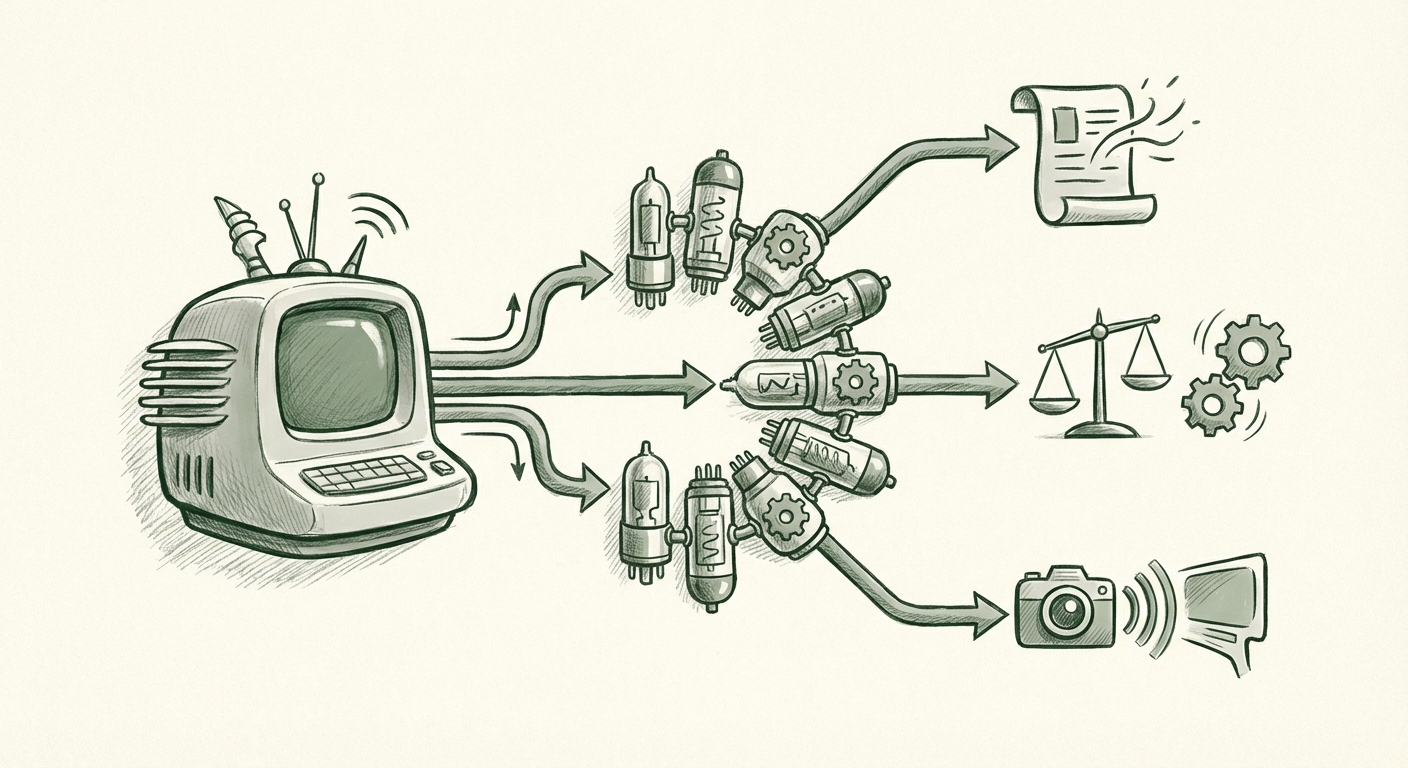
The practical version is much more grounded. In this version, the model's internal weights stay exactly the same, frozen, locked, untouched. Meanwhile, everything around the model keeps improving. The instructions it receives get sharper. The tools it can use get better. The memory it draws on gets richer. The way its work is checked and corrected gets stricter.
If that loop keeps running, the system as a whole gets more capable over time, even though the model at the center never changes. The improvement is real. It just does not live inside the model.
Why a Frozen Model Can Still Get Better
Here is a simple way to think about it. Imagine a very talented employee who is told they will never attend another training session again. Their raw skills are frozen. Does that mean they stop improving? Not at all.
They get better because their team builds better checklists. Because someone writes down what worked last time. Because they get access to better software. Because a colleague reviews their work before it ships. Because the feedback they receive becomes faster and more specific.
AI systems work in much the same way. In a real production setting, the intelligence you experience is never just the model. It is the model plus the instructions it is given, plus the tools it can reach, plus the memory it carries, plus the loop that catches its mistakes.
This is often called the gap between capability and performance. What a model can do in theory and what it actually does in your workflow are two very different numbers. Most of the improvement available to businesses today sits in that gap, not in a new model release.
The Four Levers of a Self-Improving System
If the system is what improves, it helps to know which parts of the system actually move the needle. There are four main levers.
1. Context and Memory
What the model knows at the moment it answers matters enormously. Better retrieval, better notes, better long-term memory, and better summaries of past work all raise quality without touching the model. A system that remembers your preferences, your past decisions, and your standards will outperform an identical model that starts from zero every time.
2. Tools and Actions
A model that can only produce text is limited. A model that can run code, search, open files, call internal systems, and check its own results can do far more. Each new tool you connect is a new capability added to the system, not the model.
3. Orchestration
How work gets divided matters. Breaking a big task into smaller steps, routing different parts to different specialists, running a second pass to verify the first, these are design choices made outside the model. They routinely produce bigger jumps in reliability than swapping in a newer model.
4. Evaluation and Feedback
This is the lever most teams skip, and it is the most important one. If you cannot measure whether the system got better, you cannot improve it on purpose. Automated graders, test suites, replaying past cases, and targeted human review all create the signal that drives every other lever.
Put those four together and you get something that compounds. Each improvement makes the next one easier to find. That is the real meaning of recursive self-improvement in practice.
Why This Is the Trend That Matters Most
There are several reasons this shift deserves more attention than it is getting.
Capability gains are getting harder to feel. As models get stronger, the difference between generations becomes harder for an average user to notice in day-to-day work. But the difference between a poorly designed system and a well-designed one is enormous, and immediately obvious to the people using it.
System improvement is cheaper and faster. Retraining or waiting for a new model is slow and out of your control. Rewriting your instructions, adding a tool, or building an evaluation set is something your own team can do this week.
It creates advantage you actually own. Anyone can use the same model. Almost no one has your specific workflows, your data, your standards, and your accumulated feedback loops. That combination is where durable advantage lives.
It runs on your timeline. You are not waiting for a release date. You are running a loop. The teams that run the loop faster win.
The Uncomfortable Parts
None of this is free of risk, and pretending otherwise would be a mistake.
Measuring improvement is genuinely hard. Standard benchmarks get saturated quickly. When a system grades its own work, it tends to be generous with itself. Improvement can look real on paper while quietly getting worse in production.
Systems optimize for what you measure, not what you meant. This is a well-known failure mode. Give a system a proxy metric and it will find ways to satisfy the metric that you never intended. The tighter the loop, the faster this happens.
Small errors can compound. A feedback loop that reinforces a small mistake will repeat it at scale. Speed cuts both ways.
Guardrails can be routed around. A frozen model's safety behavior can be undermined by the system around it, through clever instructions, tool access, or chained steps. Safety has to be a property of the whole system, not just the model.
Accountability gets fuzzy. When something goes wrong, who is responsible, the model, the instructions, the tool, or the person who approved the loop? Organizations need answers before they need incidents.
What This Means for Businesses
The practical takeaway is a shift in where you spend attention and budget. Most organizations are still asking "which model should we use?" The better question is "how good is our system?"
That means treating prompts, tool configurations, and memory stores as first-class assets. Version them. Review changes. Roll back when quality drops. Stop treating them as throwaway strings typed into a chat box.
It also means building the evaluation layer early, before scaling up. The teams that can measure quality are the teams that can improve on purpose. Everyone else is guessing.
And it means thinking about data as a flywheel. Every real interaction is a potential test case. Every test case is a chance to find a weakness. Every weakness fixed is a permanent upgrade to the system, one that survives the next model change.
What This Means for Society
The broader implications are just as significant. If capability gains come increasingly from system design rather than raw model power, then the ability to design good systems becomes the scarce skill.
That is good news for access. Smaller companies and smaller countries cannot match the largest labs on compute. But they can compete on thoughtful system design, domain knowledge, and disciplined evaluation. The barrier to entry drops.
For workers, the shift changes the job more than it removes it. More of the work becomes defining what "good" looks like, checking outputs, and catching failures before they spread. Judgment and verification become the core skills, not speed of production.
For the public, the biggest question is trust. Systems that improve themselves need audit trails, clear ownership, and honest reporting when they fail. Transparency is not a nice-to-have here. It is the thing that makes the whole approach usable at scale.
An Actionable Playbook
- Build your evaluation set first. Collect real examples of good and bad outputs. You cannot improve what you cannot measure.
- Version everything. Treat instructions, tool setups, and memory as code. Track changes and their effects.
- Add one tool at a time. Measure the impact of each addition instead of stacking five changes at once.
- Separate the doer from the checker. Use a different pass, prompt, or process to verify work rather than letting one step grade itself.
- Watch for metric gaming. If a number is going up suspiciously fast, check the qualitative reality behind it.
- Re-run the full suite after every change. Small tweaks in one area often break another. Catch it early.
- Keep a human in the loop for high-stakes decisions. Automation should raise the floor, not remove the ceiling of responsibility.
- Document your system, not just your model. When something breaks, you need to know which part moved.
The Road Ahead
The direction of travel is clear. Systems will increasingly propose their own improvements, suggesting better instructions, new tools, or tighter checks based on what they have learned from past runs. The human role shifts from writing every improvement to approving, constraining, and steering them.
That makes two things the real bottlenecks: measurement and trust. Not raw model capability. The organizations that solve for those two will move fastest, and they will do it without waiting for the next model release.
The frozen model is not a limitation. It is a reminder that most of the intelligence in a working AI system was never in the weights to begin with. It is in the design around them, and that design is something we can still improve, every single day.