Opus 5.5, DeepSeek's Training Grounds, and Claude's DNA: What AI's New Learning Loop Means for You
Something has shifted in how fast artificial intelligence moves. It used to be that a major model release was a once-or-twice-a-year event. Now it feels like a drumbeat, and the beats are getting closer together. Three stories landing in the same news cycle make that clear: the arrival of Opus 5.5, new insight into DeepSeek's training grounds, and a DNA discovery inside Claude.
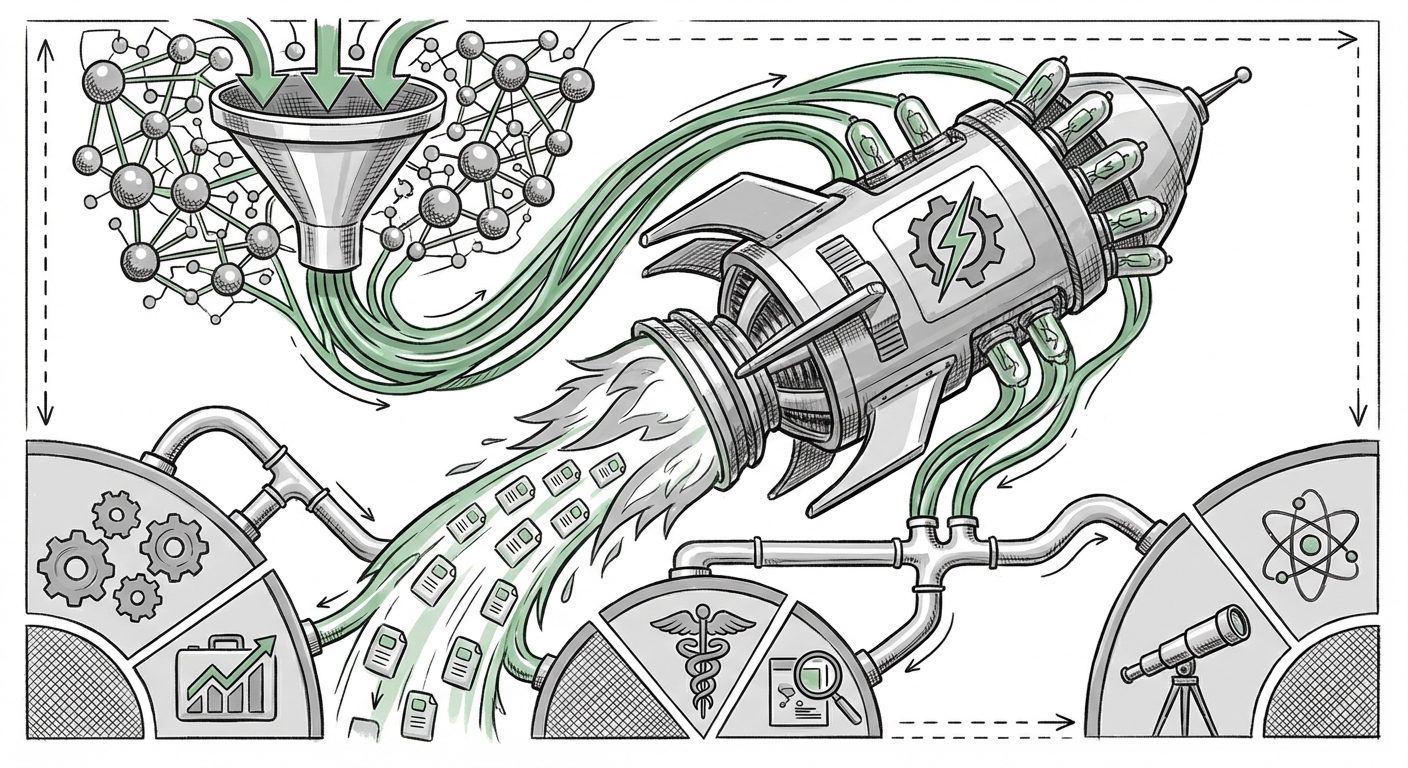
On the surface, these look like three unrelated headlines about three different companies doing three different things. They are not. Read together, they describe a single system at work, a learning loop where better models build better tools, and better tools build better models. Understanding that loop is now more useful than tracking any single release.
The Learning Loop: Why AI Now Teaches Itself
The idea behind a learning loop is simple. Each generation of AI helps build the next one. Models write code. Models generate training data. Models review and score other models. Engineers use AI to speed up the research that produces better AI.
That creates a feedback cycle. It does not need to be fully automatic to be powerful, it only needs to be faster than doing everything by hand. Every step that gets compressed shaves time off the next release. That is why the gaps between major model updates keep shrinking while the capability jumps keep holding steady.
The three developments covered here each plug into a different part of that loop. One is about raw capability. One is about the cost of getting there. One is about understanding what we've built. Together, they give us a rare full view of where the technology is heading.
Opus 5.5 and the New Rhythm of Frontier Releases
The first thread is Opus 5.5. The name itself tells a story. A mid-point version number, the ".5", signals something important about how frontier labs now operate. Instead of saving everything for one giant leap, teams ship meaningful improvements between major versions.
This matters more than it sounds. For years, buyers of AI technology faced a tough planning problem. You picked a model, you built around it, and then you waited a long time for the next big upgrade. Now the improvements arrive in steady steps. That is good for capability, but it creates a new headache: keeping up.
The practical effect on the ground is about reliability over novelty. Mid-cycle releases tend to focus on the things that make a model usable in real work, following long, complicated instructions, handling bigger jobs without losing the plot, using tools accurately, and giving answers that hold up under scrutiny. Those are the traits that decide whether an AI project ships or stalls.
For anyone building with AI, this changes the math. The question is no longer "is the model smart enough?" It is "can I count on it, repeatedly, in production?" Point releases are where that question gets answered.
DeepSeek's Training Grounds: Efficiency as a Superpower
The second thread is what goes on inside DeepSeek's training grounds. The story here is not just about a model, it is about how that model gets built in the first place.
Training a frontier model is one of the most resource-hungry engineering projects humans attempt. It takes enormous computing power, huge amounts of data, and long stretches of expensive trial and error. So when a team finds a smarter path through that process, the impact ripples across the entire industry.
Efficiency is the quiet superpower of modern AI. A team that can reach strong results with fewer resources changes two things at once. First, they lower their own costs. Second, they lower the price floor for everyone else, because competitors have to respond.
This is where the loop tightens. Cheaper training means more experiments. More experiments mean faster discovery of what works. Faster discovery means the next model arrives sooner and costs less. Over time, the whole field moves down the cost curve together.
For businesses, this is the most directly useful takeaway of the three stories. Every step down in training and serving cost eventually shows up as a lower bill, often combined with more capability for the same money. That combination is rare in technology, and it is the single biggest reason AI budgets keep expanding instead of shrinking.
Why Efficiency Beats Bragging Rights
There is a temptation to treat raw size as the only scoreboard. It never was. What actually wins is the ability to deliver strong results at a price people will pay, repeatedly, at scale. An efficient training pipeline is not a consolation prize. It is a long-term advantage that compounds.
Claude's DNA Discovery: Opening the Black Box
The third thread is the most intriguing: a DNA discovery inside Claude. The phrase captures an idea that has moved from research curiosity to serious engineering: looking inside a model to understand how it works, not just what it outputs.
Think of it this way. Historically, we judged AI the way you might judge a chef, by tasting the food. If the dish was good, we celebrated. If it was bad, we had little idea why. Interpretability work changes that. It is the equivalent of getting a look at the recipe, the ingredients, and the kitchen.
Calling it "DNA" is a useful metaphor. Every model develops internal patterns, structures and tendencies that shape how it responds. When researchers can identify those patterns, several doors open at once:
- Trust: When you can explain why a model gave an answer, you can defend that answer to a customer, a regulator, or a board.
- Safety: Understanding internal structure helps teams spot and correct unwanted behavior before it reaches users.
- Debugging: When something breaks in production, insight into the model's inner workings turns a mystery into a fixable problem.
- Control: Better visibility into how a model reasons gives developers more precise ways to steer it.
This is the thread that will matter most over the long run. Capability wins headlines. Understanding wins contracts, audits, and regulatory approval. As AI moves into healthcare, finance, law, and government, "we think it works" is no longer a sufficient answer. "We can show you why" is.
What This Means for the Future of AI
Line up the three threads and a clear picture forms. The future of AI is not being decided by any one factor. It is being decided by three moving at once:
- Capability, models like Opus 5.5 getting steadily stronger and more dependable.
- Efficiency, training breakthroughs like those coming out of DeepSeek's training grounds driving costs down.
- Transparency, interpretability work like Claude's "DNA" research making models understandable and governable.
When all three advance together, adoption accelerates. When one stalls, the whole field slows. Right now, all three are moving, and that is why the pace feels relentless.
The likely near-term outcome is not a single dramatic breakthrough moment. It is a steady grind of improvement that quietly changes what is possible. Costs fall. Reliability rises. Trust grows. Each of those alone is incremental. Together, they cross thresholds, the point where a task that was too risky becomes routine.
Practical Implications for Businesses
1. Re-evaluate projects you shelved
If a use case was rejected a year ago because it was too expensive or too unreliable, it deserves a fresh look. Falling costs and rising reliability reopen doors that were closed for good reason at the time, but reasons expire.
2. Plan for continuous change, not one-time rollout
With improvements arriving on a steady cadence, the winning posture is to build systems that can swap models without a rebuild. Keep your prompts, evaluations, and data pipelines separate from any single vendor's quirks. That way, an upgrade is a configuration change, not a project.
3. Make evaluation a core capability
When models improve constantly, the only way to know which one is right for you is to measure it on your own work. Generic benchmarks will not tell you whether a model handles your documents, your edge cases, or your customers. Build a test set from real tasks and run it on every new release.
4. Treat transparency as a purchasing criterion
As interpretability matures, vendors will compete on how well they can explain their models. If you operate in a regulated industry, or simply need to answer to customers, favor providers who can tell you how their systems behave and why. That capability is becoming a differentiator, not a nice-to-have.
5. Stop chasing the leaderboard
The gap between top models keeps narrowing, and mid-cycle releases reshuffle the rankings anyway. The durable advantage is not picking the winner, it is being fast at adopting whatever wins next.
Actionable Insights You Can Use This Quarter
- Audit your current AI use cases and flag any that were rejected for cost or reliability. Re-test the top two.
- Build a small, real evaluation set from your own workflows, even fifty well-chosen examples beats a generic benchmark.
- Design your AI stack so the underlying model can be replaced without rewriting your application.
- Track cost per task, not cost per token. As models get more efficient, pricing structures shift in ways headline rates do not capture.
- Ask vendors directly how they test for unwanted behavior, and what visibility they have into model internals.
- Assign someone to watch mid-cycle releases. The ".5" updates often contain exactly the reliability fixes that unblock stalled deployments.
The Bottom Line
The story of Opus 5.5, DeepSeek's training grounds, and Claude's DNA discovery is really one story about a loop that keeps spinning faster. Capability improves, efficiency improves, understanding improves, and each one feeds the next.
For businesses, the message is not to panic about speed. It is to build for it. Systems that adapt beat systems that are perfectly tuned to a world that has already moved on. The organizations that thrive in this next phase will not be the ones that picked the best model on a given day. They will be the ones that built the habit of swapping it out when a better one arrives.
The loop is not slowing down. The smart move is to stop fighting it and start plugging into it.