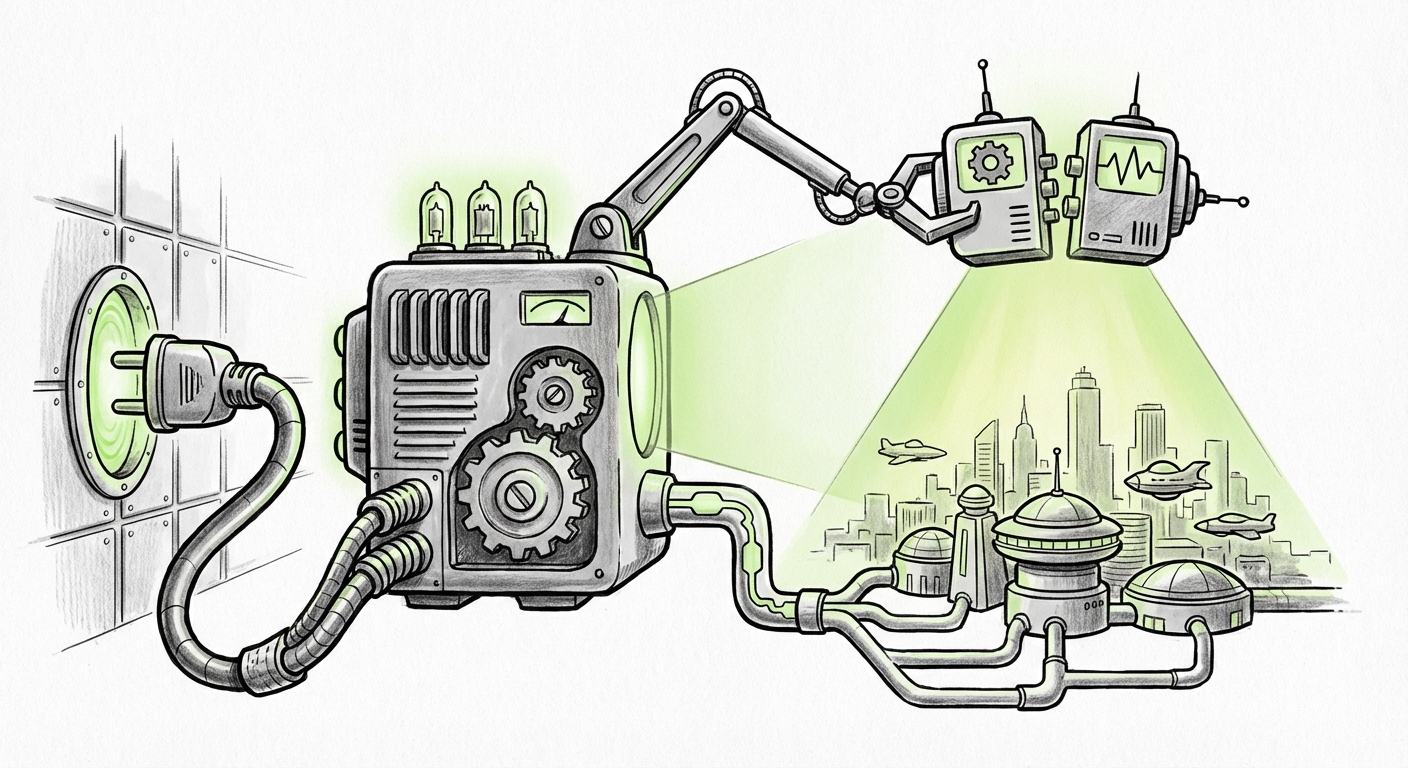
Who Owns Go-Live? The AI Stack Accountability Gap Every Team Must Close
Building an AI product has never been easier. You can rent a foundation model by the token, drop in a vector store, wire up an orchestration layer, bolt on a guardrail service, and connect a dashboard that shows it all working. In a single afternoon, a small team can assemble something that looks, feels, and demos like a finished product.
Then someone asks the only question that matters: Who signs off when this thing goes live?
That question is where modern AI projects quietly fall apart. The stack got assembled. The accountability never did.
The Stack You Assembled Isn't the System You Shipped
There is a fundamental difference between a collection of components and a system that runs in the real world. A stack is a pile of parts. A system is a promise, a promise that when a customer types something in, something safe and correct comes back out, every time, at scale, under pressure.
When every layer of your AI product comes from a different vendor, that promise gets split into pieces nobody owns. The model provider owns the model. The vector database vendor owns retrieval. The orchestration framework owns the glue code. The guardrail vendor owns the filters. But nobody in that chain owns the outcome.
This is the new shape of technical debt. It isn't messy code in one repository. It's distributed responsibility across a supply chain you don't control.
Why Go-Live Became an Orphan
Traditional software had a natural owner for launch. One engineering team wrote the service. One team ran it. When it broke at 3 a.m., one on-call engineer got paged. The boundaries were clear because the boundaries were internal.
AI broke that pattern in three ways.
First, the work got split by skill. Data scientists prototype. Machine learning engineers tune. Platform teams deploy. Product teams define success. Each group does its part beautifully and hands off. Handoffs are where ownership goes to die.
Second, the components change underneath you. A model you integrated can be updated, deprecated, or retired by a vendor you have no control over. Your system's behavior is partly a function of someone else's roadmap. That makes traditional "we built it, we own it" thinking feel false, so people hesitate to claim ownership at all.
Third, evaluation is genuinely hard. With classic software, a test either passes or fails. With AI, the same input can produce different outputs. Quality is a distribution, not a Boolean. When nobody can say with certainty whether the system is "ready," readiness becomes everyone's opinion and no one's decision.
The result: projects that demo brilliantly and stall indefinitely before launch. Not because the technology fails, but because no one is authorized to say "ship it."
The Four Seams Where Accountability Leaks
If you want to find out who owns go-live in your organization, look at the seams, the handoff points between components and teams. There are four that matter most.
1. The Data Seam
Who decides what data is allowed into the system? Who checks whether that data is fresh, accurate, and legally usable? In assembled stacks, data flows in from many directions at once. If a retrieval index goes stale, quality drops, but the model vendor will correctly say the model is fine. The data owner says the pipeline ran. Nobody owns the drop in answer quality.
2. The Model Seam
Who owns behavior when the underlying model changes? A provider swap or version update can shift tone, accuracy, cost, and latency all at once. If you never defined the acceptance criteria for model behavior, you can't tell whether a change is a regression or an improvement. Owned by nobody, noticed by everyone, usually your customers.
3. The Orchestration Seam
Who owns the prompts, the routing logic, the retries, and the fallbacks? This is the layer where most real-world failures actually live. A prompt tweak made by one team can break a workflow another team depends on. Without a clear owner, this layer accumulates invisible changes until it becomes unmaintainable.
4. The Safety Seam
Who owns guardrails, red-teaming, and incident response? Who decides when the system should refuse, escalate to a human, or shut down entirely? Safety is often treated as a final checkbox before launch. In practice it is an operating discipline that must have a named owner with real authority.
What Owning Go-Live Actually Means
Owning go-live is not the same as writing the code. It means holding four specific things:
- Decision rights. One person or role has the authority to say yes or no to launch, and to halt production when something is wrong.
- Defined success. Written, measurable acceptance criteria that describe what "good enough to ship" looks like, agreed before the pressure of a deadline arrives.
- Operational responsibility. A named on-call rotation, an incident process, and a rollback plan that works in minutes, not days.
- Continuous monitoring. Quality is not verified once. It is watched every day, because models, data, and user behavior all drift.
Notice that none of these are technical achievements. They are organizational ones. That is the uncomfortable truth of the assembled-stack era: the hardest part of AI shipping is not the AI.
Who Should Hold the Pager?
There is no single correct answer, but there is a wrong one: "everyone." Distributed ownership in practice means no ownership.
The pattern that works is a system owner, a role that sits above any individual component. This person does not need to be the best model engineer or the best platform architect. They need to be accountable for the end-to-end experience a user actually receives.
Around that role, three supporting functions should be explicitly assigned. A product owner defines what good looks like from the user's point of view. A platform owner keeps the pipeline, monitoring, and rollback machinery healthy. A risk owner holds the authority to stop a launch and the independence to use it.
The key design principle: the system owner must have authority that crosses vendor boundaries. If they cannot make a decision about a third-party component, swap it, cap it, rate-limit it, or turn it off, they do not really own the system. They are just managing a dependency.
What This Means for the Future of AI
As AI moves from experiments into core business infrastructure, the assembled-stack model will keep winning. Buying beats building for most teams. Foundation models will keep improving, components will keep getting cheaper, and integration will keep getting easier.
That means the bottleneck shifts. It will not be capability. Capability is becoming abundant. The bottleneck will be accountability, the ability of an organization to look at a complex, multi-vendor system and answer, clearly, "we know how this behaves, we know who is responsible, and we can stop it if we need to."
Three shifts follow from this.
Governance becomes a product feature. Buyers will increasingly ask vendors and internal teams not just what a system does, but who is accountable when it doesn't. Evidence of ownership will move from a nice-to-have to a procurement requirement.
The system owner role becomes a real career path. Just as DevOps emerged as a discipline between development and operations, a new discipline is emerging between AI engineering and operational risk. It will be one of the most valuable roles in the next wave of enterprise AI.
Evaluations become the contract. When behavior is probabilistic, the definition of "working" has to be written down. Teams that invest in rigorous, ongoing evaluation will ship faster than teams that argue about readiness, because they will have replaced opinion with evidence.
A Practical Playbook for Businesses
If you are assembling an AI stack right now, here is how to close the accountability gap before launch pressure arrives:
- Name the system owner before you write the first line of integration code. Assigning ownership at the end guarantees a fight at the worst possible moment.
- Write your acceptance criteria early. Define what "ready" means in measurable terms and get agreement from every team that will touch the system.
- Map every external dependency and its failure mode. For each vendor, ask: what happens to us if this changes, breaks, or disappears? Write down the answer.
- Build the kill switch first. A rollback path that works in minutes is the single most valuable thing you can build. It is also what makes it safe to move fast.
- Instrument quality, not just uptime. A system can be 100% available and completely wrong. Monitor output quality continuously.
- Give your risk owner real authority. If stopping a launch is career-limiting, you don't have a risk owner. You have a spectator.
- Review the seams, not just the components. Schedule regular check-ins on handoffs. That's where things break.
The Takeaway: Assembly Is Easy. Ownership Is the Product.
The ease of assembling an AI stack has created a false sense of readiness. Because the parts work, teams assume the whole works. Because the demo works, they assume production will too.
But a stack is not a system, and a system without an owner is a liability. The question in the title, who owns go-live?, is not a bureaucratic detail. It is the difference between an AI project that ships and one that lives forever in a staging environment.
The good news is that ownership is cheap to establish and expensive to skip. It costs one clear decision: name the person, give them the authority, and write down what success looks like. Do that, and your assembled stack becomes something far more valuable, a system you can stand behind.