AI Beats Licensed Accountants on Speed and Accuracy, But Still Can't Close the Books Alone
Artificial intelligence has crossed a line that a lot of professionals hoped it would never cross. On defined accounting tasks, AI systems are now beating licensed accountants on both speed and accuracy. That is the headline. It is also only half the story.
The second half is the part that matters more for the future of the technology: those same systems still cannot close the books without human supervision. Not "should not", cannot. That gap between doing a task well and owning a process end to end is where the next decade of AI adoption will be fought, won, and occasionally lost.
Understanding why that gap exists tells us more about the future of AI than any benchmark score ever will.
What the Finding Actually Says
Strip away the drama and the core result is straightforward. When you take a well-defined accounting job, categorizing transactions, checking figures, reconciling entries, spotting a mismatch, modern AI can work faster than a trained human and make fewer mistakes doing it. Hours of careful review collapse into minutes. Errors that slip past tired eyes at the end of a quarter get caught by a system that never gets tired.
That is genuinely significant. Accounting has always been a discipline built on precision. Speed and accuracy are not side benefits there; they are the product. If a machine outperforms a licensed professional on the two things that profession sells, the profession has to change.
But notice what kind of work this is. These are bounded tasks. They have a clear input, a clear rule, and a clear right answer. AI excels at bounded tasks because it can apply rules at a scale and consistency no human can match.
Why "Closing the Books" Is a Different Animal
Closing the books is not a bounded task. It is a process, a long chain of judgment calls that ends with someone signing their name to a number that other people will trust with real money.
Here is what makes it hard to automate:
1. Context lives outside the data
A transaction can look wrong on paper and be perfectly correct in reality, because of a deal made verbally, a timing quirk, a new customer arrangement, or an industry norm that never made it into the ledger. Humans pick up those signals from emails, hallway conversations, and memory. AI sees only what it is given.
2. Judgment requires accountability
When an accountant decides how to treat an ambiguous item, they are making a call they can be held responsible for. That responsibility is the actual deliverable. A system that produces a number but cannot stand behind it has not finished the job.
3. The stakes change the rules
Finding an error in a draft is useful. Certifying that no material errors exist is a legal and professional act. Those two things may look similar in a demo but they are completely different in practice.
4. Edge cases are the whole point
Routine work runs smoothly on autopilot. The value of a skilled professional shows up precisely when something unexpected happens. AI handles the ordinary beautifully and struggles with the genuinely novel, which is exactly when you need a human most.
This is why the finding is not a contradiction. AI wins on tasks. Humans still own processes. And a process is what a book close is.
What This Means for the Future of AI
Three patterns are emerging from this kind of result, and they will shape how AI gets used across every knowledge profession, not just accounting.
Pattern 1: Task-level AI, process-level human
The winning model is not "replace the worker." It is "replace the task inside the worker's day." One professional, supported by AI, can now do the volume of work that used to require a team. The human stays in the loop not as a courtesy, but because the process needs an owner.
Expect this structure to repeat in law, medicine, auditing, compliance, and engineering. The unit of automation is the task, not the job.
Pattern 2: Verification becomes the scarce skill
When AI can generate correct output quickly, the bottleneck shifts. Producing the answer is cheap. Knowing whether the answer is right is expensive. The professionals who thrive will be the ones who can look at machine output and instantly sense when something is off, what we might call a well-calibrated instinct for wrongness.
This is a real skill, and it is not the same as being good at the original task. It is closer to editing than writing.
Pattern 3: The supervision layer becomes a product
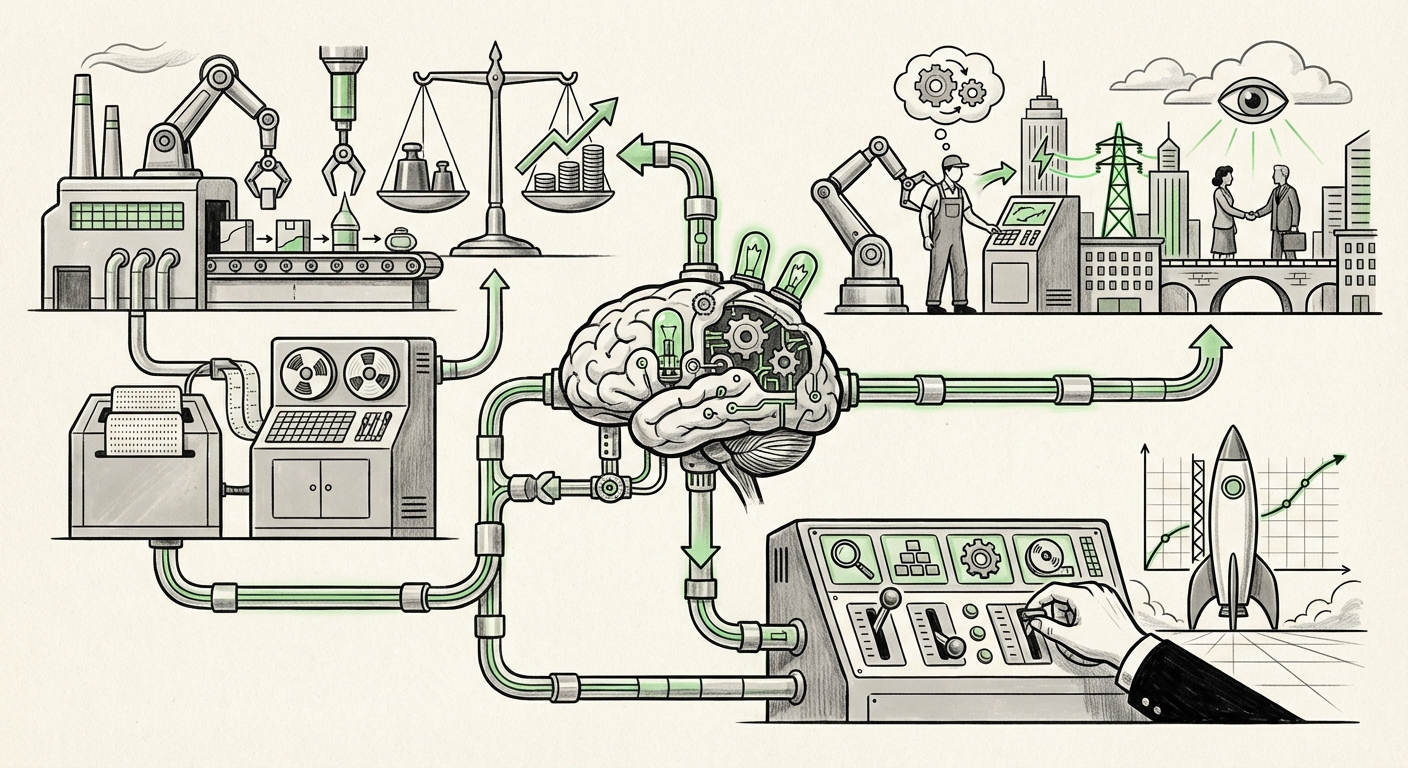
If AI cannot close the books alone, then the systems that manage the handoff between machine and human become enormously valuable. Audit trails, confidence scores, escalation rules, review queues, sign-off workflows, this plumbing is unglamorous and it is where the money will go.
The companies that win the next phase of enterprise AI will not be the ones with the smartest model. They will be the ones that make it safe and easy to trust a model that is sometimes wrong.
Practical Implications for Businesses
If you run a finance function, a law firm, or any operation built on expert review, here is what to do with this.
- Map your work by task, not by role. Break jobs into bounded tasks and open-ended processes. Automate the first aggressively. Protect the second with trained humans.
- Never remove the human sign-off from anything with legal or financial weight. The cost of oversight is small. The cost of an unsupervised error is not.
- Build review into the workflow from day one. Retrofitting oversight onto a system designed to run alone is far harder than designing it in.
- Train people to verify, not just to produce. Your team's value is shifting from doing the work to judging the work.
- Measure error detection, not just error rate. A tool that catches 95% of mistakes is only useful if you catch the other 5%.
- Keep a clear audit trail. When something goes wrong, and it will, you need to know what the system saw, what it decided, and who approved it.
What It Means for the Profession
The honest answer is that accounting is not disappearing. It is being re-tiered.
The repetitive layers of the job, data entry, routine reconciliation, basic categorization, are going away, and they are going away fast. The judgment layers, interpretation, advisory work, risk assessment, client relationships, signing off on results, are becoming more valuable, not less.
The uncomfortable part is the middle. Junior accountants have traditionally learned judgment by doing the routine work first. If AI takes the routine work, where does the next generation build the instinct they will need to supervise the machines? That is an unsolved problem, and it is not unique to accounting. Every profession that trains people through repetitive practice is about to face it.
The firms that answer it well will have a durable advantage. The ones that just cut headcount will find themselves with plenty of software and nobody who can tell when it is wrong.
The Bigger Picture
What makes this moment interesting is not that AI beat humans at a task. That has been happening for years, in narrower and narrower slices.
What makes it interesting is that the boundary is now visible. We can see clearly where machine competence ends and human accountability begins. For a long time that line was fuzzy, a matter of opinion and marketing. Now it has a shape: AI handles the bounded, humans own the consequential.
That is a healthier outcome than the extremes. It is not a world where machines quietly take over the finance department. It is not a world where AI turns out to be useless. It is a world where the work gets split along the seam that actually matters, the seam between doing something correctly and being responsible for it.
The professionals who accept that split, and position themselves on the right side of it, will be fine. The ones who insist AI can never do their job will be surprised. The ones who assume it can do all of it will be dangerous.
The future of AI is not replacement. It is supervision, and supervision is a job. A hard one. Right now, it is still a human job, and nothing in these results suggests that is about to change.