Agentic AI for Enterprise Leaders: Why a Barclays Architecture Chief Learned to Build AI Systems
For the past few years, the biggest question in big business was simple: should we use AI? That question is now settled. The new question is harder and much more practical: who builds it, who controls it, and what happens when it starts making decisions on its own?
That shift is captured in a story from inside Barclays, where an enterprise architecture leader decided to stop talking about AI from a distance and learn how to build AI systems directly. It is a small move on paper. In reality, it is a signal of something much larger: the people responsible for keeping big companies safe, organised, and compliant are now becoming builders themselves.
That matters far beyond one bank. Enterprise architecture is the discipline that decides how all the technology in a company fits together, the wiring diagram for the whole business. When the person holding that wiring diagram learns to build AI agents, it changes the way AI gets adopted everywhere.
What "Agentic AI" Actually Means for an Enterprise
Most people have used an AI chatbot that answers questions. Agentic AI is a different animal. An AI agent can be given a goal, then plan, act, use tools, call other systems, check its own work, and keep going until the job is done, with far less human hand-holding.
For a consumer, that might mean an assistant that books a trip end to end. For an enterprise, it means something far more consequential: software that can open a case, pull data from three systems, draft a document, send it for approval, and log everything it did.
That is powerful. It is also exactly the kind of power that makes risk officers nervous, and for good reason. A chatbot that gives a wrong answer is an embarrassment. An agent that takes a wrong action is an incident.
This is why agentic AI is not really a technology story. It is an architecture and governance story wearing a technology costume. And that is precisely why enterprise architects are suddenly at the centre of it.
From Governing AI to Building AI
Traditionally, enterprise architecture leaders operate at a layer above the code. They set standards, define reference models, review designs, and make sure new technology does not create chaos. They are the people who say "no, that does not fit our landscape."
The move by a Barclays architecture leader to learn how to build AI systems is a break from that pattern. Instead of reviewing AI from the outside, this leader stepped inside the build process, learning how agents are constructed, prompted, connected to data, evaluated, and constrained.
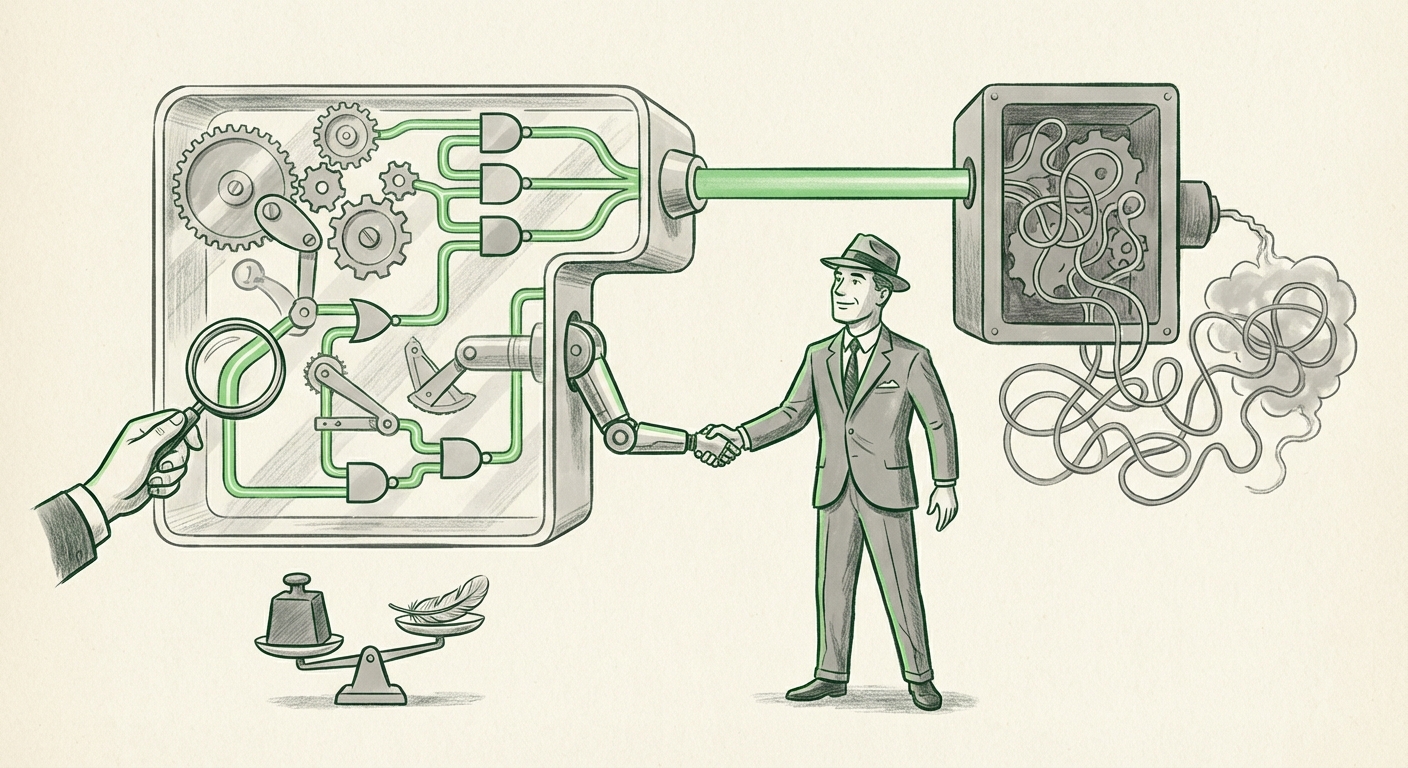
There is a hard logic to this. You cannot govern what you do not understand. Governance frameworks written by people who have never built an agent tend to be either too vague to matter or too strict to allow anything useful. Architects who have built even a small agent understand where the real failure points live: bad data, unclear instructions, missing guardrails, tools that do too much, and no way to tell whether the thing is working.
That understanding changes the questions they ask. Instead of "is this AI approved?", the question becomes "what can this agent do, what can it not do, how do we know it behaved correctly, and who is accountable when it doesn't?"
Why Banks Are the Hardest and Best Test Case
Banking is an unforgiving environment for autonomous software. Every action has a regulatory trace. Every decision may need to be explained to a customer, an auditor, or a regulator. Data is sensitive, systems are old, and the cost of a mistake is measured in trust.
That makes banks a stress test for agentic AI. If agents can be made to work safely inside a large bank, they can probably work almost anywhere. And the reverse is also true: if the industry that cares most about control cannot make agents safe, the whole enterprise promise stalls.
The response emerging across the sector is not to ban agents. It is to build the scaffolding around them, clear boundaries, logging, human checkpoints for high-stakes actions, and the ability to shut an agent down instantly.
This is where the architecture mindset becomes an advantage rather than an obstacle. Architects already think in terms of layers, boundaries, interfaces, and dependencies. Agentic AI needs exactly that kind of thinking, because an agent that touches ten systems is really ten integrations with ten new risks.
What Changes Inside the Business
When agents move from demos to production, a few things shift quickly.
1. Work moves from tasks to outcomes
Traditional software automates a step. Agents can be pointed at an outcome and allowed to figure out the steps. That is a big change for how teams are managed. Managers stop assigning tasks and start defining success criteria, boundaries, and escalation rules.
2. Data quality becomes the ceiling
An agent is only as good as the information it can reach. Companies with messy, siloed, or undocumented data will find that their agents behave unpredictably, not because the model is bad, but because the environment is. Data work, long treated as a boring prerequisite, becomes the main event.
3. Testing looks different
You cannot fully test an agent the way you test a calculator. Agents operate in open-ended situations. So teams move toward continuous evaluation: watching real behaviour, scoring outcomes, and adjusting instructions and tools over time, the way you would coach a new employee rather than ship a finished product.
4. The org chart gets questioned
If one agent can handle work that used to cross three teams, someone has to decide who owns the outcome. Agentic AI pushes companies to clarify accountability, which turns out to be healthy regardless of AI.
The Governance Problem Nobody Can Outsource
There is a tempting shortcut with agentic AI: assume the model vendor handles safety. That shortcut fails. Vendors can supply capable models. They cannot know your processes, your regulations, your customer promises, or your risk appetite.
That responsibility stays inside the company. In practice, strong agent governance tends to include:
- A clear inventory. Every agent, what it does, what it can touch, and who owns it.
- Least privilege. Agents get only the access they truly need, not the keys to everything.
- Human checkpoints. High-impact actions, moving money, changing records, contacting customers, require a human in the loop.
- Full traceability. The ability to reconstruct what an agent did, why, and with what information.
- Kill switches. A fast, tested way to stop an agent that misbehaves.
None of this is exotic. It is classic enterprise discipline applied to a new kind of actor. The difference is speed. Agents act in seconds, so controls must be automated rather than reviewed in a weekly meeting.
The Skills Shift: Architects Who Build
The Barclays example points to a wider talent trend. The most valuable enterprise technologists over the next few years will not be pure strategists or pure engineers. They will be people who can move between both, who understand the business architecture and can also get their hands on the tools.
This has real implications for hiring and development. Companies that only hire specialists will struggle to connect AI capability to business reality. Companies that only promote generalists will build agents with no architectural discipline. The answer is deliberate cross-training: teach architects to build, and teach builders to think in systems.
It also changes leadership. Executives do not need to write code. But they do need enough fluency to ask sharp questions about data access, evaluation, failure modes, and accountability. Leaders who cannot ask those questions will be sold whatever sounds impressive.
What This Means for the Future of AI
Three directions look clear from here.
First, agentic AI will be adopted through architecture, not through hype. The winners will not be the companies with the flashiest demos. They will be the ones that wired agents into their systems properly, with the right boundaries and the right data.
Second, governance becomes a competitive advantage. In regulated industries, the ability to deploy agents safely, and to prove it, is a moat. Speed with control beats speed without it, because uncontrolled speed eventually hits a wall.
Third, the human role moves up a level. As agents handle execution, people shift toward defining goals, judging quality, handling exceptions, and taking responsibility. That is not a downgrade. It is a change in what "doing the work" means.
Actionable Insights for Enterprise Leaders
- Get hands-on at the top. Have at least one senior architecture or technology leader build a working agent, even a small internal one. Understanding follows building.
- Start with a bounded, boring process. Pick something with clear rules, measurable outcomes, and low blast radius. Prove the pattern before scaling.
- Fix data access before scaling agents. Most agent failures trace back to bad or unreachable data, not the model.
- Write down what agents may never do. Prohibited actions are often clearer and more useful than broad policy statements.
- Invest in evaluation as a permanent function. Treat agent quality like a service level, not a one-time launch check.
- Name an owner for every agent. No owner, no deployment.
- Train across the boundary. Build a pipeline of people who understand both business architecture and how AI systems are actually constructed.
Conclusion
The most telling detail in this story is not that a bank is using AI. Banks have been using AI for years. It is that the person responsible for the bank's technology blueprint decided to learn how to build the thing he would eventually have to govern.
That is the shape of the next phase. Agentic AI will not be adopted by organisations that treat it as a procurement decision or a pilot program. It will be adopted by organisations whose leaders understand it deeply enough to set boundaries that are both safe and useful.
For enterprise leaders, the message is direct: stop outsourcing your understanding. The future of AI inside your company will be decided by how well you can build it, constrain it, and explain it. The people who learn to do all three, starting with your architects, will determine whether agentic AI becomes a genuine advantage or an expensive lesson.