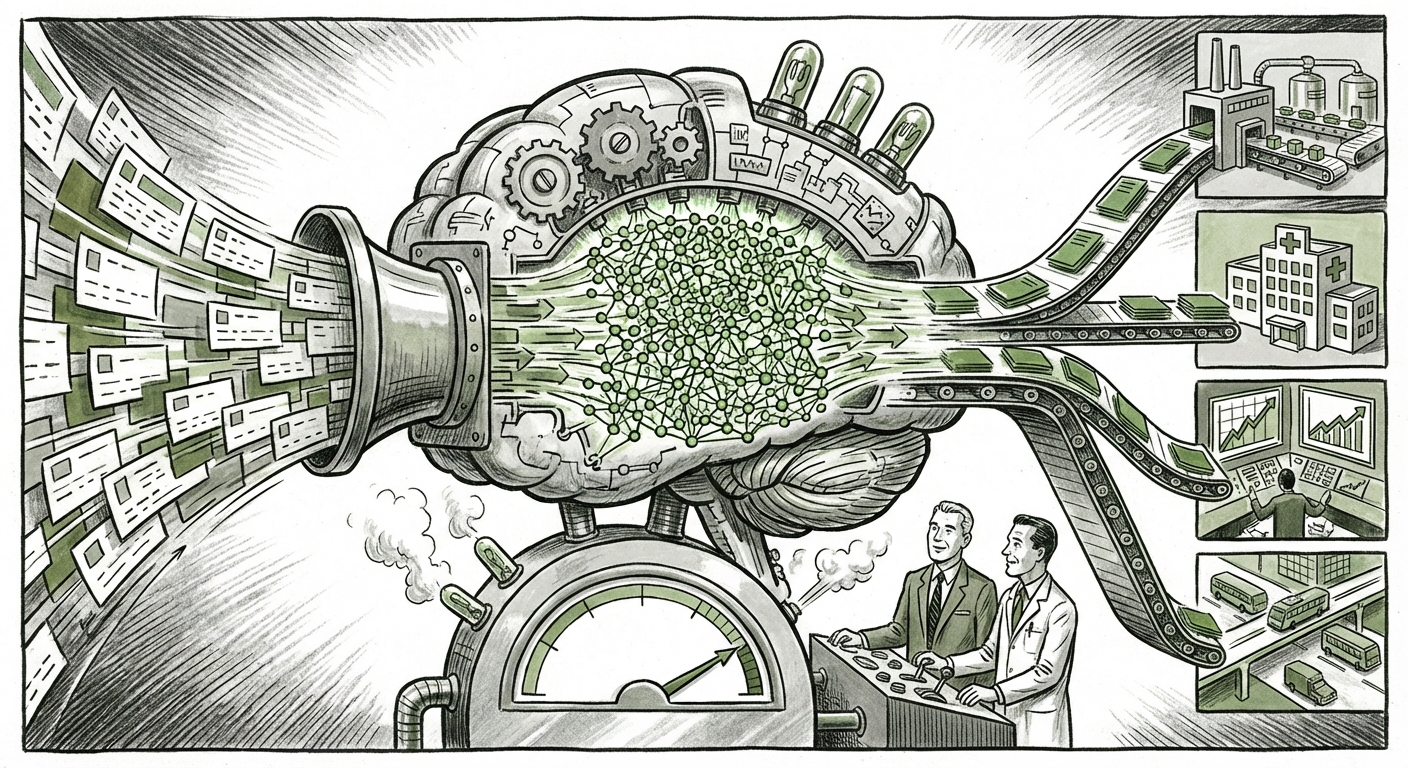
AI and the Death Penalty: What a Botched Execution in Tennessee and a Push to Expand Capital Punishment Mean for Automated Justice
On October 3, 2026, the political world woke up to a jarring pairing of headlines. Days after a botched execution attempt in Tennessee, the President suggested expanding capital punishment. For most people, this is a story about law, politics, and morality. For anyone who builds, buys, regulates, or relies on artificial intelligence, it is also something else entirely: a brutal stress test of every assumption we make about technology, error, and consequences that cannot be undone.
Here is the uncomfortable truth that the AI industry keeps circling. The hardest question in artificial intelligence is no longer "can the model do it?" It is "what happens when it gets it wrong, and who pays the price?" A botched execution is the most extreme possible version of that question. There is no rollback. There is no retry. There is no version 2.0 released next quarter. And that is exactly why this story belongs in a conversation about the future of AI.
Why a Botched Execution Is Really an Automation Story
Every high-stakes human process is, at its core, a system. It is made of trained people, written procedures, checklists, equipment, timing, and verification steps. When a system like that fails visibly, especially in front of witnesses, three predictable reactions follow.
First, calls for more oversight. Second, calls for more standardization. Third, calls for automation, based on the simple theory that machines do not get tired, distracted, rushed, or sloppy at 11 p.m.
That third instinct is where AI enters the frame. And it is precisely the instinct that deserves the most scrutiny. Because automation does not remove error. It relocates it. It moves mistakes from the hands of a person who can hesitate into the logic of a system that cannot.
The Tennessee case and the President's subsequent suggestion to expand capital punishment push this question into the open with unusual force. Whatever your view on the policy itself, the technology question underneath it is universal: when a process is designed to be final, how much of that process should ever be handed to a machine?
Where AI Already Touches the Justice System
It is worth being precise, because the debate often swings between two myths, that AI runs the courts, or that it plays no role at all. Neither is true.
AI and machine learning already sit inside the legal and criminal justice pipeline in dozens of quiet, practical ways:
- Legal research and document review. Attorneys on both sides use AI to scan millions of pages of discovery, case law, and transcripts in hours instead of months.
- Forensic analysis. Pattern-matching systems assist with DNA mixture interpretation, fingerprint comparison, and digital evidence triage.
- Risk and assessment tools. Statistical models have been used for years to inform decisions about bail, sentencing, and parole, usually as one input among many.
- Administration. Records management, scheduling, translation, victim notification, and cold-case review increasingly depend on automated systems.
- Investigation support. Link analysis and anomaly detection help investigators find patterns in large data sets.
Notice what all of these have in common. They are probabilistic. They produce likelihoods, rankings, and confidence scores, not certainties. That is fine when the output is a research shortcut. It becomes a very different proposition when the output feeds into a decision that is irreversible.
The Irreversibility Problem
Here is the core mismatch that the AI industry has not fully reckoned with.
Modern AI is built on statistics. Its greatest strength, reasoning under uncertainty at enormous scale, comes with a built-in admission: it will be wrong sometimes, and it cannot tell you exactly when. That is not a bug to be patched. It is the mathematical nature of the approach.
A medical triage tool that is right 95 percent of the time saves lives. A final, irreversible decision that is wrong five percent of the time is not a rounding error. It is a catastrophe with a name and a family attached to it.
So the governance question sharpens into something concrete: which decisions should never be delegated fully to a probabilistic system? Capital punishment sits at the far end of that spectrum. But the same logic applies to autonomous weapons, critical infrastructure shutdowns, credit decisions that determine whether a family keeps its home, and clinical recommendations that end treatment.
The lesson from Tennessee is not that AI should be banned from high-stakes settings. It is that irreversibility must be treated as a first-class design constraint, not an afterthought bolted on during legal review.
Bias Does Not Disappear. It Compounds.
There is a second problem that surfaces whenever automation touches criminal justice: data.
Machine learning models learn from historical records. In any domain shaped by decades of uneven enforcement, uneven access to counsel, and uneven outcomes, those records carry the past forward. Sometimes the pattern the model learns is the signal we actually want. Sometimes it is the bias we were hoping technology would fix.
Worse, automation can launder that bias. A human decision-maker can be questioned, cross-examined, and challenged on the record. A model that produces a number can hide the reasoning behind a wall of vendor confidentiality and proprietary weights. The result is a decision that feels objective precisely because it is opaque.
Human-in-the-Loop Is Not a Magic Wand
The standard corporate answer to all of this is "we keep a human in the loop." It sounds reassuring. Research on automation bias suggests it is often a comfort rather than a control.
When a system presents a recommendation with a confident interface, human reviewers tend to defer. They approve more, question less, and move faster. The human becomes a signature, not a safeguard. In a high-volume workflow, that is a feature. In a life-or-death workflow, it is a single point of failure dressed up as oversight.
Real human oversight requires friction: reviewers with the time, authority, information, and incentive to say no. Without those four things, the loop is decorative.
What This Means for Businesses
Most companies will never touch capital punishment. But the governance principles this story exposes apply to every organization deploying AI in consequential decisions. The pattern is the same at every scale, just with less dramatic stakes.
- Tier your decisions by reversibility. Separate AI use cases into reversible (a recommendation, a draft, a ranking) and irreversible (an approval, a denial, a termination, a payment lock). Apply wildly different controls to each tier.
- Demand audit trails, not just outputs. If you cannot reconstruct why a system produced a result six months later, you do not have a system you can defend.
- Make uncertainty visible. Confidence scores that never reach the decision-maker are theater. Push uncertainty into the interface where it can change behavior.
- Assign named accountability. "The model decided" is not an answer regulators, courts, or customers will accept. Every automated decision needs a human owner.
- Test for the tail, not the average. A model that performs beautifully on average can fail catastrophically on the exact cases where failure matters most.
- Write the incident plan before launch. When the system fails, and it will, what happens in the first hour determines everything that follows.
What It Means for Society
The broader implication is that AI governance is graduating from a technical topic to a constitutional one. Questions that used to live in computer science departments are now landing in courtrooms and legislatures:
- Does a person have a right to understand how an automated decision affecting them was made?
- Who is liable when an automated system contributes to harm, the vendor, the operator, or the agency that bought it?
- Should procurement standards require independent auditing before deployment, not after scandal?
- How do we build public literacy fast enough to keep up with deployment speed?
None of these have clean answers. But the direction of travel is clear. The era of deploying first and asking questions later is ending, not because regulators suddenly got brave, but because the stakes keep getting higher and the failures keep getting more public.
The Bigger Trend: Reversibility as a Design Constraint
Step back, and the Tennessee story is a single data point on a much larger curve. AI is moving out of the sandbox and into domains where decisions cannot be unmade: healthcare, energy grids, defense, autonomous vehicles, financial systems, and yes, the justice system.
For the last several years, the industry has optimized for capability. Bigger models, faster inference, broader deployment. That phase is not over, but it is being joined by a second phase defined by a different question: how do we build systems that fail safely in a world where failure has consequences?
The organizations that internalize this early will hold a real advantage. Not because they are more cautious, but because they will be able to deploy in the highest-value, highest-risk settings where cautious competitors cannot follow. Trust, in this next phase, is not a soft metric. It is the license to operate.
The Road Ahead
A botched execution attempt in Tennessee and a call to expand capital punishment are, on their face, stories about criminal justice. Look one layer down and they become a story about the limits of process, the seduction of automation, and the cost of getting the design wrong.
The technology world should be paying attention. Not because AI caused this, and not because AI will solve it. But because the same logic that governs an irreversible public act governs every automated decision a company makes at scale. The difference is only in how quickly the consequences arrive and how loudly they echo.
Build for the tail. Design for failure. Keep a human who can actually say no. And treat irreversibility as the constraint that decides everything else. The headlines will change. The principle will not.