You May Never Open Google Drive Again: How AI Is Making File Folders Obsolete
Think about the last time you opened Google Drive. Chances are, you did not go there to look at anything. You went there to find something, a contract, a photo, a spreadsheet from three quarters ago, and then you clicked through a maze of folders trying to remember whether you filed it under "Clients," "2026," or "Final_v3_USE THIS ONE."
That whole ritual may be on its way out. The direction of travel in artificial intelligence is clear: the interface is disappearing. You will not open a drive. You will ask a question, and the answer, pulled from files you forgot you even had, will simply appear.
This is not a small convenience upgrade. It is a fundamental shift in how humans relate to their own information, and it changes what businesses need to build, protect, and staff for.
The Folder Was Always a Crutch
Folders exist because computers could not understand meaning. A folder named "Tax Stuff 2024" is a human being manually stuffing context into a filename so that a machine could later retrieve it. Every company on earth has an unwritten, constantly-violating rulebook about where things go. Every new employee spends their first month learning where the bodies are buried.
That system works, barely, as long as humans are the ones doing the searching. It collapses the moment an AI agent is doing the work instead.
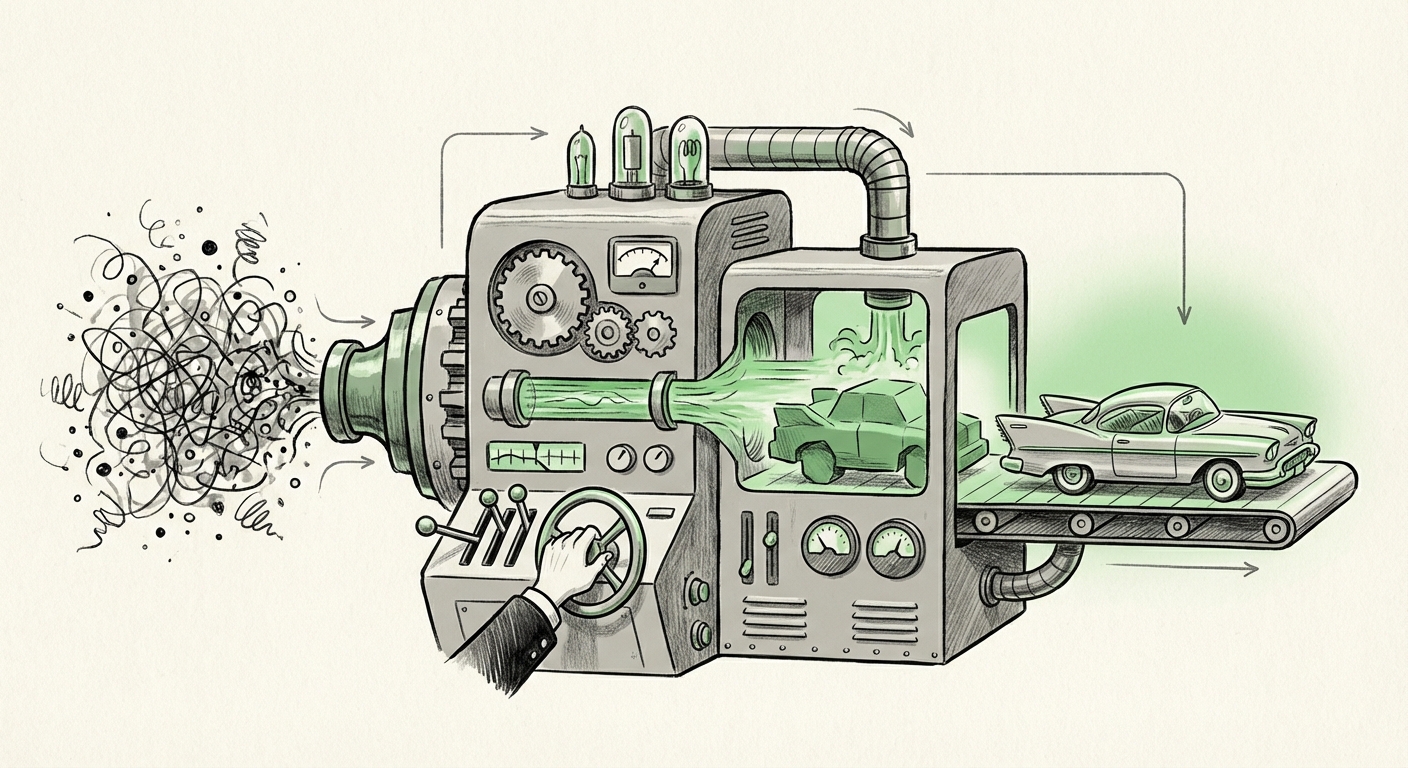
Modern AI does not care about folders. It cares about meaning. When a model reads your document, it builds a mathematical picture of what that document is about, not just what it is called. That means the question "what did we promise the customer about delivery times?" can be answered from a paragraph inside a scanned PDF that was never named anything useful at all.
Once retrieval works that way, the folder tree becomes what the filing cabinet became: a storage artifact nobody visits directly.
From Storage to Answers: The Real Shift
The important change is not that search got better. It is that the output changed shape.
Old model: you search, you get a list of files, you open them, you read, you decide.
New model: you ask, the system reads everything relevant, and it hands you the answer, with the files attached as receipts.
That difference sounds small. It is enormous. It moves the human from being a file-finder to being a decision-maker. And it means the value of your data is no longer tied to how neatly it is organised. It is tied to whether an AI can reach it and understand it.
This is the part many organisations have not absorbed yet. A company with a chaotic, sprawling, poorly labelled drive is no longer automatically a mess. If every document is machine-readable and reachable, the AI can do the sorting work at query time. Conversely, a beautifully organised drive locked inside a system the AI cannot touch is close to worthless.
Structure used to be the moat. Access is the moat now.
What This Means for the Future of AI
Three trends are converging, and they explain why the drive window is closing.
1. AI is becoming an agent, not a chatbot
The first wave of AI answered questions. The current wave takes actions. An agent can read a folder of invoices, draft the summary, file the report, and message the right person, without you opening a single tab. Once the agent can act, the graphical interface becomes optional. You do not need to see the folder to have the work done.
2. Context is the new battleground
Every AI provider is racing to sit on top of your personal and company knowledge. Not because storage is valuable, storage is cheap, but because your files are the context that makes a general model feel personal. Whoever holds the context holds the user. That is why the fight over workspaces, drives, and document stores is really a fight over the future of the assistant layer.
3. The interface is collapsing into conversation
We already saw this pattern with search engines, then with maps, then with music. Each time, the app that used to be a destination became a background utility. The drive is next in line. The files stay. The window you used to open them does not.
Practical Implications for Businesses
If your team stops opening the drive, several things break, and several things get much better.
The permission problem gets real
When an AI answers a question, it answers from everything it can reach. That means your existing permission structure is no longer just about who can click what. It is about who can ask what. A single over-permissive folder can leak information through a polite, well-formed sentence instead of a suspicious download. Access reviews, sensitivity labels, and permission hygiene move from IT housekeeping to board-level risk.
Data quality becomes a performance issue
AI systems are only as good as the material they read. Duplicated files, five versions of the same contract, and abandoned drafts all create noise. This does not require a heroic cleanup project, but it does mean that governing your content is now a performance optimisation, not a nice-to-have.
The org chart changes shape
The job of "finding the thing" is quietly vanishing. The job of "deciding what the thing means" is growing. Roles built around document retrieval, basic reporting, and information triage will shrink. Roles built around judgment, verification, and customer relationships will expand.
What Workers Will Actually Do All Day
Here is the honest version of the future: people will spend less time hunting and more time checking.
When an AI hands you an answer assembled from twelve documents, your new skill is verification, knowing whether that answer is trustworthy, what it left out, and what needs a human signature. That is a different cognitive job than digging through folders, and it is arguably a better one, because it uses judgment instead of patience.
The risk is that people stop verifying. An answer that arrives instantly and looks confident feels true. Teams that build a habit of spot-checking AI output, especially on numbers, dates, and legal language, will get the upside. Teams that do not will get the mistakes at machine speed.
The Risks Nobody Is Talking About
- Silent data sprawl. If nobody opens the drive, nobody notices what has accumulated there. Old files keep feeding AI answers long after they stop being true.
- Loss of the map. Folder structures are, awkwardly, also a form of institutional memory. When the map disappears, organisations need a new way to understand what they know.
- Vendor gravity. The assistant that sits on your files becomes very hard to leave. Switching costs move from "move some documents" to "lose your institutional brain."
- Confidence without competence. Fluent output is not the same as correct output, and the gap is easiest to miss when the interface is effortless.
Actionable Insights: What to Do Now
You do not need to predict the exact shape of the next two years to prepare for it. You need to make your information AI-ready.
- Audit what your AI can reach. Assume anything accessible may one day be summarised in a sentence to someone who should not have seen it. Fix the worst gaps first.
- Fix permissions before you fix folders. Organisation is a nice-to-have. Access control is the whole game.
- Kill the duplicates. Start with contracts, policies, and pricing sheets, the documents where a stale version causes real damage.
- Tag your truth. Mark which documents are current and authoritative. Even a simple "approved version" convention gives an AI signal to prefer.
- Build a verification habit. Make it normal, not rude, to ask "where did that come from?" and check the source files.
- Keep your data portable. Prefer formats and platforms that let you move your knowledge out. Context is too valuable to lock in by accident.
- Retrain the team, not just the tools. The skill that matters now is asking good questions and checking the answers.
The Bottom Line
The drive is not going to disappear. Your files are not going anywhere. What is disappearing is the act of browsing them.
That is a bigger deal than it sounds. Every previous shift in computing, from command lines to windows, from desktops to phones, changed who could use a computer and what they used it for. The shift from browsing to asking does the same thing. It lowers the skill floor for getting real work out of your own information, and it raises the bar for keeping that information clean, safe, and honest.
The people who win the next few years will not be the ones with the tidiest folder trees. They will be the ones whose knowledge is reachable, trustworthy, and ready to answer the moment someone asks.