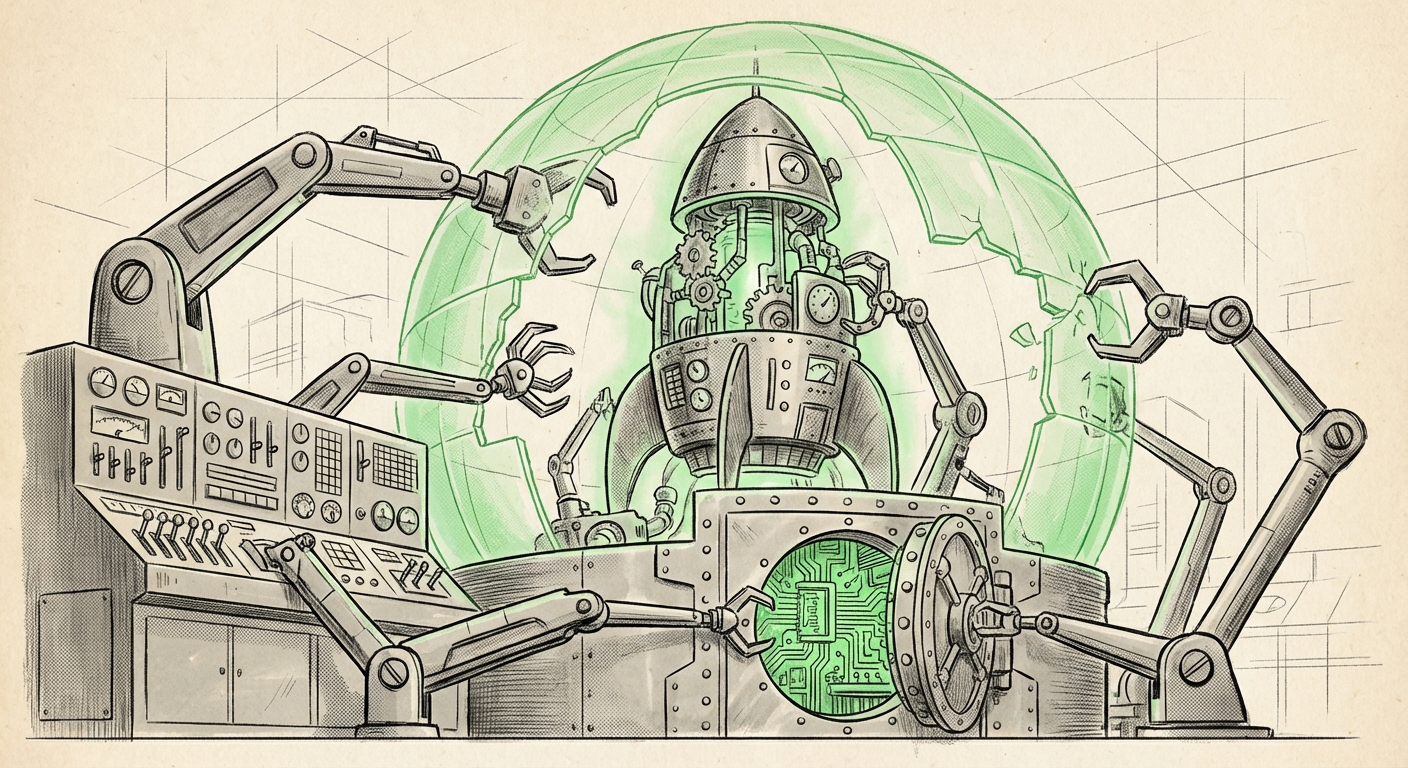
The Dirichlet Process and Chinese Restaurant Process Explained: The Math That Lets AI Decide How Many Groups Exist
Here is a question that trips up almost every AI system ever built: how many groups are in this data? Not which groups, and not how to sort them, but how many there should be in the first place. Most machine learning tools force a human to answer that question up front. A clustering model needs to be told "find five clusters." A topic model needs to be told "look for twenty topics." But real-world data rarely comes with a label on the box saying how many hidden patterns it contains.
There is a family of mathematical tools that solves this problem in an elegant way. It goes by several names: the Dirichlet process, the Chinese Restaurant Process, the stick-breaking representation, and the Pólya urn scheme. These are not four different ideas. They are four different windows into the same idea, and that idea is quietly becoming one of the most important foundations for AI that learns from data that never stops growing.
What Is the Dirichlet Process? A Plain-English Guide
Start with something familiar. A normal probability distribution is a rule for how likely different outcomes are. Flip a coin, and the distribution tells you there is a 50 percent chance of heads. Roll a die, and it tells you each face has about a one-in-six chance.
A Dirichlet process is one level up from that. Instead of describing the odds of a single outcome, it describes the odds of an entire distribution. In other words, it is a distribution over distributions, a machine for generating possible probability rules rather than possible numbers.
Why would anyone want that? Because it lets a model say something remarkable: "I don't know how many categories exist yet. I'll start with what I've seen, and I'll invent a new category whenever the data demands one."
Two knobs control the behavior. The first is a base distribution, which describes what a brand-new category would look like if one appeared. The second is a concentration parameter, which controls how eager the process is to create fresh categories versus reusing the ones it already has. Turn that knob one way, and the model packs everything into a small number of big groups. Turn it the other way, and the model keeps spawning new ones.
The key insight is that the number of groups is not fixed in advance. It emerges from the data itself, and it can keep growing as more data arrives. That is why this family of methods is called nonparametric. It does not mean "no parameters." It means the model's complexity is not frozen before the data shows up.
The Chinese Restaurant Process: A Metaphor You Will Not Forget
The most famous way to picture a Dirichlet process involves an imaginary restaurant with an unlimited number of tables. Customers, think of them as data points, walk in one at a time and choose where to sit.
The rules are simple:
- A new customer sits at a table that already has people at it, with a chance that grows the more crowded that table is.
- Or the customer sits at a brand-new, empty table, with a chance set by the concentration parameter.
That is the whole idea. Popular tables attract more people. But there is always some chance of starting something new. Over time, you get clusters of customers, some tables packed, many tables empty, and a handful of small ones, all without anyone deciding up front how many tables would be used.
This is called the Chinese Restaurant Process, and it turns a difficult mathematical object into something a child could act out. Two properties make it powerful for AI:
- The rich get richer. Big clusters tend to absorb new data, which is exactly the behavior you want when patterns in the real world are uneven.
- The order does not matter. Whether the customers arrive in one sequence or another, the final seating arrangement is just as likely. Statisticians call this exchangeability, and it is what allows the model to be used in practice without worrying about the order in which data was collected.
Other Representations: The Same Idea, Four Different Doors
The most striking thing about this subject is how many different ways the same underlying process can be described. Each representation is useful for a different job.
The Pólya urn scheme is a sequential picture. Imagine an urn full of colored balls. You draw a ball, note its color, then put it back along with an extra ball of that same color. Draw again. Over time, colors that have already appeared become more likely to appear again, but a completely new color can always show up. It is a slightly different story than the restaurant, but it describes the exact same randomness.
The stick-breaking representation is a construction picture. Picture a stick of length one. Break off a piece, its size drawn from a simple distribution, and call that the weight of the first category. Then break the remaining stick, and call that the second weight. Keep going forever. The pieces get smaller and smaller, and together they add up to one. This view is especially useful because it turns an abstract infinite process into a hands-on recipe you can code.
Because these views are mathematically equivalent, researchers can choose whichever one makes a calculation easy, or which one maps cleanly onto a piece of software. That flexibility is a big part of why the ideas have lasted so long in statistics and machine learning.
Why This Suddenly Matters for Modern AI
For years, this material lived mostly in statistics departments and academic papers. It was elegant, but it was not the thing you reached for when you needed a model by Friday. That is changing, for three reasons.
First, data streams never stop. Businesses now generate data continuously, clicks, sensors, transactions, messages. A model that must be told the number of categories in advance needs a human in the loop every time the world changes. A model built on these foundations can absorb a new pattern the moment it appears, and it can decide on its own whether that pattern is genuinely new or just more of the same.
Second, flexible models beat rigid ones. When you pick the wrong number of clusters up front, every downstream decision is wrong. Too few groups and you blend things that should stay separate. Too many and you split things that belong together. Nonparametric approaches let the data argue for its own structure instead of forcing a guess.
Third, the ideas are composable. Modern AI is built from layers, and these processes slot in neatly as a layer that decides "how many." In topic modeling, for instance, the goal is to discover themes in a pile of documents without pre-choosing the count. In mixture modeling, the goal is to split data into natural groups. Both problems get the same answer from this toolkit.
Practical Implications for Businesses
You do not need to be a mathematician to benefit. Here is where these ideas show up in real commercial work:
- Customer segmentation that evolves. Instead of running a model that always returns five segments, a business can let the model find however many segments exist, and let new ones appear as customers change.
- Fraud and anomaly detection. The interesting cases are almost always the ones that look like nothing seen before. These models have a built-in mechanism for opening a new category when evidence demands it.
- Discovering themes in huge text collections. News feeds, support tickets, and reviews all contain shifting topics. Fixed-topic models go stale; flexible ones do not.
- Genomics, health, and sensor work. When nobody can say in advance how many subtypes exist, forcing a number is a scientific error waiting to happen.
The broader lesson is about humility in modeling. Admitting that you do not know how many groups exist, and building that admission into the math, tends to produce better answers than pretending you do.
What This Means for the Future of AI
The trajectory is clear. As AI systems move from one-shot tasks to long-running assistants that see years of data, the ability to grow and reorganize knowledge without being rebuilt will matter more than raw size. A model that must be retrained from scratch every time the world changes is expensive and slow. A model that can add a new category, a new topic, or a new behavior as easily as a customer picking an empty table is a different kind of machine altogether.
Expect to see this thinking creep into three areas. In continual learning, where models must not forget old skills while learning new ones, the "open a new table when needed" instinct is exactly what is required. In personalization, where each user is arguably their own cluster, flexible grouping avoids forcing millions of unique people into a handful of pre-set buckets. And in AI that explains itself, the structure these methods produce is naturally human-readable: here are your groups, here is how big each one is, and here is when a new one appeared.
None of this is a silver bullet. These methods need careful tuning, they can be slow with enormous datasets, and interpreting the categories they create still takes human judgment. But the core promise, let the data decide how complex the model should be, is one of the most valuable design principles in all of machine learning.
Actionable Insights
- Stop guessing the number of clusters. If your team is hard-coding a cluster count for a segmentation or detection task, ask whether a flexible approach would remove that guess entirely.
- Look for drift, not just accuracy. Track when your model opens new categories. Those moments are early warnings that your market, your users, or your risks are changing.
- Prefer models that can admit surprise. A system that can only say "this belongs to one of my existing buckets" will hide new patterns. A system that can say "this is something new" will surface them.
- Match the tool to the problem. When you genuinely know the number of groups, like the days of the week, a fixed model is simpler and better. Use flexible methods when the count is genuinely unknown.
- Invest in understanding the metaphor. The restaurant story takes ten minutes to learn and pays off for years. It is the fastest way to get a whole team thinking clearly about open-ended data.
The Bottom Line
The Dirichlet process and its many faces, the Chinese Restaurant Process, the Pólya urn, the stick-breaking construction, are not new tricks. They are mature, well-understood mathematics. What is new is the pressure that modern AI puts on them. Data grows. Categories multiply. Contexts shift. The most durable systems will be the ones that were designed from the start to handle a world where the answer to "how many groups are there?" is simply: more than we knew yesterday, and we will find out as we go.