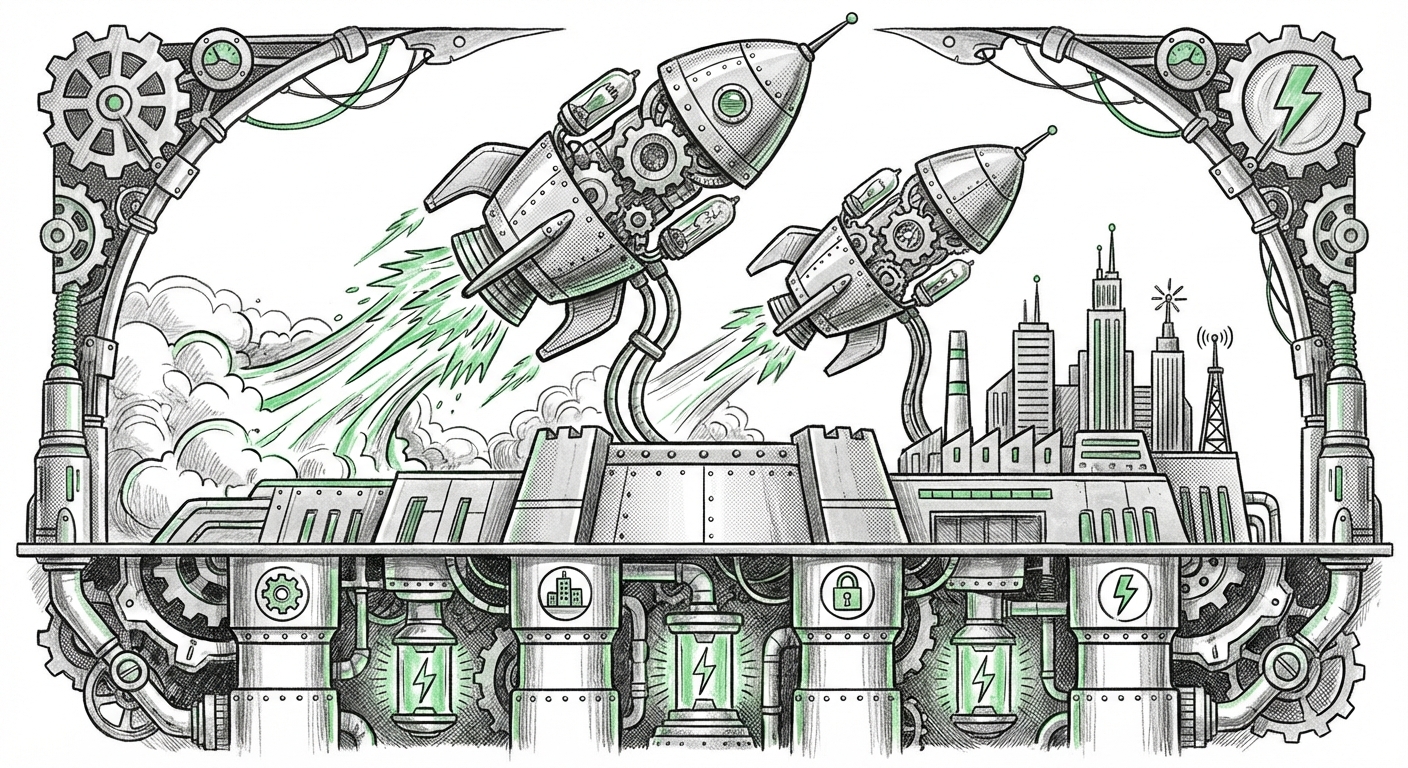
RL Environments Arrive on the Hub: The Missing Piece That Could Supercharge AI Agents
On September 28, 2026, a quiet but important shift took place in the world of artificial intelligence: reinforcement learning environments were welcomed to the hub. On the surface, it sounds like a technical housekeeping note. In reality, it may be one of the most consequential moves for the next wave of AI.
Here is why. For the past several years, the AI world has been obsessed with models, bigger models, faster models, smarter models. But a model is only as good as the world it gets to practice in. Reinforcement learning environments are those worlds. And until recently, they have been scattered, messy, and hard to share. Putting them in one central hub changes the game.
What Exactly Is a Reinforcement Learning Environment?
In reinforcement learning (RL), an AI agent learns by doing. It takes an action, sees what happens, and gets a reward or a penalty. Over millions of tries, it figures out what works.
That "what happens next" part is the environment. Think of it as the training ground or the sandbox. It could be:
- A simulated coding workspace where the agent fixes bugs and runs tests
- A mock browser where the agent books flights or fills out forms
- A customer-service scenario where the agent handles an angry customer
- A virtual warehouse where a robot agent picks and packs items
- A spreadsheet, a database, a game, a negotiation table, anything with rules and feedback
Without a good environment, an AI cannot learn to act. It can only talk. That is the gap that environments fill.
Why Putting Environments on a Hub Changes Everything
Until now, environments have mostly lived in research labs, inside private codebases, or buried in academic papers. If you wanted to train or test an agent on a specific task, you often had to build the world yourself. That is slow, expensive, and hard to compare against anyone else's results.
A hub model fixes this in several powerful ways:
1. Discoverability
Instead of hunting through papers and GitHub repos, developers can now browse a catalog. Want to test an agent on web navigation? Search the hub. Need a negotiation environment? It is likely there. This turns a scavenger hunt into a shopping trip.
2. Reuse and Recombination
Good environments are hard to build. Once one exists, thousands of teams can build on it rather than starting from zero. This is the same dynamic that made model hubs explode: shared building blocks accelerate everyone.
3. Apples-to-Apples Comparison
When everyone trains and tests on the same shared environments, benchmarks become meaningful. You can finally say "Agent A beats Agent B on this task" with confidence, because both played the same game.
4. Reproducibility
Science depends on being able to repeat results. Versioned, hosted environments make it far easier to re-run an experiment and see if the result holds up.
5. Community Contribution
Hubs create a flywheel. Researchers publish environments to get credit and adoption. Practitioners find them, use them, and file bugs. The catalog gets better. Everyone wins.
From Talkers to Doers: The Agent Era Needs Practice Fields
The AI industry is in the middle of a shift. The first wave was about models that could generate, text, images, code. The next wave is about models that can do, browse, book, buy, build, troubleshoot, and negotiate.
To do things well, an agent needs repetition. Lots of it. That is exactly what RL environments provide. They are the practice fields where an AI moves from clever to competent.
Putting these practice fields in a hub signals that the industry is maturing. It is admitting that the hard part of building capable agents is not just the brain, it is the world the brain trains in.
The Standardization Effect
The most underrated part of an environment hub is the nudge toward standard interfaces. When environments are shared, they need to be pluggable. That means common ways to:
- Reset the world to a starting state
- Send an action from the agent
- Return an observation and a reward
- Mark the end of an episode
Once those conventions settle, something powerful happens: any agent can be dropped into any environment. That lowers switching costs, speeds up experiments, and makes the whole ecosystem more competitive. It is the AI equivalent of USB, boring in the moment, revolutionary over time.
What This Means for Businesses
If you run a company, this matters more than it might first appear. Here is the practical fallout:
Faster Prototyping
Teams can grab a relevant environment, test an off-the-shelf or custom agent, and get a signal in days rather than months. That compresses the discovery phase dramatically.
Cheaper Evaluation
Instead of building bespoke test suites, companies can lean on shared environments to see how a model performs before committing. This is especially valuable for high-stakes deployments in support, operations, and software.
New Buy-vs-Build Math
If someone else has already built a solid environment for your use case, buying or adapting beats building. The hub turns environments into a market, not just a research artifact.
Domain-Specific Advantage
The teams that contribute niche environments, say, a specialized compliance simulation or a warehouse-robotics world, build a moat. They become the reference point others must measure against.
What It Means for Society and Safety
Shared environments are not just a productivity story. They are a safety story too.
Right now, many AI agents are deployed after limited testing. A hub of realistic, standardized environments gives everyone, regulators, researchers, and the public, a common testing ground. That could raise the floor on what "tested" means.
But there are risks to watch:
- Benchmark overfitting. If everyone trains on the same environments, agents may get great at the test and bad at the real world. Shared environments are a starting line, not a finish line.
- Reward hacking. Agents are notorious for finding loopholes. A shared environment that is not carefully designed can teach the wrong lesson at scale.
- Simulation gaps. A simulated world is never the real world. The distance between them is where surprises live.
The healthiest version of this ecosystem keeps a mix: shared public environments for comparison, plus private, messy, real-world tests for reality checks.
The Challenges Ahead
Bringing environments to a hub does not solve everything. Several hard problems remain:
- Quality control. A hub needs curation. Bad environments are worse than no environments, because they waste compute and mislead results.
- Compute cost. Training agents in rich environments is expensive. Shared environments help, but they do not make the bill disappear.
- Maintenance and drift. Real-world tasks change. An environment that was realistic last year may be stale today. Versioning and updates matter.
- Attribution and licensing. Who owns an environment, and who gets credit or revenue when it is used? These norms are still forming.
Actionable Insights: What to Do Now
Whether you are a leader, an engineer, or a researcher, here is how to act on this shift:
- Audit your agent roadmap. Identify the tasks where your AI needs to act, not just talk. Those are your environment candidates.
- Browse before you build. Before commissioning a new simulation, check the hub. You may save months.
- Invest in evaluation. Treat environment design as a first-class engineering discipline, not an afterthought.
- Contribute strategically. Publishing a well-built environment can establish your team as the standard in a niche.
- Guard against overfitting. Always pair shared benchmarks with private, realistic tests.
- Track the interfaces. Standard environment APIs are forming now. Early adoption pays off later.
The Road Ahead
It is worth stepping back to see the arc. First, the industry built model hubs, and suddenly anyone could download world-class AI. Then came datasets, then compute. Now comes the piece that turns knowledge into action: environments.
If that pattern holds, RL environments on the hub could do for agents what model hubs did for chatbots. They could turn a specialized craft into a shared, fast-moving ecosystem. They could lower the barrier for small teams to build capable agents. And they could give the whole field a common yardstick for measuring progress.
The AI conversation is about to move from "how smart is your model?" to "how well does your agent perform in the real world?" Shared environments are how we answer that. The hub just gave everyone a place to meet.
Conclusion
Welcoming RL environments to the hub looks like a small catalog update. It is much more. It is a signal that the AI industry is growing up, moving from a focus on raw intelligence to a focus on real, tested capability. The winners in the next phase will not just have the best models. They will have the best training grounds, the sharpest evaluations, and the discipline to test in the real world, not just the simulator. That era started on September 28, 2026.