Reflection AI's Beam: What a 501B Open-Weight Model With 23B Active Parameters Means for AI's Future
On October 5, 2026, Reflection AI introduced Beam, a new open-weight AI model. The numbers attached to it are the kind that make engineers sit up straight: 501 billion total parameters, but only 23 billion active parameters at any given moment. It is built as a mixture-of-experts (MoE) model, and it is aimed squarely at coding and agentic workloads.
That last part matters more than the raw size. Beam is not trying to be a chatbot that wins trivia night. It is trying to be the engine inside software that writes software, plans multi-step tasks, calls tools, checks its own work, and keeps going until a job is done. That is a very different design goal, and it points toward where the whole industry is heading.
Here is what Beam actually represents, why the 501B/23B split is a bigger deal than it sounds, and what businesses and workers should do about it.
The Real Story Is Not the 501 Billion, It Is the 23 Billion
When people hear "501 billion parameters," they usually picture a gigantic, expensive, slow machine. That is the old mental model. Sparse models like Beam break that model apart.
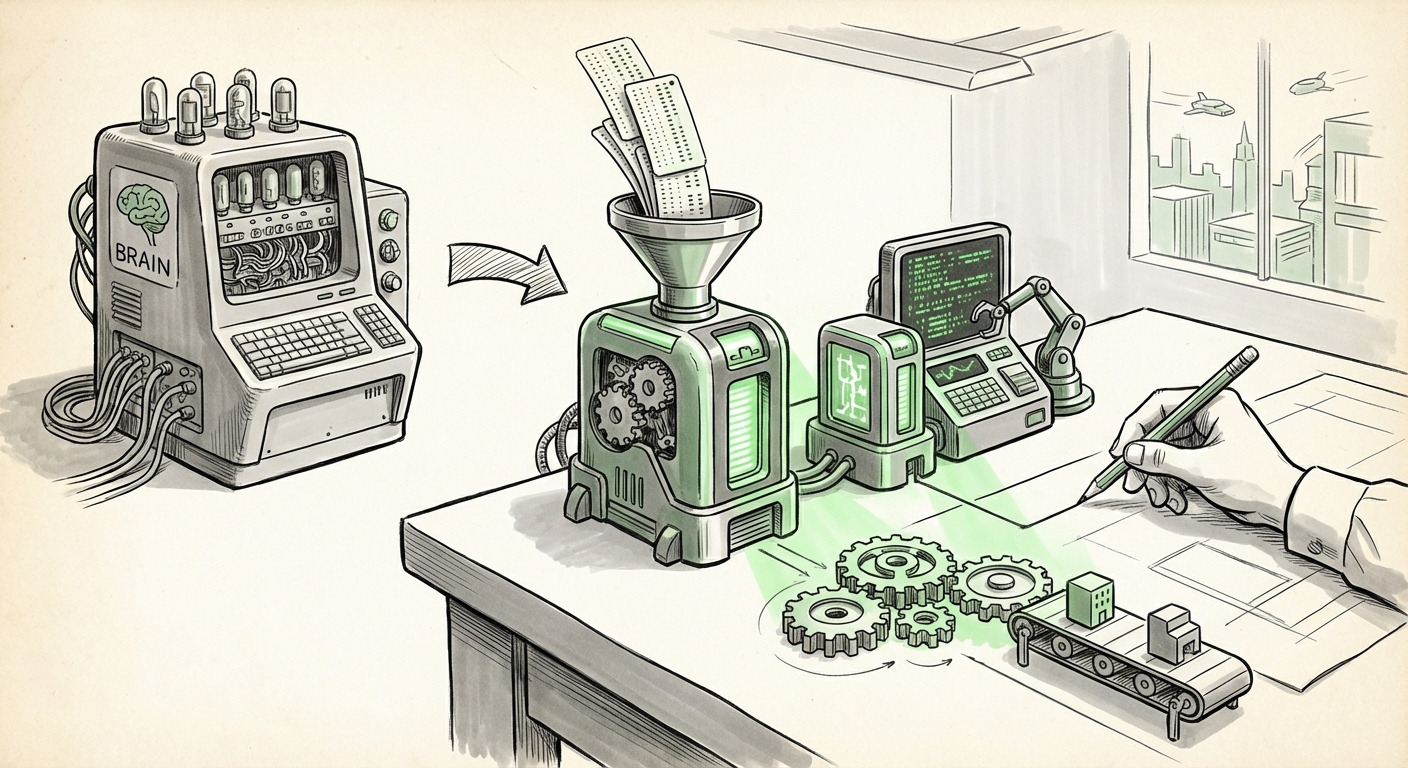
Think of a mixture-of-experts model as a huge building full of specialists. The building has 501 billion parameters' worth of knowledge and skill locked inside it. But when a question comes in, the model does not wake up every specialist. It routes the work to a small handful of them, in Beam's case, a slice worth about 23 billion active parameters.
Do the math: that is roughly one in twenty-two parameters doing the work on any given token. The rest sit quietly until they are needed.
Why that design choice is so powerful
- You get big-model knowledge at small-model speed. The model can hold a vast range of skills in its weights while only paying the compute cost of the active slice.
- Costs stay tied to activity, not to size. Running a 501B model sounds terrifying on a budget. Running a 23B-active model is a different conversation entirely.
- Specialisation is built in. Experts can learn different domains, one cluster of experts for Python, another for debugging traces, another for planning steps, another for structured tool calls.
- It fits real agent loops. Agents do not make one clean request. They make dozens or hundreds of calls in a row. Efficiency per call compounds dramatically over a long task.
This is the core insight: total parameters are a measure of capacity, but active parameters are a measure of cost. Beam is designed to have a lot of one and very little of the other.
Why "Open-Weight" Changes the Competitive Landscape
The word open-weight is doing enormous work in this announcement. A 501B open-weight model from a company like Reflection AI is not just a product release, it is infrastructure that other people build on.
When weights are open, a few things happen at once:
- Organisations can self-host. Companies with strict data rules, banks, hospitals, defence contractors, government agencies, can run the model inside their own walls instead of sending sensitive code and documents to someone else's servers.
- Fine-tuning becomes possible. A team can adapt Beam to its own codebase, its own internal tools, its own style guides and compliance rules. A general model becomes a specialist.
- The price floor drops. Open weights create downward pressure on the entire market. When a capable frontier-class model is available to download, closed providers have to justify their pricing with something other than raw capability.
- Ecosystems form fast. Fine-tunes, quantised versions, tooling, inference optimisations and evaluation suites show up within weeks, and every one of them makes the model more useful.
The strategic implication is blunt: model capability is becoming a commodity, and the value is migrating upward to the layer where the model is used. If a strong open-weight model exists, the winner is rarely the lab that trained it. The winner is whoever wraps it in the best workflow.
Why Coding and Agentic Workloads Are the Target
Reflection AI did not aim Beam at general conversation. The stated focus is coding and agentic workloads, and that is not an accident. These are the two uses where AI is currently generating the most measurable economic value, and where the technical requirements are hardest.
Coding is the perfect proving ground
Code has a rare quality in the AI world: it can be checked automatically. You can run it. It either compiles or it does not. Tests either pass or they fail. That means a coding model can be improved with feedback loops that are objective rather than vibes-based. It also means the value delivered is easy to measure, features shipped, tickets closed, review time saved.
Agents are where the difficulty spikes
An agent is not a single answer. It is a loop: understand the goal, plan, act, observe the result, correct, repeat. That loop is brutal on models for a few reasons:
- Errors compound. A small mistake on step three can wreck step thirty. Long-horizon reliability matters far more than single-response quality.
- Context grows fast. Logs, file contents, tool outputs and prior attempts pile up quickly.
- Latency adds up. If each step is slow, the whole task takes forever, which is exactly where a sparse model's efficiency pays off.
- Tool use must be exact. Calling a function with the wrong argument shape breaks everything downstream. This is a precision problem, not a creativity problem.
A model that is cheap enough per call to run a hundred-step loop, and strong enough at code and structured output to survive that loop, is a genuinely different tool from a general-purpose chatbot. That is the gap Beam appears built to fill.
The Economics of Running Agents at Scale
Most businesses underestimate one thing: agents multiply inference costs. A single user request can trigger ten, fifty, or two hundred model calls. If every one of those calls runs on an expensive, dense frontier model, the economics fall apart fast.
This is the quiet reason sparse models matter commercially. Let us walk through a simple example.
Suppose your support team wants an agent that reads a customer email, looks up the account, checks recent orders, drafts a reply, and escalates edge cases to a human. That is maybe six to fifteen model calls per ticket. At a thousand tickets a day, you are looking at tens of thousands of calls daily, and the cost per call decides whether the project is viable or fantasy.
Now apply the same logic to software engineering. An agent that fixes a bug might read twenty files, run tests four times, and revise its patch six times. A model where only 23 billion parameters are active per step is far cheaper to keep in that loop than one where hundreds of billions are burning on every token.
The takeaway for anyone planning AI budgets: stop pricing per conversation and start pricing per completed task. The winning models will be the ones that finish the whole job affordably, not the ones that sound best on a single prompt.
Practical Implications for Businesses
Beam is a reminder that the build-versus-buy question has changed. A few actionable moves:
- Audit what leaves your walls. If sensitive code or customer data is currently flowing to external APIs, an open-weight model gives you a path to keep it in-house.
- Measure completed tasks, not demo quality. Track how often an agent finishes a job end-to-end without a human rescue. That number, not a benchmark, determines ROI.
- Build for model portability. If your product is tightly coupled to one model's quirks, you are renting your future. Good abstraction lets you swap in a better or cheaper model as it appears.
- Invest in evaluations before you invest in features. Open-weight models vary widely once you fine-tune or quantise them. A private test set of your real work is worth more than any public leaderboard.
- Watch the hardware bill. Sparse models change the calculus for self-hosting. What was impossible on your own servers two years ago may be sensible now.
What This Means for Workers and Society
Models built specifically for coding and agentic work push automation deeper into knowledge work. That is uncomfortable and important.
The pattern is consistent: AI tends to take over tasks before it takes over jobs. A coding-focused agent does not replace a senior engineer. It replaces the tedious parts of engineering, boilerplate, test writing, dependency upgrades, log triage, first-pass review. What is left is judgement, architecture, customer understanding, and accountability. Those are human skills, and they get more valuable, not less.
But there is a real transition risk. Junior roles have historically been where people learn judgement by doing the tedious work. If the tedious work disappears, the apprenticeship ladder needs to be rebuilt deliberately. Companies that automate entry-level tasks without thinking about how they will grow senior talent are quietly hollowing out their own future.
Open weights also shift power. When a capable model is downloadable, a small team in a small country can build at a level that previously required a giant lab's budget. That is genuinely good for competition, innovation and regional autonomy. It also makes governance harder, because weights that are released cannot be recalled.
Risks and Open Questions
No release like this is only upside. A few things worth watching:
- Reliability over long horizons. The hardest problem in agentic AI is not intelligence, it is staying on track for fifty consecutive steps without drifting.
- Security. An agent with file system access and the ability to run code is a powerful thing to point at an untrusted input. Prompt injection becomes a real attack surface.
- Evaluation honesty. Coding benchmarks are easy to overfit. Real productivity gains require real measurement inside real teams.
- Cost of fine-tuning. A 501B base model, even sparse, is not trivial to adapt. Many organisations will depend on the community to produce the tuned variants that matter.
- An open model does not mean a cheap deployment. Weights are free; the hardware, serving stack and expertise are not.
What to Watch Next
The direction of travel is clear. Expect sparse architectures to become the default for anything serious. Expect open-weight releases to keep pressuring closed providers on price. Expect the agentic layer, memory, planning, tool orchestration, guardrails, evaluation, to become the place where products are actually won or lost. And expect coding to stay the beachhead, because it is the one domain where AI output can be verified automatically and value can be logged in a changelog.
Beam's headline number is 501 billion. Its meaningful number is 23 billion. That ratio is the whole lesson: the future of AI is not about building the biggest model, it is about building the model that is smart enough to be useful and cheap enough to be everywhere.
Conclusion
Reflection AI's Beam is a signal more than it is a single product. A 501B open-weight mixture-of-experts model with 23B active parameters, tuned for coding and agentic workloads, tells you exactly where the frontier is moving: toward massive capacity with small running costs, toward openness as a competitive strategy, and toward models judged by whether they finish work rather than how well they talk about it.
For businesses, the practical response is straightforward. Test the model against your real tasks. Measure completed work, not demo moments. Keep your systems portable. And start planning your budgets around agents that make hundreds of calls, not chatbots that make one.
The companies that treat this as a plumbing upgrade will get a faster chatbot. The companies that treat it as a cost-structure change will get something much bigger: software that does software.