Intelligence Can Be Rented But Taste Must Be Earned: The AI Skill That Decides Who Wins
For almost all of human history, smart thinking was expensive. If you wanted expert analysis, a polished draft, a working plan, or a clever idea, you had to find a person who had spent years building that skill, and then pay them a lot of money for their time.
That world is over. Today, raw intelligence is something you can rent. You plug into a model through an interface or an API, pay for what you use, and get capable reasoning back in seconds. It is metered, reliable, and cheap enough to use casually. Intelligence has become a utility, like electricity or water.
But here is the twist that is shaping the next phase of AI adoption: when everyone can rent the same intelligence, intelligence stops being an advantage. What becomes valuable instead is something you cannot rent, download, or subscribe to. It has to be built slowly, from experience. That something is taste.
Renting Intelligence Is Now Routine, and That Is the Point
The most important shift in AI is not that models got smarter. It is that capability became accessible. A two-person startup and a global enterprise can access similar reasoning power through the same rented channels. The gap between them is no longer about who has the smartest tool. They have the same tool.
When a resource becomes abundant, its value moves. This has happened before. Computing power became cheap and moved to the cloud. Storage became cheap and moved to buckets. Information became cheap and moved to search. In each case, the scarce thing shifted upward, to the people who knew what to build, what to keep, and what to throw away.
AI is following the same pattern. The model is the meter. The judgment about what to ask it, what to trust, and what to ship is where the value now lives.
Why Taste Cannot Be Rented
Taste is often misunderstood as a matter of personal preference, "I just know what I like." In professional work, taste means something far more demanding. It is the ability to look at a hundred possible outputs and instantly sense which one is right for the moment. It is judgment compressed into instinct.
You cannot rent that. A rented model can generate options, but it cannot carry your context, your history of failures, your understanding of your customer, or your feel for what will land. Those things live in people, teams, and organizations. They are earned through doing the work, seeing the results, and adjusting.
Consider a simple example. Ask an AI to write ten versions of a product description and it will do it instantly. Ten competent, grammatically clean options. Now ask which one will actually convert for a specific audience, on a specific day, at a specific price point, in a market that just shifted. The model will guess. A person with taste will know, and if they are wrong, they will know why.
That is the difference. Rented intelligence produces plausible. Earned taste produces right.
The Three Ingredients of Taste
Taste is not a single skill. It is a bundle of three things, and each one takes time to build.
1. Discernment, knowing what quality looks like
Discernment is the ability to tell good from nearly good. This matters more than ever, because AI output is rarely obviously bad. It is usually fine. The danger is subtle: work that looks done but is hollow. Discernment is what lets you catch that.
2. Judgment, knowing what matters now
Judgment is about priority and timing. Of all the things you could do, which one deserves the effort today? Rented intelligence can help you analyze options, but the decision to commit is human. Judgment comes from having made calls before and living with the outcomes.
3. Restraint, knowing what to leave out
This is the rarest and most underrated part of taste. AI makes adding easy. It will happily generate more features, more words, more ideas. The discipline to cut, simplify, and stop is what separates strong work from noise. Restraint is a taste muscle that atrophies quickly if you never exercise it.
What This Means for Businesses
As rented intelligence spreads, output quality converges. Everyone's first drafts get better at the same time. This creates a strange new problem: when average quality rises, average stops being a differentiator. Being "as good as everyone else" is now the default.
Three practical consequences follow.
The middle layer gets squeezed. Roles that mainly involved producing competent first-pass work, assembling drafts, summarizing, formatting, basic analysis, are the ones most exposed. The work does not vanish, but the value attached to it drops fast, because it can be rented.
The ends of the pipeline get more valuable. Deciding what problem to solve in the first place, and taking responsibility for the final call, are both human-heavy activities. Rented intelligence can support both, but it cannot own either.
Trust becomes a product feature. When everyone can produce similar-looking output, customers gravitate to whoever they believe will make good calls. Trust is the public face of taste.
How AI Will Actually Be Used
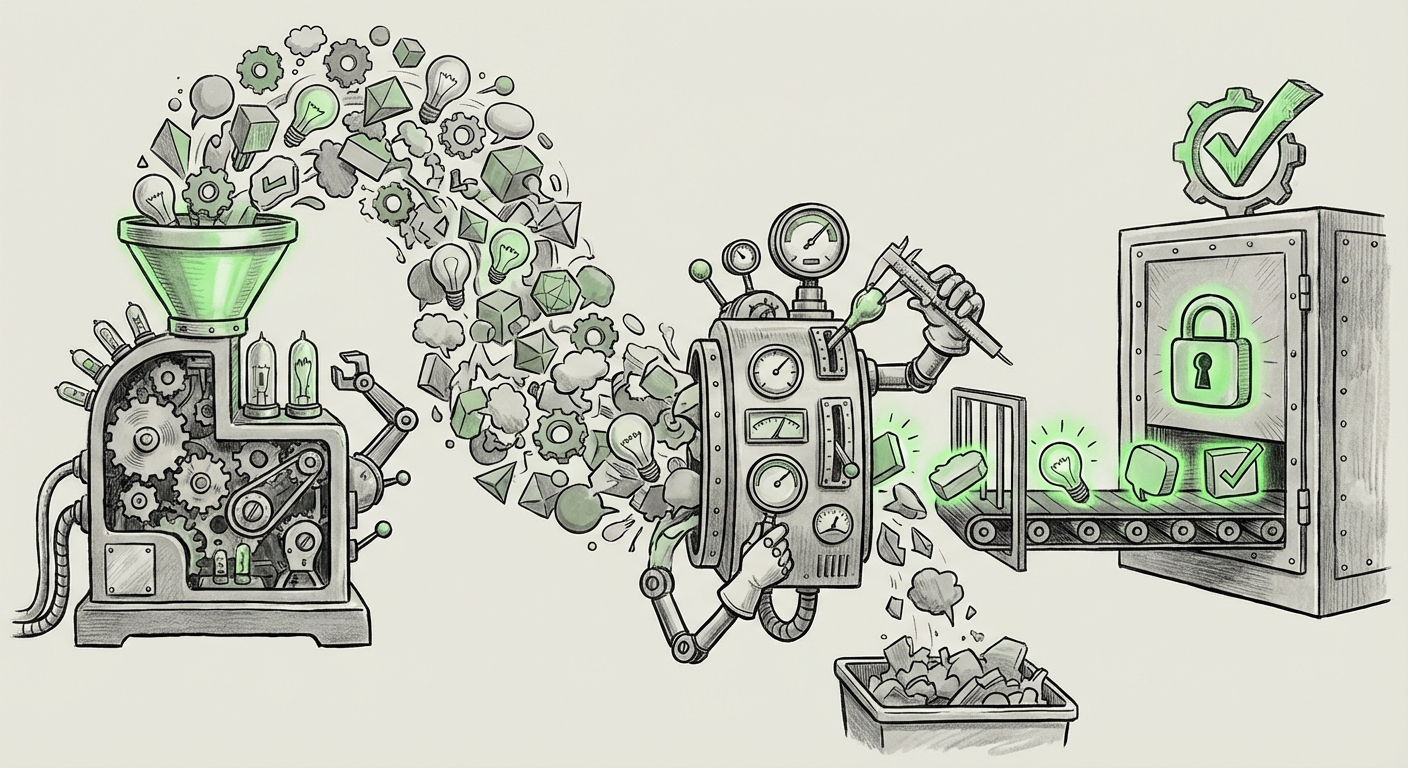
The popular story about AI is that it does the work. The more accurate story is that it expands the option space, and humans narrow it. The job shifts from generation to selection.
This is a bigger change than it sounds. For decades, the bottleneck in knowledge work was production. Could you get the thing made? Now the bottleneck is evaluation. Can you tell, quickly and reliably, which of fifty AI-generated options is the one worth shipping?
That reframes what teams should invest in. The winners will not be the teams with the most AI tools. They will be the teams that get very good at reviewing, comparing, and choosing, and that build clear standards so choices are consistent. Evaluation becomes a core discipline, not an afterthought.
It also changes how AI gets deployed inside organizations. Instead of asking "where can we automate?" the better question becomes "where do we want more options, and who has the taste to choose among them?" Those are two very different planning conversations, and only the second one compounds over time.
The Risk of Renting Without Earning
There is a real danger in all this accessibility. If a team rents intelligence without ever building taste, it can produce enormous volumes of plausible work that no one is equipped to judge. The output looks fine. The results are mediocre. And because the work looks done, nobody investigates.
This is how taste atrophy happens. If you always accept the first reasonable answer, you stop training the instincts that tell you when something is off. Over time, you lose the very ability that made you valuable. The tool does not replace judgment, but leaning on it carelessly can erode it.
There is also a homogenization risk at the level of markets. If thousands of teams rent from the same few sources of intelligence, their outputs will drift toward the same middle. Distinctiveness becomes harder to achieve, which makes genuine taste more valuable, not less.
A Practical Playbook
Earning taste is not mysterious, but it is deliberate. Here is what that looks like in practice.
- Review out loud. When your team picks one option over another, say why. Written reasoning turns private instinct into shared standards.
- Keep score. Track which decisions turned out well. Taste sharpens fastest when feedback is honest and close to the moment.
- Hire for judgment, train for tools. Tools can be taught in days. Judgment takes years, so weight it heavily in hiring.
- Protect the cut. Make someone responsible for removing, not just adding. Editing is where taste becomes visible.
- Do the reps yourself. If you never draft, critique, or decide, you cannot develop the instincts that make AI output useful.
- Use AI to widen, humans to narrow. Let models produce variety. Let people apply standards. Do not confuse the two.
What This Means for Society
Rented intelligence is genuinely democratizing. A person with a good idea and a small budget can now access reasoning power that used to require a large team. That is a real widening of opportunity, and it should not be dismissed.
But access to intelligence is not the same as access to taste. Taste is built through exposure, mentorship, feedback, and practice, things that remain unevenly distributed. If intelligence becomes a cheap utility while taste stays hard to earn, the gap between people will not disappear. It will move. The advantage shifts from those who can think, to those who can judge.
That has implications for education and training. Memorizing facts matters less. Forming opinions, defending them, and revising them in the face of evidence matters far more. The curriculum of the future is less about answers and more about the ability to tell good answers from bad ones.
The Bottom Line
The era of renting intelligence is here, and it is only getting cheaper. That is good news for anyone with curiosity and a problem to solve. But it also raises the bar. When capability is common, distinction comes from judgment, from knowing what is worth doing, what is worth keeping, and what is worth cutting.
Rent the intelligence without hesitation. Use it to explore, draft, and analyze. But treat taste as the real asset, because it is the one thing no subscription can deliver. It is built one decision at a time, and it is the only advantage that gets stronger the longer you hold it.