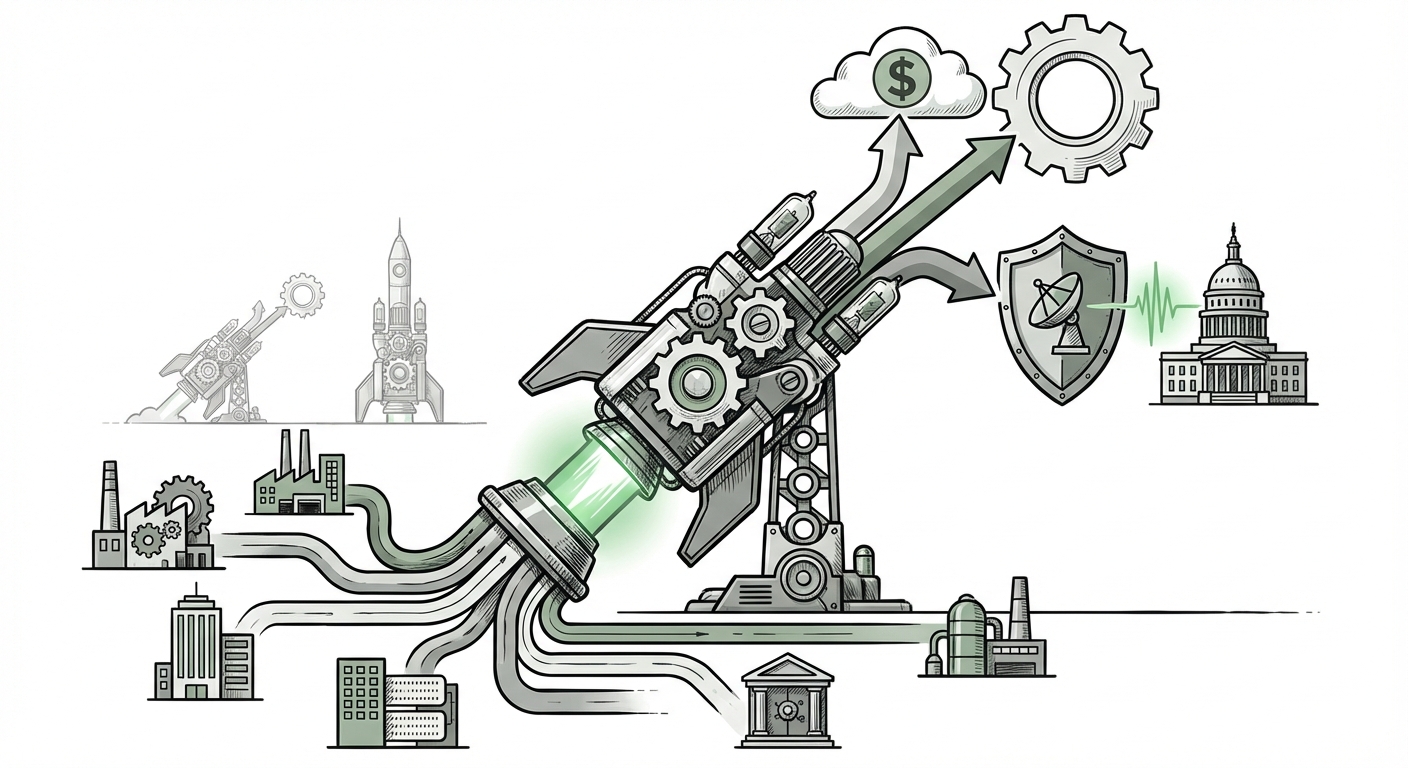
B-1 Bomber Pullout and Iran: What Asymmetric Conflict Means for the Future of AI in Warfare
Something strange is happening in the way the world's most powerful military and one of its most sanctioned adversaries are facing off. The United States has pulled its B-1 bombers out of the picture. Iran, by almost every traditional measure, is outgunned. And yet, that same outgunned country is keeping the U.S. on edge.
That single fact, an underdog setting the tempo for a superpower, is the most important thing to understand about modern conflict. It is also the clearest sign yet of where artificial intelligence in warfare is heading next.
For anyone who builds, buys, or regulates AI, this is not a distant foreign policy story. The same ideas that make a weaker force dangerous, speed, cheapness, swarms, and unpredictability, are the same ideas reshaping your industry right now. Here is what the B-1 pullout really tells us, and what it means for the future of AI.
What the B-1 Pullout Actually Signals
The B-1 is a long-range heavy bomber. It is expensive, it is visible, and it is a classic symbol of air power. When a platform like that gets pulled out of a region, observers usually read it one of two ways: either tensions are cooling, or the mission has changed.
The interesting part is what sits underneath the headline. A bomber is a cold, hard asset. It does not adapt. It does not learn. It flies a planned route at a planned time and delivers a planned effect. Against a modern, layered defense, that predictability is a liability. Against a cheap, fast, networked adversary, it is an even bigger one.
Meanwhile, the side that is outgunned keeps forcing the stronger side to react. That is the definition of asymmetric advantage. And asymmetry is exactly the problem AI was born to solve, on both sides of the fight.
Why an Outgunned Adversary Can Still Set the Pace
Traditional military math is simple: more planes, more ships, more money equals more power. That math has been breaking down for years. The reason is that information now beats inventory.
An adversary that cannot match you plane for plane can instead:
- Send many small, cheap systems instead of a few big, expensive ones.
- Move faster than your planning cycle.
- Hide inside noise, civilian traffic, commercial signals, ordinary internet.
- Force you to spend a million dollars to stop a thousand-dollar problem.
None of that requires a superior factory base. It requires superior software, better sensing, and faster decisions. That is a software problem. And software problems are where AI eats traditional advantages for breakfast.
This is why a bomber pullout is not really a story about bombers. It is a story about whether big, slow, expensive platforms still make sense in a world where small, fast, cheap and smart is winning.
The Three AI Jobs That Matter Most in This Kind of Standoff
When analysts talk about AI in defense, they usually lump everything together. That hides the real picture. In practice, AI shows up in three distinct roles, and each one shapes deterrence differently.
1. Sensing and Fusion, Seeing the Unseen
Modern battlefields generate an ocean of data: radar, satellite, radio, drone video, open-source chatter, shipping records. No human team can read it all in real time. AI's first job is to fuse that ocean into a single, usable picture, and to flag the one thing that does not fit.
This is where AI creates the most immediate edge. It shortens the gap between "something happened" and "we understand what happened." In a standoff where one side keeps the other guessing, that gap is the whole game.
2. Decision Support, Thinking Faster Than the Other Guy
The second job is recommending options. Not pulling the trigger, recommending where to look, what to move, and what the trade-offs are. This is where AI gets politically sensitive, because the line between "recommend" and "decide" is thin and getting thinner.
The speed problem is real. If an adversary can act in minutes and your staff process takes hours, you have already lost the round. AI compresses that cycle. But compressed cycles also mean less time for human judgment, which is exactly where risk lives.
3. Autonomy, Machines That Act Alone
The third job is doing things without a human in the loop: drones that fly in coordinated packs, systems that jam signals on their own, defenses that react in milliseconds.
This is the most powerful and the most dangerous category. Cheap autonomous systems are how an outgunned force gets reach. They are also how mistakes get made at machine speed.
The Cost-Exchange Problem: AI's Real Superpower
Here is the concept that ties the whole story together: cost exchange.
If it costs you a great deal to defend against something that costs your opponent very little, you lose over time, even if you win every single engagement. This is the quiet math that keeps strong powers on edge.
AI supercharges cost exchange in both directions:
- It lowers the cost of offense. Software is cheap to copy. One good autonomy model can fly a thousand cheap drones.
- It lowers the cost of defense too, if you adopt it. AI-driven sensors and interceptors can shoot down cheap threats far more cheaply than humans or legacy systems can.
- It punishes anyone who waits. The gap between the side that adopts and the side that does not grows fast.
That is why a bomber leaving a region matters. It is a signal that the expensive, low-volume approach is being questioned, while the cheap, high-volume, AI-enabled approach keeps proving itself.
The Big Risk: AI-Accelerated Escalation
There is a darker thread here, and it deserves plain language.
When two sides both use AI to sense, decide, and act faster, the space for de-escalation shrinks. Humans calm things down. They hesitate. They call each other. Machines do not. If both sides automate their reaction times, a small incident can cascade into a crisis before anyone has time to pick up a phone.
This is not a hypothetical for the future. It is a design choice being made right now, in procurement offices and labs, by people who mostly are not thinking about escalation at all. They are thinking about latency.
The practical answer is not to ban the technology. It is to build deliberate friction, checkpoints, human confirmation steps, and clear rules about what machines may never decide on their own. Speed is a weapon. Uncontrolled speed is a hazard.
What This Means for Businesses Outside Defense
You are probably not buying bombers. But the same forces are hitting your market, and the parallels are direct.
The "outgunned" competitor is coming for you. A smaller rival with better AI tooling can out-react a larger, slower incumbent. They do not need your headcount. They need better automation and faster loops.
Cost exchange is your margin story. If your competitors can serve a customer at a fraction of your cost because their processes are automated end-to-end, price pressure follows. That is the same math, just with invoices instead of missiles.
Speed becomes table stakes. Customers now expect responses in seconds, not days. AI is how you get there without doubling your staff.
Governance is a competitive feature. The organizations that put clear human checkpoints around AI decisions, especially in finance, healthcare, hiring, and safety, will be the ones that keep their licenses and their reputations when something goes wrong.
Actionable Insights: What to Do Now
Whether you lead a company, a team, or a policy group, the takeaways are concrete:
- Audit your decision speed. Find the place where your organization takes the longest to go from signal to action. That is your highest-value AI project.
- Invest in data fusion before you invest in models. Most AI failures are data failures wearing a costume.
- Design human checkpoints on purpose. Decide in advance which decisions a machine may never make alone. Write it down.
- Think in cost exchange terms. For every process, ask: what does this cost us to defend, versus what it costs a competitor to attack? That ratio matters more than last year's budget.
- Treat autonomy as a spectrum, not a switch. Move up it deliberately, with logging, review, and rollback plans.
- Watch the low end, not just the high end. The most disruptive AI applications are usually cheap, numerous, and boring, not the ones in the headlines.
The Road Ahead
The pullout of the B-1 bombers is a small headline that points at a very large shift. The era of winning by having more is fading. The era of winning by seeing more, deciding faster, and adapting cheaper is here.
That shift is not only happening in the skies over a contested region. It is happening in supply chains, in customer service, in hospitals, in banks, and in every organization that has to react before its competitor does.
AI is not a magic wand. It is a multiplier, on speed, on cost, and on the consequences of your decisions. The outgunned side keeps the strong side on edge because it understands that. The question for the rest of us is whether we will learn the same lesson before someone else does it to us.