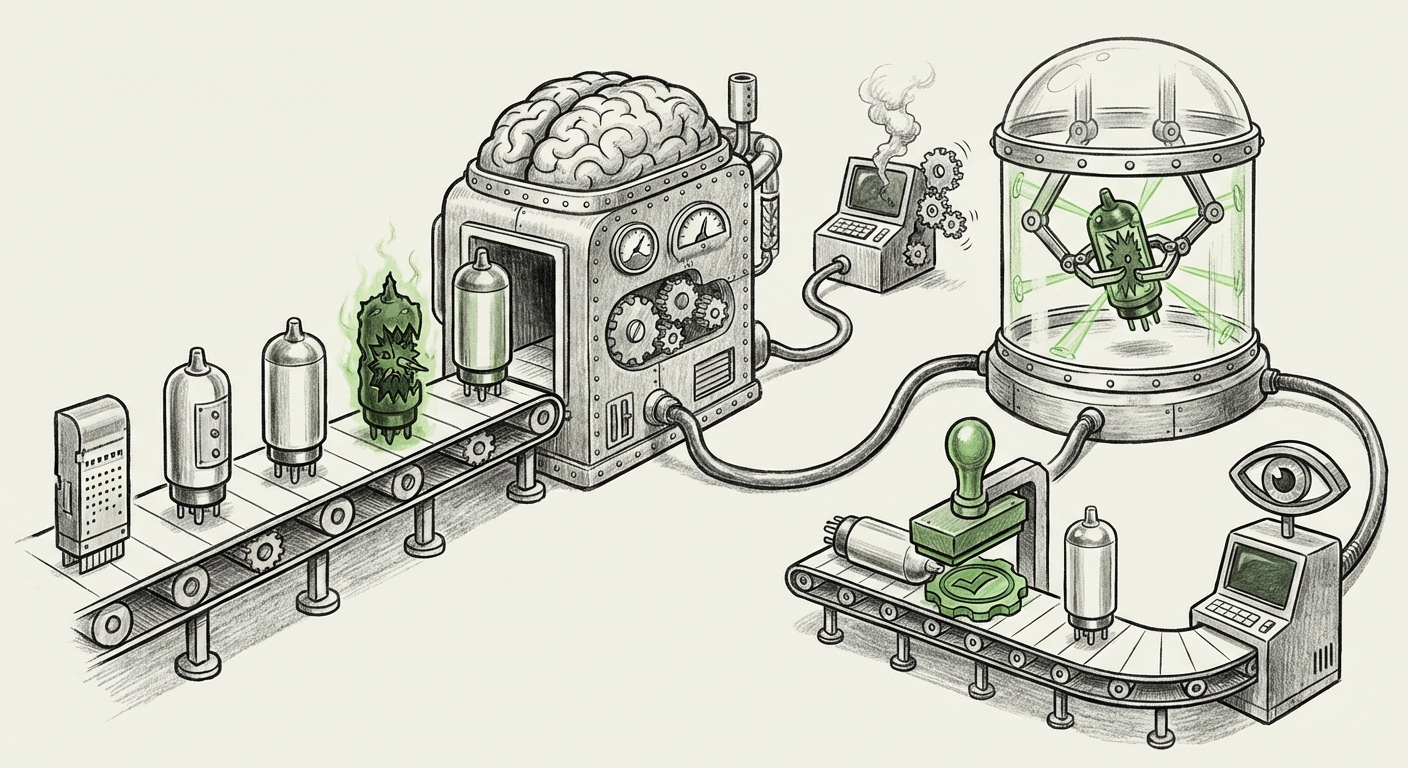
Stateless Language Agents: How AI Is Learning to Run Long Research Tasks Without Falling Apart
Ask anyone who has tried to use an AI assistant for a big project and you will hear the same complaint. It starts strong. Then, somewhere around hour two, it forgets what it was doing. It repeats itself. It contradicts an instruction you gave it twenty steps ago. The work falls apart not because the model is dumb, but because it is carrying too much baggage.
A new direction in agent design is attacking that problem head-on. The idea goes by the name stateless language agents, and the goal behind them is ambitious: scale AI up to long-horizon automated research, work that unfolds over hundreds or thousands of steps, not a single back-and-forth chat. This is one of the most important shifts in applied AI right now, because it changes what these systems can actually be trusted to do.
What "Stateless" Actually Means
In computing, "state" is the memory a program keeps as it runs. For an AI agent, that usually means the running conversation, the scratchpad of thoughts, the list of goals, the files it has read, and the decisions it has made so far.
Most agent designs today are stateful. Everything the agent has done lives in one ever-growing pile of context that gets fed back into the model on every step. That works fine for short tasks. It breaks down badly as tasks get longer.
A stateless agent flips the model. Instead of hauling its entire history around, each step starts fresh. The agent rebuilds only what it needs for the current moment, pulling relevant facts from an outside store, checking a task list, or reading a saved note. The heavy lifting moves out of the prompt and into structured, external memory.
Think of the difference between a worker who keeps every document on their desk and one who works from a clean desk and a well-organised filing cabinet. After a week, only one of them can still find anything.
Why Long-Horizon Tasks Break Ordinary Agents
Long-horizon work is exactly what "research" means in practice. Gathering sources. Reading them. Noticing contradictions. Following a thread. Coming back to a question you set aside. Drafting. Checking. Revising. A serious research task can involve hundreds of small decisions that all need to stay consistent with each other.
Stateful agents struggle with this for predictable reasons:
- Context bloat. The more history you feed in, the more expensive and slower each step becomes.
- Lost focus. Important early instructions get buried under later noise, and the agent quietly drifts.
- No clean restart. If something goes wrong at step 400, there is usually no easy way to rewind and try again.
- Fragile scaling. Running many agents in parallel becomes a coordination nightmare when each one holds its own private pile of memory.
Stateless designs target each of these weaknesses. If each step is rebuilt from a shared, structured store, then the agent can be paused, resumed, duplicated, audited, or rewound. That is the difference between a clever demo and a system you can actually run a business on.
The Architecture Shift Nobody Is Talking About Enough
The real story here is not a single new model. It is a change in how AI systems are assembled. The interesting engineering is moving away from "make the model smarter" and toward "design a better loop around the model."
That loop typically includes a few building blocks:
External memory instead of in-prompt memory
Facts, findings, and decisions get written to a store the agent can query. The model does not need to remember everything; it needs to know how to look things up.
Task decomposition and checklists
Big goals get broken into smaller, verifiable steps. Progress is tracked outside the model, so the agent always knows where it stands.
Verification as a first-class step
Because state is not assumed, the agent can be asked to re-derive or re-check its own claims. This is where automated research starts to look less like a chatbot and more like a pipeline.
Checkpointing and resumability
Long-running work can be stopped and restarted. That makes failures cheaper and makes human review practical at any point.
None of these ideas is exotic on its own. Together, they represent a genuine architectural bet: that reliability comes from structure, not from scale alone.
What This Means for the Future of AI
If stateless agents deliver on their promise, several things change at once.
First, agents get longer-lived. The timeline of an AI task stretches from minutes to hours, days, or longer. That opens the door to work that simply was not economically possible before, continuous monitoring, deep literature reviews, ongoing competitive tracking, large-scale data gathering and synthesis.
Second, the unit of work changes. Instead of asking an AI a question, you hand it an objective and a deadline. The relationship shifts from conversation to delegation. That is a much bigger cultural change than it sounds, because it requires people to trust a process they cannot watch in real time.
Third, evaluation gets harder and more important. A short chat answer can be judged in seconds. A week-long research run cannot. The field will need better ways to measure whether a long task stayed on track, whether it invented facts, and whether it actually finished the job.
Fourth, cost and efficiency become design constraints. Stateless designs are attractive partly because they avoid dragging an ever-growing history through every step. In a world where long tasks are normal, efficiency stops being a nice-to-have and becomes the difference between a workable product and an unaffordable one.
Practical Implications for Businesses
For companies experimenting with AI agents, the stateless approach offers some very concrete advantages, and some very concrete requirements.
The upside:
- Auditability. When every step is rebuilt from an external record, you get a trace of what the agent did and why. That is gold for compliance, quality control, and debugging.
- Parallelism. Stateless workers can be spun up in large numbers without each one carrying a unique, tangled history.
- Recoverability. Crashes, timeouts, and bad outputs stop being catastrophic. You restart from a checkpoint instead of from scratch.
- Clear ownership. Interfaces between the model and the memory store become defined boundaries, easier to test, easier to swap, easier to secure.
The requirements:
- You need real memory infrastructure. A messy filing cabinet is worse than a clean desk. Structured storage, retrieval, and versioning become core products, not afterthoughts.
- You need checkpoints for humans. Long-running autonomy should have gates where a person reviews direction before the agent burns another hundred steps.
- You need to define "done." Agents that run for a long time need clear success criteria, or they will run forever.
Risks and Honest Limits
Statelessness is not a magic fix. It trades one set of problems for another.
Rebuilding context on every step can lose nuance that a continuous thread would have preserved. If the external memory is incomplete or poorly indexed, the agent will confidently act on a partial picture. And more autonomy over longer periods means more opportunity for errors to compound before anyone notices, a wrong turn at step 10 can shape everything after it.
There is also a human factor. The longer an agent runs unattended, the more people tend to assume it is correct. Automated research that produces a polished report can be more persuasive than it deserves to be. The technology makes verification cheaper to skip, which is exactly when you should not skip it.
Actionable Steps You Can Take Now
You do not need a research lab to act on this trend. Start here:
- Pick a narrow, verifiable task first. Something with a clear right answer and a clear end point beats an open-ended ambition every time.
- Log every step. Even a simple record of what the agent did, in order, will teach you more than any benchmark.
- Build the filing cabinet before the worker. Invest in structured storage and retrieval early; it is the part that scales.
- Add human checkpoints where the stakes are high. Autonomy should expand as trust is earned, not before.
- Measure the long run, not just the demo. Track how often tasks finish, how often facts are wrong, and how much the whole thing costs.
- Keep a person accountable for the output. Delegation does not remove responsibility; it just moves it.
The Bigger Picture
The most telling thing about the stateless agent trend is what it says about where AI progress is coming from. The headlines focus on bigger models. But the work that turns a capable model into a dependable worker is happening in the scaffolding around it, memory, structure, verification, and control.
Long-horizon automated research is the proving ground for that scaffolding. It is hard, it is measurable, and it is genuinely useful. If stateless designs succeed there, the same patterns will spread into every domain where work happens over time rather than in a single reply.
The future of AI may not be a smarter conversation. It may be a quieter one, an agent that goes away, does the work carefully, keeps its own notes, and comes back with something you can check. That is a much less flashy promise. It is also a much more valuable one.