APCD Explained: How Adaptive Path-Contrastive Decoding Could Make AI Models More Reliable
Every business that has put a large language model in front of a customer has run into the same wall. The model sounds confident. It writes beautifully. And every so often, it simply makes something up. A wrong policy number. A fake citation. A number that looks real but is not. That single flaw is what keeps many companies from handing AI the keys to anything important.
A new piece of research dated October 2026 tackles that problem head-on. It is called APCD, Adaptive Path-Contrastive Decoding for Reliable Large Language Model Generation. The name is a mouthful, but the idea behind it is one of the most practical directions in AI right now. Instead of rebuilding a model from scratch to make it more trustworthy, APCD changes how the model chooses its words while it is writing.
That distinction matters more than it sounds. It points to a future where reliability is something you can tune, switch on, and pay for, not something you have to hope for.
Why Reliability Is the Real Bottleneck for AI
The last few years of AI progress have been about capability. Models can write code, summarize contracts, draft marketing copy, and answer questions across nearly every field. Raw ability is no longer the hard part. Trust is.
Think about what happens when a model gets something wrong. In a chat window, a mistake is annoying. Inside a claims system, a medical summary, or a legal filing, it is a liability. Companies have responded in predictable ways. They add human reviewers. They build guardrails. They limit what the model is allowed to touch. All of that adds cost and slows everything down.
So the industry has been hunting for fixes that make the model itself more dependable. Two big camps have emerged. One camp retrains or fine-tunes models on better data, expensive, slow, and never fully finished. The other camp intervenes at decoding time: the moment when the model is picking the next word. APCD belongs to that second camp, and that is why it is worth paying attention to.
What Contrastive Decoding Actually Means
To understand APCD, you first need to understand the trick it builds on.
When a language model generates text, it does not write a whole paragraph at once. It picks one word, then the next, then the next. At each step it assigns a probability to every possible word in its vocabulary. Normally it just picks a likely one and moves on.
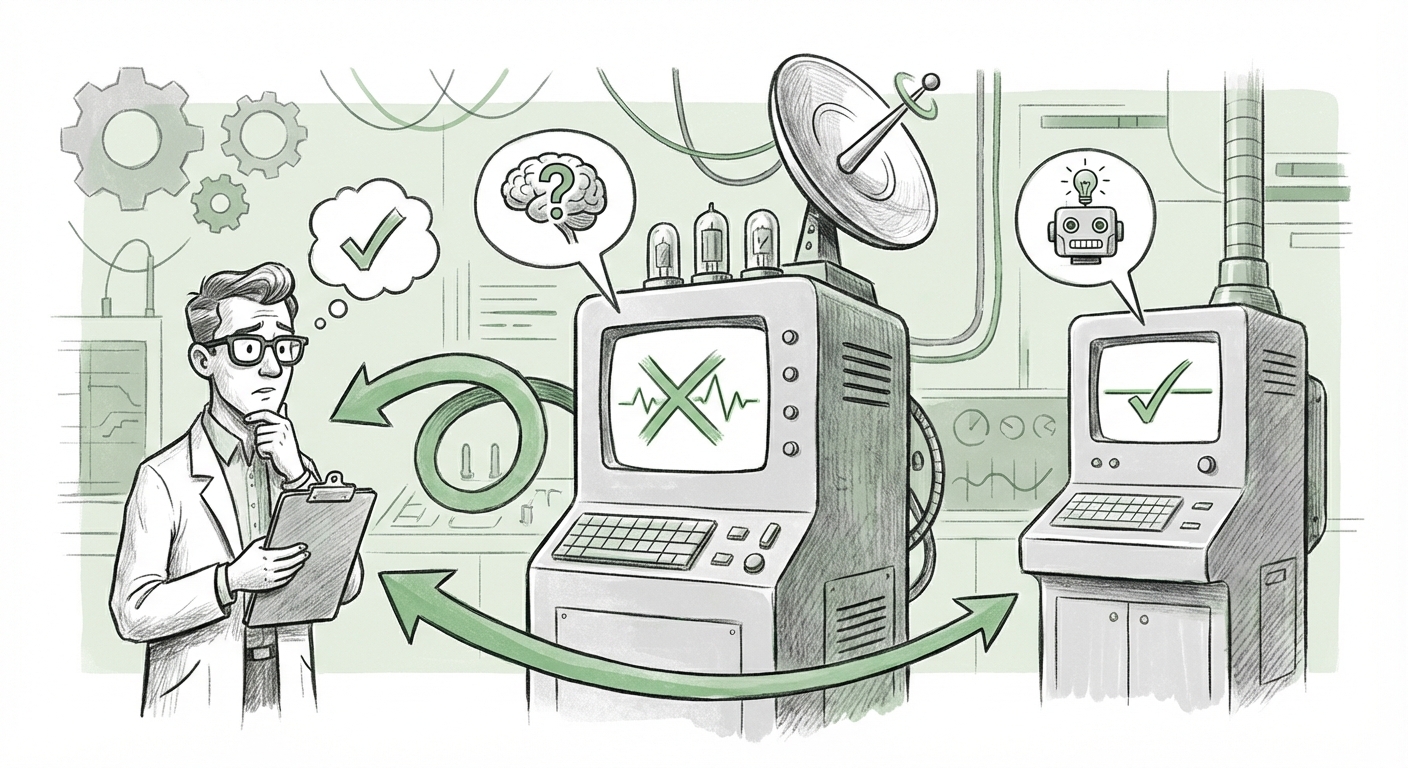
Contrastive decoding adds a twist. It runs the same prompt through two versions of the model, typically a strong one and a deliberately weakened one. Then it compares the two sets of probabilities. The logic is simple: whatever the strong model likes and the weak model also likes is probably just generic, predictable language. Whatever the strong model likes but the weak model does not is probably the genuinely useful, specific, fact-grounded answer. By subtracting one from the other, the system pushes its final choice toward the sharper option.
It is a bit like asking two people the same question, one an expert, one a novice, and paying close attention to where the expert's answer diverges. The divergence is where the real knowledge lives. That contrast is what filters out bland filler and, in many cases, reduces the confident nonsense that makes models unreliable.
What "Adaptive Path" Adds to the Picture
The word contrastive in APCD is familiar ground. The words adaptive path are where the new thinking comes in.
Older contrastive methods tend to apply the same comparison recipe at every step, from the first word to the last. But generation is not uniform. The opening of a sentence, where the model is setting up a topic, rarely needs the same treatment as the middle, where a specific fact or number has to land correctly. Applying one fixed rule across a whole response is a blunt instrument.
The design direction implied by APCD is that the contrast should adapt as the model moves along its generation path. How strong should the contrast be right now? Which comparison is most useful at this point in the sentence? The method adjusts as it goes, rather than locking in one setting for the entire output.
Why does that matter in practice? Because too much contrast can make a model's writing strange and unnatural, while too little leaves the original problems in place. An adaptive approach aims to find the balance per step, keeping the text fluent while still steering away from unsupported claims. It is the difference between a fixed prescription and a doctor who adjusts the dose as the patient responds.
That framing also explains the word reliable in the title. The goal is not just better answers. It is answers you can depend on, consistently, across the long and messy prompts that real business work involves.
Decoding-Time Fixes: Cheap, Fast, and Reversible
Here is the part that should get a technology leader's attention. A method that works at decoding time has practical advantages that retraining does not.
- No retraining required. You do not need to gather a new dataset, run a costly training job, or wait weeks to see results.
- You can switch it on and off. Reliability becomes a setting, not a permanent property baked into the model.
- It works across models. Because it operates on the output step rather than the model's internal weights, the same idea can be applied to different systems.
- It is tunable per use case. A customer support bot and a financial analysis tool have very different tolerance for error, and adaptive methods can reflect that.
The trade-off is compute. Running a second, weaker model alongside the main one and comparing their outputs costs more processing power per response. That is the honest cost of this family of techniques. But as inference becomes cheaper and more efficient, that trade-off keeps tilting in favor of doing the extra work.
What This Means for the Future of AI
APCD is one paper, but it sits inside a much larger shift that will define the next phase of AI.
1. Reliability becomes an engineering layer, not a hope
For years, trust in AI was treated as a property of the model itself, you got what you got. The move toward decoding-time control changes that. Reliability becomes something engineers design, measure, and adjust, the way they handle latency or uptime. That is a maturing industry signal.
2. The gap between "cool demo" and "production system" starts to close
The single biggest reason AI pilots stall is that pilots are forgiving and production is not. A method that reduces unsupported claims at the point of generation directly attacks that gap. Expect more enterprises to move AI into regulated and high-stakes workflows as these tools improve.
3. Smaller, cheaper models get more useful
If contrast-based methods let a smaller model borrow sharpness from a comparison process, the economics of AI deployment change. Not every task will need the largest, most expensive model. That pushes costs down and spreads AI into places it could not previously afford to go.
4. Evaluation gets harder, and more important
Adaptive methods are less predictable by design. That makes rigorous testing essential. The companies that win with AI will be the ones that build strong internal evaluation, not just the ones that adopt the newest technique.
Practical Implications for Businesses
For product teams: Treat decoding strategy as a product decision, not just a research detail. The same base model can behave very differently depending on how its outputs are steered. That is an opportunity to differentiate on quality rather than on which model you license.
For risk and compliance teams: New reliability techniques are good news, but they are not a substitute for oversight. They reduce error rates. They do not eliminate them. Human review should stay in place where the consequences of a mistake are severe.
For finance and operations leaders: Watch the cost curve. Methods that require extra computation per response will show up in your inference bill. The right question is not "is this free?" but "does the accuracy gain outweigh the added cost for this specific workflow?"
For society more broadly: The more reliable AI becomes, the more it will be trusted with tasks that affect people directly, benefits decisions, medical information, legal guidance. That is a real benefit, and it raises the bar for transparency. Systems that quietly change how they generate answers need to be documented and auditable.
Actionable Insights: What to Do Now
- Build an error-rate baseline. Before adopting any new decoding method, measure how often your current system produces unsupported or false statements. You cannot improve what you have not measured.
- Segment by risk. Apply reliability techniques first to the highest-stakes use cases, where a single bad answer carries real cost.
- Pilot before you commit. Treat decoding-time methods as you would any infrastructure change, test on real traffic, compare outputs, and watch both quality and latency.
- Keep humans in the loop for high-stakes decisions. Better models reduce the review burden. They rarely remove it entirely.
- Track the research direction, not just the headline. The specific name APCD may not survive. The category, adaptive, contrast-based control at generation time, almost certainly will.
The Bottom Line
The most important AI story of the next few years will not be about models that can do more. It will be about models you can actually rely on. APCD, with its combination of contrastive comparison and adaptive, path-aware control, is a clear signal of where the field is heading: away from hoping models behave, and toward engineering them to.
For businesses, that is the difference between an AI experiment and an AI asset. The techniques will keep changing names. The goal will not.