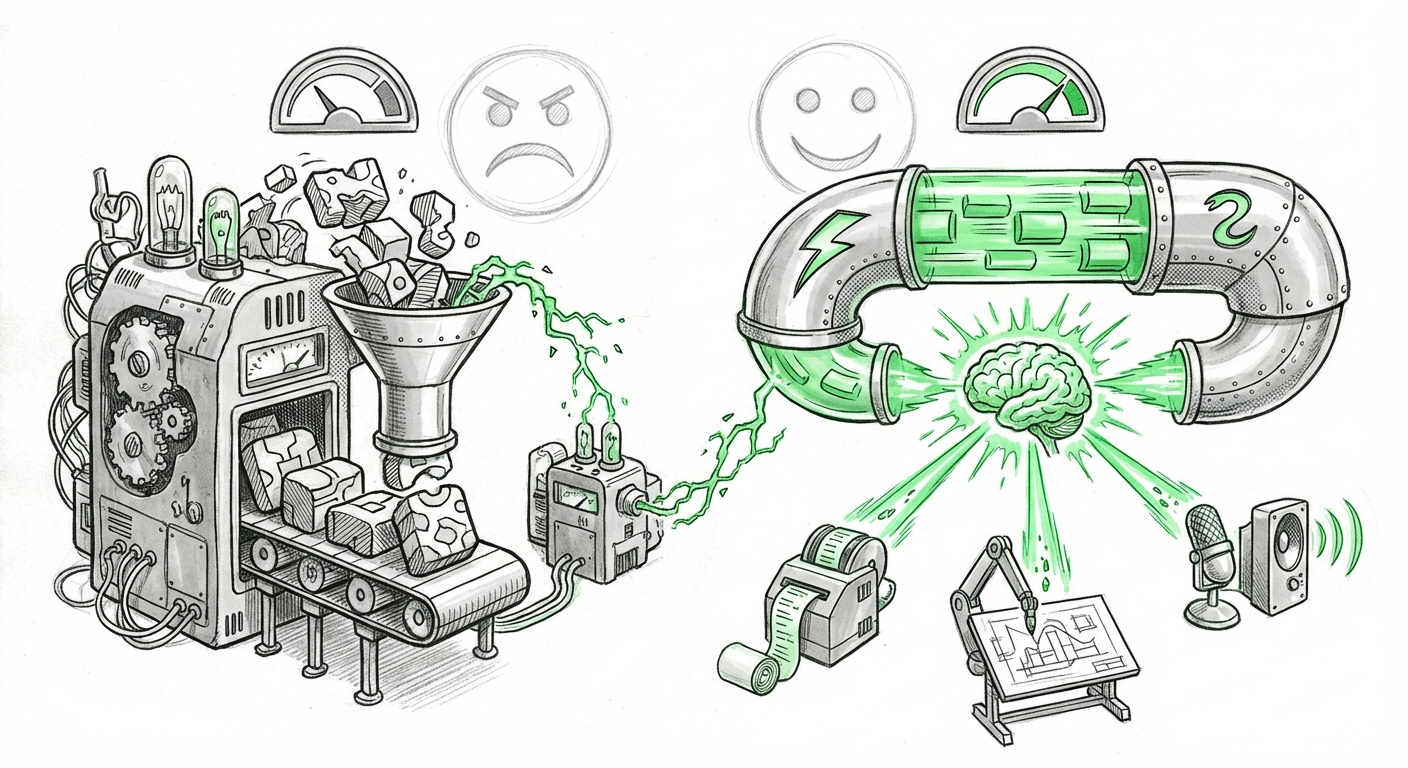
Building AI Agents with Docker Agent: What It Means for the Future of AI
Artificial intelligence has moved past the stage of simple chat. The big story right now is AI agents, software that doesn't just answer questions, but takes actions. It books the meeting, writes the report, queries the database, calls the API, and keeps working until the job is done.
That sounds great until you try to run an agent in the real world. Agents need tools, files, network access, memory, and a safe place to run. They break in messy ways. They can wander into the wrong systems. They can rack up costs if nobody is watching. This is the gap that Docker Agent is built to close, and it points to where the entire agent economy is heading.
Why Agents Are Different From Ordinary Software
A traditional app does exactly what you programmed it to do. An agent decides for itself what to do next. That flexibility is the whole point, and also the whole problem.
Think of an agent like a new employee. You can give them a laptop and a list of tasks, but you also need to control what doors their key opens. Without limits, a helpful assistant can become a liability. With too many limits, they can't get anything done.
Agents need a few things to operate:
- A runtime environment, somewhere to execute code and run tools
- Isolation, a boundary so the agent can't touch things it shouldn't
- Reproducibility, the same setup every time, on every machine
- Observability, a way to see what the agent did and why
- Portability, the ability to move from a laptop to a server to the cloud
Those five needs map almost perfectly onto what containers already do. That's the insight behind Docker Agent, bring the same packaging discipline that tamed web servers and microservices to the wild world of autonomous agents.
What Docker Agent Actually Represents
At its core, the idea is straightforward: an agent should be something you can build, ship, and run like any other piece of software. Instead of a tangle of scripts, API keys, and hidden dependencies, the agent becomes a packaged unit with a defined environment.
That matters because agents are notoriously fragile. A prompt change here, a library update there, and yesterday's working agent becomes today's mystery. Containers solve this by freezing the environment. If it runs on your machine, it runs on the server. If it runs on the server, it runs in production.
There's a bigger idea at play too. Containers were the foundation of the cloud-native wave, the shift that let companies deploy software in small, independent pieces. Agents are the next layer on top of that foundation. If containers were the shipping containers of the internet, agents are the workers moving goods inside them.
Sandboxes Are the Real Prize
Here's the part businesses should pay the most attention to: isolation.
An agent that can write and run code is powerful. An agent that can write and run code with no boundaries is dangerous. If an agent has full access to a company's file system or cloud credentials, a single bad decision, or a single clever prompt from an attacker, becomes a serious incident.
Containers give agents a sandbox. The agent can experiment, fail, and retry without touching anything important. If something goes wrong, you throw the container away and start fresh. That's a level of safety that's hard to achieve any other way.
From Impressive Demo to Reliable Product
Almost every company experimenting with AI has hit the same wall. The demo is amazing. The rollout stalls.
The reason is usually not the model. It's everything around the model, the plumbing, the permissions, the deployment, the monitoring. Getting an agent to work once is easy. Getting it to work a thousand times, for a thousand users, without surprises, is hard.
Packaging agents as containers turns that hard problem into a familiar one. Engineering teams already know how to build container images, scan them for vulnerabilities, push them to a registry, and roll them out. They already have pipelines for this. Docker Agent lets them reuse that muscle memory instead of inventing a new process from scratch.
This is the quiet but enormous shift. The AI industry is learning that the hard part of AI is not intelligence, it's operations.
The Coming Agent Supply Chain
Once agents can be packaged, they can be shared. That opens the door to a market that looks a lot like the one for container images today.
Imagine a world where you don't build every agent yourself. You pull a pre-built research agent, a pre-built data-cleaning agent, a pre-built customer support agent. You configure it. You run it. You update it when a new version ships.
That future raises real questions, and they're worth thinking about now:
- Trust: Who built this agent, and what does it actually do when you're not watching?
- Provenance: Can you verify an agent hasn't been tampered with?
- Updates: How do you patch an agent safely when it's already handling live work?
- Cost control: Agents make decisions that spend money. Who sets the limits?
The container world spent years solving these problems, signed images, vulnerability scanning, registries, version pinning. Agents will inherit those solutions, which is a big reason the container approach is so appealing. It's not just a technical convenience. It's a shortcut to a decade of hard-won lessons.
What This Means for Businesses
For business leaders, the message is practical rather than philosophical.
1. Your AI Strategy Is Now a Platform Strategy
If agents run in containers, then the platform that runs your software is also the platform that runs your AI. That changes budgeting conversations. The question stops being "which AI vendor do we pick?" and becomes "how do we run and govern autonomous workloads across the company?"
2. Start Small and Boring
The teams that succeed with agents will be the ones that pick narrow, well-defined jobs first, the ones with clear success criteria and low blast radius. Think internal research, log summarization, ticket triage. Not "let the agent manage our cloud infrastructure."
3. Treat Agents Like Employees With Access Badges
You wouldn't give a new hire keys to every room on day one. Apply the same logic. Give each agent the minimum access it needs, monitor what it does, and add permissions only when there's a proven reason.
4. Budget for Watching, Not Just Building
Building an agent is the easy part. Running it reliably is where the long-term cost lives. Logging, evaluation, guardrails, and human review are not optional extras, they're the product.
What This Means for Society
There's a broader story here that goes beyond tooling.
When agents become easy to build and safe to run, automation spreads faster. Small companies gain access to capabilities that used to require big engineering teams. That's a genuine leveling effect, a two-person startup can deploy the same kind of automated workflows as a Fortune 500 firm.
But it also means more work shifts from "doing the task" to "defining and supervising the task." Jobs will change shape. Some roles will shrink. New ones will appear around designing agents, auditing them, and resolving the edge cases they can't handle.
The organizations that handle this transition well will be the ones that treat agents as coworkers with clear job descriptions, not magic boxes. Clarity about scope, limits, and accountability is what makes automation trustworthy.
Actionable Takeaways
- Learn the container mindset. If your team understands images, containers, and registries, you're already most of the way to understanding how agents will be deployed.
- Design for isolation from day one. Assume the agent will do something unexpected. Build the sandbox first, not last.
- Make reproducibility a requirement. If you can't run the same agent twice and get comparable behavior, you can't operate it at scale.
- Decide your permission model early. Which systems can this agent touch? What can it spend? Who reviews it?
- Plan for evaluation. You need a way to know whether the agent is doing a good job, not just whether it finished.
- Watch the packaging layer. The tools that let you build and ship agents will shape which agents actually reach production. That's where the leverage is.
The Bigger Picture
Every major computing wave has followed the same pattern. First comes raw capability. Then comes chaos. Then comes packaging and control, and that's when the technology actually changes the world.
Cloud computing followed it. So did mobile apps, and so did the web itself. AI agents are walking the same path right now.
Docker Agent matters less as a single tool and more as a signal. It says the industry has stopped treating agents as clever toys and started treating them as software that has to run reliably, safely, and at scale. That shift is what turns AI from an experiment into infrastructure.
The winners in the next phase of AI won't be the companies with the smartest model. They'll be the ones with the cleanest way to package, ship, and govern autonomous workers, and the discipline to give those workers exactly the right amount of freedom.